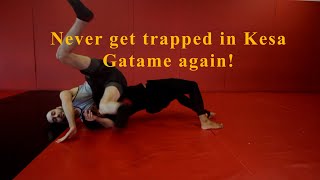
Hand Placement on Opponent's Shoulder
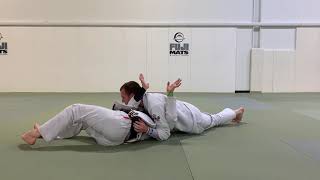
The instructor demonstrates proper grip mechanics by placing the heel of the palm against the opponent's shoulder, targeting the protruding bone structure for secure control. This grip placement prevents slippage, particularly when the top player is heavy or well-muscled, creating a stable anchor point for the escape.
Hip Pressure and Hand Positioning
The bottom player uses the opposite hand to apply pressure against the opponent's hip while maintaining the shoulder grip. This dual-hand control system allows the bottom player to manage the top player's weight distribution and create space for the escape movement.
Core-Driven Escape Mechanics
The escape relies on swinging the hips and core side to side rather than pure upper body strength. By allowing the opponent's pressure to work in combination with controlled core movement, the bottom player generates momentum to break free from the north-south position.
Over-Under Grip Variation
The technique can be executed with alternating hand positions: one hand pressing the armpit while the other controls the opposite shoulder. This variation allows practitioners to adapt the escape based on the opponent's positioning and defensive responses.
Historical Context and Technique Origin
This escape method represents a foundational technique from the mid-1990s jiu-jitsu era and was the predominant approach to north-south escapes during that period. The technique is not a recent innovation but rather an established fundamental movement in Brazilian jiu-jitsu.
Core Conditioning Over Flexibility
The escape prioritizes core strength and conditioning rather than flexibility requirements. The movement involves lifting the feet off the mat and utilizing the opponent's pressure to facilitate the escape through controlled spinal rotation.
Surface Considerations and Adaptability
While the technique functions more smoothly on slippery mats, it can be adapted for self-defense scenarios on less forgiving surfaces. The core movement may not produce a complete spin on concrete but can generate sufficient opening to transition to a more defensible position such as half guard.
Defensive Utility and Offense Prevention
The continuous core movement forces the top player into a defensive, controlling posture rather than an offensive one. This disruption prevents the opponent from executing submission attacks or strikes, providing the bottom player with crucial recovery time and positional improvement opportunities.
ESCAPE North:South Position!
Key Takeaways
- •Hand Placement on Opponent's Shoulder
- •Hip Pressure and Hand Positioning
- •Core-Driven Escape Mechanics
- •Over-Under Grip Variation
This video is a continuation of our last video on basic north/south escape using the pendulum swing. Check out the details and you are sure to find something useful! Enjoy! If you have any questions, comments, or suggestions, please comment below. More videos to come! Please like, share, and subscribe!! PLEASE Click this link to SUPPORT the TeachMeGrappling Channel!!! https://www.patreon.com/TeachMeGrappling or https://www.paypal.me/CoachBrianPeterson Your contribution is much appreciated and will help me continue to bring you content! 🙏 www.NextLevelGuy.com The NextLevelGuy Podcast with Coach Brian Peterson has been released!! Check it out!
Related Techniques
Frequently Asked Questions
What does this video teach about north-south escape?
This video covers hand placement on opponent's shoulder, hip pressure and hand positioning, core-driven escape mechanics. It provides detailed instruction from TeachMeGrappling Coach Brian.
How long does it take to learn north-south escape?
The basic mechanics can be understood in a single session, but developing reliable execution requires consistent drilling over weeks of practice. This 8-part breakdown helps structure your training by isolating each phase of the technique.
What are the key details for finishing north-south escape?
While the technique functions more smoothly on slippery mats, it can be adapted for self-defense scenarios on less forgiving surfaces. The core movement may not produce a complete spin on concrete but can generate sufficient opening to transition to a more defensible position such as half guard.