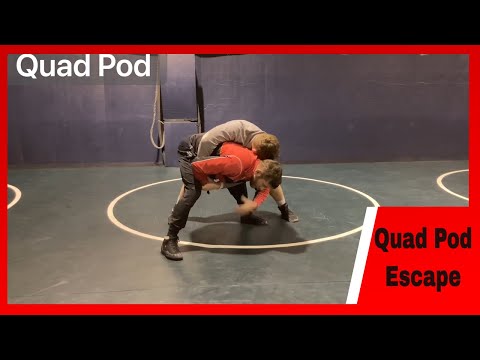
4 Tips for Bottom Wrestling
0
Wrestling Bottom Escape·Isaac Gomez
in this Video I go over how to be better at bottom position wrestling and some tips for getting out
Not yet documented
The Wrestling Bottom Escape family covers escape techniques from the wrestling bottom (referee's) position — the on-hands-and-knees starting position used in folkstyle wrestling where one wrestler is on bottom with the opponent behind in a riding position. [1] This is a wrestling-specific escape family that addresses the unique challenges of the folkstyle bottom position: the top wrestler has a waist-and-wrist ride (seatbelt-like control from behind), and the bottom wrestler must escape to standing, reverse position, or create a neutral scramble. [1],[2] The four fundamental wrestling bottom escapes are the stand-up (explosive rise to feet), the sit-out (sitting through to face the opponent), the switch (reaching back to reverse position), and the Granby roll (shoulder roll to escape). [2],[3] In folkstyle wrestling, escaping from bottom scores 1 point (escape) and reversing scores 2 points (reversal), making these directly scoring techniques. [3]
Wrestling bottom escapes are fundamental to American folkstyle wrestling, where the referee's position (starting on hands and knees with the opponent behind) is a standard starting position unique to the folkstyle ruleset. [1] Dan Gable's Iowa wrestling program (15 NCAA titles) was renowned for bottom wrestling and escape ability. [1],[2]
Escape (1 point) and reversal (2 points) are fundamental scoring actions in folkstyle wrestling. [1]
No images yet for this technique.
Sign in to suggest an image.
in this Video I go over how to be better at bottom position wrestling and some tips for getting out
Hello, Coach Isaac J. Knable here! Check out my training tools, courses, and programs here 👉 https://stan.store/isaacj…
No instructional courses yet for this technique.
Sign in to suggest a course.
Risk of injury to the person this technique is applied to
Wrestling bottom escapes are fundamental movements with minimal injury risk; the primary risk is neck strain from Granby rolls
Skill level needed to execute this technique reliably
Whether this technique is allowed under major competition rule sets
Coaching Wrestling Successfully (Dan Gable, 1999)
Description sources — [1] Coaching Wrestling Successfully (Gable, 1999) [2] NCAA folkstyle rules and wrestling methodology
Standard katakana transliteration of Western martial arts terminology (外来語) — used in Japanese MMA, boxing, and BJJ communities
Description sources — [1] Coaching Wrestling Successfully (Gable, 1999) [2] NCAA folkstyle rules and wrestling methodology
explosive hips (stand-up), hand-fighting ability, cardio endurance
explosive athletes, strong hands (grip stripping), good conditioning
glutes (explosive stand-up), forearms (hand fighting), hip flexors (sit-out), core (switch rotation)
Every move, in any martial art, shares a few universal traits. Mix and match below to pinpoint the right tool — or compare equivalents across styles.
The Hip Heist is a wrestling escape technique where the bottom wrestler explosively lifts and shifts the hips to create space and reverse position — a dynamic escape that uses hip explosion to break the opponent's riding control. [1] The hip heist is related to the BJJ hip escape (shrimp) but executed more explosively and typically from the referee's position. [1,2]
The Peterson Roll is a wrestling reversal executed from the bottom referee's position (or any time the opponent has rear control with one or both arms across the body) where the bottom wrestler reaches back to grip the opponent's near-side arm or leg, then rolls forward and underneath the opponent in a controlled somersault to land in a top control position. [1] The mechanic uses the opponent's forward pressure as the rotation axis: by collapsing the near elbow and tucking the head, the bottom wrestler converts incoming weight into rotational momentum that spirals the opponent over their shoulder. [1,2] Common in folkstyle and freestyle wrestling, the Peterson is one of the high-percentage escapes from the down position and can also score back-exposure points if the roll is finished cleanly into a side or back-control finish. [1]
Grab four fingers at a time and make that grip feel really painful, since the opponent can only hold you down with four fingers. Isaac Gomez emphasizes that controlling the hands is essential to preventing them from maintaining top position.
Keep the rubber part of your wrestling shoe on the mat with your feet constantly pushing, either running away or pushing backward into your opponent. If your feet come off the mat, you're in a bad position.
You need to keep fighting and try multiple things in succession—if your first move gets stopped, you should immediately attack with another option rather than giving up. Isaac Gomez stresses that you need to overwhelm your opponent with possibilities so he can't defend everything.
Create separation between your hips and your opponent's hips—maintaining distance is key to breaking free. Once you create this space, grab the hands and keep moving without stopping.
The Wrestling Bottom Escape family covers escape techniques from the wrestling bottom (referee's) position — the on-hands-and-knees starting position used in folkstyle wrestling where one wrestler is on bottom with the opponent behind in a riding position. This is a wrestling-specific escape family that addresses the unique challenges of the folkstyle bottom position: the top wrestler has a waist-and-wrist ride (seatbelt-like control from behind), and the bottom wrestler must escape to standing, reverse position, or create a neutral scramble.
Wrestling bottom escapes are fundamental to American folkstyle wrestling, where the referee's position (starting on hands and knees with the opponent behind) is a standard starting position unique to the folkstyle ruleset. Dan Gable's Iowa wrestling program (15 NCAA titles) was renowned for bottom wrestling and escape ability.
Unified MMA: legal — Legal defensive/transitional technique; IBJJF: legal — Legal; IJF: legal — Legal; ADCC: legal — Legal; UWW: legal — Legal; FIAS Sport Sambo: legal — Legal
Danger rating 2/10. Low — wrestling bottom escapes are fundamental movements with minimal injury risk; the primary risk is neck strain from Granby rolls
The standard setup chain: Start in Referee's Position → Explode → Hand Fight → Execute → Clear → Score.
Standard counters include: When riding on top: follow the hips — when the bottom wrestler moves, move with them / Ankle ride — hooking the bottom wrestler's ankle to prevent stand-ups / Tight waist-and-wrist — maintaining control prevents all escapes / Tilt — attacking with tilts when the bottom wrestler attempts to escape.
Common variants: Stand-up (explosive rise to feet; the most commonly scored escape [1]); Sit-out (sitting through to face the opponent); Switch (hooking the opponent's leg and reversing (2 points)); Granby roll (shoulder roll escape [2]); Peterson roll (arm trap and forward roll to reverse); Hip heist (explosive hip movement to create space); Short sit (quick partial sit-out to create angle for stand-up).
Escape (1 point) and reversal (2 points) are fundamental scoring actions in folkstyle wrestling.
Top errors to watch for: Staying flat on the mat — referee's position should be on hands and knees, ready to explode; flat = riding time / Not hand fighting on stand-up — just standing without stripping the waist ride gets you returned to the mat / Telegraphing the escape direction — varying escape attempts keeps the rider guessing / Only using one escape — predictable bottom wrestlers get ridden easily.
The Wrestling Bottom Escape is also known as Bottom Wrestling Escape, Referee's Position Escape, Turtle Escape (Wrestling).