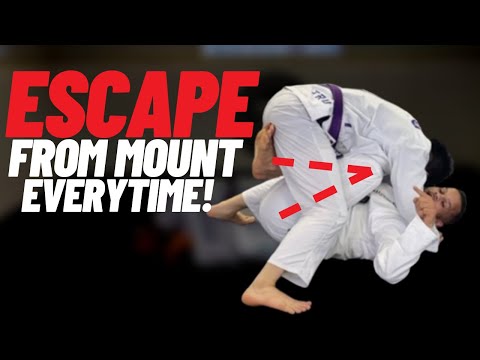
2 Ways to Escape the Mount EVERY Time!
0
Mount Escape·BIG OSS Jiu-Jitsu Channel
ESCAPE FOR ALL BELT LEVEL! IF YOU ARE HAVING HARD TIME GETTING OUT OF MOUNT THIS VIDEO IS FOR YOU. I am very happy to s…
Translation: mount escape
The Mount Escape family covers all techniques for escaping the mount position, where the opponent sits on top of the defender's torso with legs straddling the body. [1] Mount is one of the most dominant positions in grappling and MMA — the top fighter has gravitational advantage, access to strikes, and can transition to submissions — making mount escapes among the most critical survival skills. [1],[2] Primary escape methods include the trap and roll (upa), shrimp to half guard or full guard, heel drag escapes, and kipping escapes. [2],[3]
Mount escapes have been fundamental to ground fighting since the earliest grappling systems, with the bridge and roll being one of the most ancient and instinctive escape techniques. [1] BJJ expanded the mount escape curriculum to include multiple escape paths — trap and roll, shrimp, heel drag, kipping — providing options for different opponent reactions. [2],[3]
Mount escapes are essential survival techniques — the mount is one of the most dominant positions in grappling, giving the top player access to strikes, chokes, and armlocks while the bottom player has limited offensive options. [1] Saulo Ribeiro rates mount escape as one of the first techniques a white belt must learn, as inability to escape mount makes all other skills irrelevant. [1] In MMA, fighters trapped in mount absorb an average of 3-5 significant strikes per minute, making rapid escape critical for survival. [2]
Mount escapes are taught across all BJJ lineages, with the upa (trap and roll) and elbow escape (shrimp) tracing directly to Helio Gracie's foundational curriculum. [3] The Gracie self-defense methodology positions mount escape as the single most important ground technique for a smaller person facing a larger attacker. [4]
Mount escapes are critical in BJJ and MMA, as mount is one of the most dominant positions. [1]
No images yet for this technique.
Sign in to suggest an image.
ESCAPE FOR ALL BELT LEVEL! IF YOU ARE HAVING HARD TIME GETTING OUT OF MOUNT THIS VIDEO IS FOR YOU. I am very happy to s…
No instructional courses yet for this technique.
Sign in to suggest a course.
Risk of injury to the person this technique is applied to
Bottom escapes from mount/side control; bridge and hip escape mechanics (Ribeiro 2008)
Skill level needed to execute this technique reliably
Whether this technique is allowed under major competition rule sets
Jiu-Jitsu University (Saulo Ribeiro, 2008)
Alias sources — [1] Jiu-Jitsu University (Ribeiro, 2008) [2] Kodokan Judo (Kano, 1986)
Effectiveness sources — [1] Jiu-Jitsu University (Saulo Ribeiro, 2008) [2] Mastering Jujitsu (Renzo Gracie & John Danaher, 2003)
Standard katakana transliteration of Western martial arts terminology (外来語) — used in Japanese MMA, boxing, and BJJ communities
Alias sources — [1] Jiu-Jitsu University (Ribeiro, 2008) [2] Kodokan Judo (Kano, 1986)
Effectiveness sources — [1] Jiu-Jitsu University (Saulo Ribeiro, 2008) [2] Mastering Jujitsu (Renzo Gracie & John Danaher, 2003)
explosive hip bridge power, shrimping ability, timing
strong glutes and hip extensors for powerful bridges
glutes, hip extensors, core, quadriceps
Every move, in any martial art, shares a few universal traits. Mix and match below to pinpoint the right tool — or compare equivalents across styles.
The Heel Drag Escape subfamily covers mount escape techniques where the defender uses one foot to hook and drag the opponent's ankle, creating enough space to insert the knee and transition to half guard. [1] The heel drag works by collapsing the opponent's base on one side — by hooking their ankle and dragging it toward the defender's body, the opponent's leg is displaced, creating space for the defender's knee to enter. [1,2] The heel drag is particularly effective when the opponent maintains a high mount or grapevine position. [2,3]
The Kipping Escape subfamily covers mount escape techniques that use a sharp hip thrust (kip) to explosively create space, disrupting the opponent's base and enabling escape or reversal. [1] The kipping motion drives the hips upward in a sharp, explosive buck that momentarily elevates the opponent, creating a window of opportunity to insert the knee for half guard or to execute a shrimp. [1,2] The kipping escape is an explosive technique that relies on timing and power rather than gradual positional improvement. [2,3]
The Shrimp Mount Escape subfamily covers mount escapes that use the hip escape (shrimp) movement to create space and recover guard from the mounted position. [1] The shrimp mount escape is the most commonly used mount escape technique because it allows the defender to recover guard without rolling the opponent over — the defender simply creates enough hip space to reinsert a knee or leg and reguard. [1,2] Variations include shrimping to full guard, shrimping to half guard, and the running escape which uses a continuous shrimping motion. [2,3]
The Trap and Roll (also known as Upa or Bridge and Roll) is the most fundamental mount escape in BJJ — the bottom fighter traps one of the mounted opponent's arms and the same-side foot, then bridges explosively at a 45-degree angle to roll the opponent over, ending in their closed guard. [1] This is typically the first mount escape taught to every BJJ beginner because it is mechanically simple, requires no flexibility, and works against opponents of all sizes when executed with proper timing. [1,2] The technique exploits a fundamental principle: if the opponent cannot post with their hand AND cannot base with their foot on one side, a powerful bridge in that direction will roll them over regardless of their weight. [2,3] The trap and roll is most effective when the mounted opponent reaches for a submission or pushes off the chest, creating the arm-trapping opportunity. [3]
The two fundamental mount escapes — elbow-knee escape (shrimping) and bridge-and-roll (upa) — are the first escapes taught in every BJJ school. Saulo Ribeiro considers the elbow-knee escape the single most important technique in jiu-jitsu. (Ribeiro, Jiu-Jitsu University)
According to BIG OSS Jiu-Jitsu, the fundamental rule is: if you push, it's to escape; if you pull, it's to attack. Understanding when to use each action is critical, as many practitioners forget the correct timing and pull or push at the wrong moment.
No—BIG OSS Jiu-Jitsu emphasizes that the real power in mount comes from your opponent's hips, not the cross face. Instead of worrying about the cross face, focus your hands on controlling your opponent's hip, which is where their power originates.
BIG OSS Jiu-Jitsu cautions to be aware of arm chokes, back takes, and the Ezekiel choke while escaping. Since you're in a bad position, avoid exposing yourself too much as you work your escape.
BIG OSS Jiu-Jitsu stresses that mount escape is the foundation of your jiu-jitsu—when you find yourself in a bad position, knowing what to do makes all the difference. Regular practice ensures you have reliable options at any belt level.
The Mount Escape family covers all techniques for escaping the mount position, where the opponent sits on top of the defender's torso with legs straddling the body. Mount is one of the most dominant positions in grappling and MMA — the top fighter has gravitational advantage, access to strikes, and can transition to submissions — making mount escapes among the most critical survival skills.
Mount escapes have been fundamental to ground fighting since the earliest grappling systems, with the bridge and roll being one of the most ancient and instinctive escape techniques. BJJ expanded the mount escape curriculum to include multiple escape paths — trap and roll, shrimp, heel drag, kipping — providing options for different opponent reactions.
Unified MMA: legal — Legal defensive/transitional technique; IBJJF: legal — Legal; IJF: legal — Legal; ADCC: legal — Legal; UWW: legal — Legal, escape scores 1 point (freestyle), reversal scores 1 point; FIAS Sport Sambo: legal — Legal; NCAA Folkstyle: legal — Legal, escape scores 1 point, reversal scores 2 points
Danger rating 3/10. Moderate — bottom escapes from mount/side control; bridge and hip escape mechanics (Ribeiro 2008)
The standard setup chain: Frame Defence → Trap the Arm → Bridge Explosively → Roll to Top.
Standard counters include: Heavy Hips — maintain low hip pressure and wide base to absorb the bridge / Grapevine — hook legs inside opponent's thighs to neutralize hip movement / Post Hand — post arm on the mat in the direction of the bridge to maintain balance.
Common variants: Bridge and roll (upa) (explosive bridge trapping arm and leg to reverse position); Elbow-knee escape (framing and shrimping to recover guard); Foot drag escape (dragging the opponent's foot with the heel to create spac…); Combination escape (bridging to force a reaction, then shrimping when the opp…).
Mount escapes are critical in BJJ and MMA, as mount is one of the most dominant positions.
Top errors to watch for: Pushing the opponent with straight arms — extended arms invite armbar and triangle attacks; keep elbows tight / Bridging without trapping a hand and foot — the bridge is wasted if the opponent can post / Lying flat and giving up — constant escape attempts are mandatory; passive defence leads to worse positions / Turning to turtle — giving your back from mount bottom is trading one bad position for another.
The Mount Escape is also known as Maunto Esukēpu, Full Mount Escape, Tate Shiho Gatame Escape.