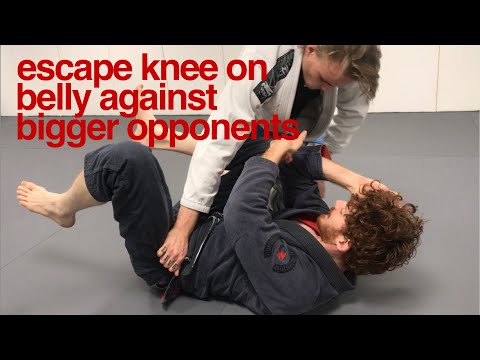
Knee On Belly Escape (Effective Vs Larger Opponents)
0
Knee On Belly Escape·JonThomasBJJ
This video explains my method for escaping the knee on belly. Rather than turning into my opponent exposing the danger o…
Translation: knee on belly escape
The Knee On Belly Escape family covers techniques for escaping the knee-on-belly (or knee-on-stomach) position, where the opponent places one knee on the defender's midsection with the other leg posted for balance. [1] Knee-on-belly creates intense pressure on the diaphragm, making breathing difficult and creating urgency to escape — panicked reactions are the biggest danger, as they often lead to worse positions or submission exposure. [1],[2] Primary escape methods include framing and shrimping to create distance, and pushing the knee off while reguarding. [2],[3]
KOB escapes are fundamental in BJJ defensive training. [1]
Knee on belly escapes are essential in BJJ competition. [1]
No images yet for this technique.
Sign in to suggest an image.
This video explains my method for escaping the knee on belly. Rather than turning into my opponent exposing the danger o…
No instructional courses yet for this technique.
Sign in to suggest a course.
Risk of injury to the person this technique is applied to
Bottom escapes from mount/side control; bridge and hip escape mechanics (Ribeiro 2008)
Skill level needed to execute this technique reliably
Whether this technique is allowed under major competition rule sets
Jiu-Jitsu University (Saulo Ribeiro, 2008)
Alias sources — [1] Jiu-Jitsu University (Ribeiro, 2008) [2] Jiu-Jitsu University (Ribeiro, 2008)
Effectiveness sources — [1] Jiu-Jitsu University (Ribeiro, 2008) [2] Mastering Jujitsu (Gracie & Danaher, 2003)
Standard katakana transliteration of Western martial arts terminology (外来語) — used in Japanese MMA, boxing, and BJJ communities
Alias sources — [1] Jiu-Jitsu University (Ribeiro, 2008) [2] Jiu-Jitsu University (Ribeiro, 2008)
Effectiveness sources — [1] Jiu-Jitsu University (Ribeiro, 2008) [2] Mastering Jujitsu (Gracie & Danaher, 2003)
hip mobility, explosive bridge/shrimp power, timing
flexible hips and strong glutes for escape movements
glutes, hip flexors, core, triceps (framing)
Every move, in any martial art, shares a few universal traits. Mix and match below to pinpoint the right tool — or compare equivalents across styles.
The Frame And Shrimp KOB Escape uses a combination of arm framing against the opponent's knee and hip escape (shrimp) movement to create distance and recover guard from the knee-on-belly position. [1] The defender frames against the pressing knee with both forearms, creating enough space to hip escape away, then reinserts the legs to recover a guard position. [1,2] The key is maintaining frame contact with the knee throughout the shrimp to prevent the opponent from re-establishing the pressure. [2,3]
The Push Knee And Reguard subfamily covers knee-on-belly escapes where the defender pushes the pressing knee off the body directly, then immediately reinserts the legs to establish guard before the opponent can transition to another control position. [1] This escape addresses the knee directly — rather than shrimping away, the defender uses both hands to push the knee off the torso and down to the mat, then quickly closes guard or establishes half guard. [1,2] The speed of the reguard is critical, as the opponent will immediately attempt to re-establish knee-on-belly or transition to mount. [2,3]
The knee-on-belly escape requires framing on the opponent's knee and shrimping the hips to create space for re-guarding. The urgency is high because knee-on-belly allows the top player to strike and submit while scoring 2 points in IBJJF. (Ribeiro, Jiu-Jitsu University; IBJJF Rules v6.0)
Connecting your elbow and knee space is critical—if your elbow and knee stay connected, your opponent won't be able to maintain a tight position or go for submissions like an armbar. Jon Thomas BJJ emphasizes that this connection is one of the most important fundamentals of the escape.
Keeping your outside leg high maintains core tightness and makes it easier to keep your knee connected to your elbow. If you put that leg on the floor, it becomes much harder to maintain the connection needed for the escape.
While turning is possible, Jon Thomas BJJ notes it's not his preferred approach, especially against larger opponents, because many skilled grapplers will simply spin to the other side and maintain control—creating a disadvantageous position.
Frame your hand on the opponent's knee while keeping your elbow super tight to your body. This tight elbow position prevents them from attacking submissions and gives you the structure needed to begin your escape.
The Knee On Belly Escape family covers techniques for escaping the knee-on-belly (or knee-on-stomach) position, where the opponent places one knee on the defender's midsection with the other leg posted for balance. Knee-on-belly creates intense pressure on the diaphragm, making breathing difficult and creating urgency to escape — panicked reactions are the biggest danger, as they often lead to worse positions or submission exposure.
Knee-on-belly escapes were developed alongside the position's use in BJJ competition, where knee-on-belly became a valued scoring position and transition platform. The position's uncomfortable pressure has made its escape a practical priority in training.
Unified MMA: legal — Legal defensive/transitional technique; IBJJF: legal — Legal; IJF: legal — Legal; ADCC: legal — Legal; UWW: legal — Legal; FIAS Sport Sambo: legal — Legal
Danger rating 3/10. Moderate — bottom escapes from mount/side control; bridge and hip escape mechanics (Ribeiro 2008)
The standard setup chain: Create Space → Disrupt Control → Execute Escape → Recover Position.
Standard counters include: Maintain Pressure — keep consistent weight distribution to limit escape space / Anticipate Direction — read escape attempt direction and block early / Transition — flow to a new position when the current one is threatened.
Common variants: Standard escape (primary escape mechanic using frames, bridges, or hip mov…); Combination escape (chaining two escape directions or methods); Counter escape (using the opponent's attack attempt to create the escape …); Competition variation (modified for rule-set optimisation).
Knee on belly escapes are essential in BJJ competition.
Top errors to watch for: Pushing the opponent's body instead of the knee — the knee is the contact point; push it off your torso / Shrimping toward the opponent instead of away — shrimp in the direction opposite to the knee / Lying flat and absorbing the pressure — KOB requires immediate, active response / Reaching for the opponent's leg with the far hand — this exposes your arm to kimuras and armbars.
The Knee On Belly Escape is also known as Nī On Berī Esukēpu, KOB Escape, Knee Ride Escape.