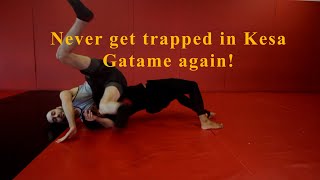
Introduction to Knee on Belly Escape
The knee on belly position presents a significant control challenge that requires systematic escape methodology. This technique focuses on effective escape strategies, particularly relevant when defending against larger or stronger opponents.
Elbow-Knee Connection Principle
Maintaining connection between the defending elbow and knee is fundamental to preventing tight control and creating defensive framing space. When the elbow and knee remain connected, the defender can generate leverage for pushing with both the knee and hands, even under significant pressure.
Disadvantages of Turn-Based Escapes
While turning to escape knee on belly is possible, it carries tactical disadvantages against experienced opponents. Larger opponents frequently counter the turning motion by spinning to the opposite side or transitioning to front headlock attacks, leading to unfavorable scrambling positions.
Framing and Elbow Positioning
The escape begins with framing the hand on the opponent's knee while maintaining a tight elbow to prevent armbar attacks. The defender's objective is to rotate the body slightly and maneuver the elbow in front of the opponent's knee.
Forward Shrimp Motion Execution
Once the elbow advances past the knee, the defender places their foot on the ground and executes a forward shrimp motion, pulling the hip out and centering the body. This movement drops the opponent's knee and re-establishes elbow-knee connection in a more advantageous position.
Post-Escape Guard Positioning
After executing the forward shrimp, the defender maintains the outside leg high to keep the core tight and preserve knee connection. The defender then frames with the hands and uses the outside foot to make contact with the opponent's hip or lasso, creating space to bring the other leg through toward center.
Forward Shrimp Mechanics Compared to Standard Shrimp
The forward shrimp differs from a standard shrimp by moving from a side-lying position to a flat position, rather than from center to side. This motion is frequently used in jiu-jitsu when pressure prevents the defender from simply turning back to center, allowing them to reposition and resume guard.
Complete Escape Sequence Review
The complete escape involves blocking the opponent's knee, rotating away to position the elbow ahead of the knee, placing the foot on the ground for friction, and executing a forward shrimp motion to create working space. Once space is established, the defender must be prepared to frame and engage in positional scrambling to fully recover guard position.
Knee On Belly Escape (Effective Vs Larger Opponents)
Key Takeaways
- •Introduction to Knee on Belly Escape
- •Elbow-Knee Connection Principle
- •Disadvantages of Turn-Based Escapes
- •Framing and Elbow Positioning
This video explains my method for escaping the knee on belly. Rather than turning into my opponent exposing the danger of front head locks or an opponent switching to side control on my opposite side, I focus on turning away and connected my elbow knee frames back together. This method of escape is in my opinion far more effective for fighting vs a stronger, or bigger opponent)
Related Techniques
Frequently Asked Questions
What does this video teach about knee on belly escape?
This video covers introduction to knee on belly escape, elbow-knee connection principle, disadvantages of turn-based escapes. It provides detailed instruction from JonThomasBJJ.
How long does it take to learn knee on belly escape?
The basic mechanics can be understood in a single session, but developing reliable execution requires consistent drilling over weeks of practice. This 8-part breakdown helps structure your training by isolating each phase of the technique.
What are the key details for finishing knee on belly escape?
The forward shrimp differs from a standard shrimp by moving from a side-lying position to a flat position, rather than from center to side. This motion is frequently used in jiu-jitsu when pressure prevents the defender from simply turning back to center, allowing them to reposition and resume guard.