Guard Classification Framework
Brazilian Jiu-Jitsu guards are organized into five primary categories: closed guard, open guards with outside leg positioning, half guards, inside positioning guards, and leg entanglements. Each category contains subcategories defined by specific grip patterns, and guards within the same category tend to transition fluidly between one another. Understanding this taxonomy helps practitioners identify which positions suit their technical development stage.
Closed Guard Fundamentals
Closed guard involves locking both feet around the opponent's torso and serves as an excellent platform for submissions and sweeps while providing strong defensive coverage. Variants include the standard closed guard with legs locked at the waist, high guard achieved by climbing the legs higher around the torso to facilitate arm lock and back attacks, and the rubber guard, which requires greater flexibility. Closed guard's defensive properties make it difficult for opponents to mount effective offense.
Open Guard: Outside Leg Positioning
Open guards with both feet positioned on the outside of the opponent's legs or torso provide superior guard retention and defensive positioning in competitive grappling. The K guard involves feet on the outside with the knee positioned on the inside, attached to the opponent's leg to set up leg entanglements and leg locks. De la Riva guard uses one foot hooked on the outside of the opponent's leg with a threading hook to the inside, enabling back takes and sweeps.
Gi-Specific Open Guards
The collar sleeve guard allows control of the opponent's posture through gi grips, enabling upper body attacks such as triangles, armbars, and omoplatas by isolating the opponent's arm. The lasso guard involves threading one leg over the opponent's arm and under the armpit to block guard passes and set up sweeps. Spider guard controls both sleeves with feet attached to both biceps, facilitating upper body submissions, sweeps, back takes, and leg entanglements.
Half Guard Positions
Half guard positions involve one foot placed inside the opponent's legs and one foot outside, serving primarily to slow opponent movement and isolate their leg for sweep setups rather than submissions. The sit-up guard against a standing opponent uses arm grips on the opponent's leg with mixed foot positioning for sweeps and single-leg takedown entries. The knee shield variants (high and low) provide defensive positioning against heavy pressure, creating space for recovery to preferred guard positions.
Advanced Half Guard Techniques
The underhook half guard, where the underhook is applied on the same side as the trapped leg, is considered one of the most effective half guard positions for sweeping and functions across MMA, sport grappling, and self-defense contexts. Deep half guard is achieved by scooting underneath the opponent far enough to isolate their leg and prevent effective weight application, particularly benefiting practitioners with limited hip mobility. Reverse De la Riva half guard against a standing opponent produces outcomes similar to open guard positioning and often combines with other guard styles.
Inside Positioning and Leg Entanglement Guards
Inside positioning guards employ feet placed inside the opponent's legs and have gained prominence in no-gi submission grappling for accessing leg locks and entanglements. Shin-to-shin positioning places the practitioner's ankle against the opponent's ankle, enabling elevation into single-leg X guard or X guard. Butterfly and half butterfly guards set up sweeps when the opponent is kneeling, with half butterfly allowing practitioners to scoot deeper and access the saddle or single-leg X positions while maintaining upper body attack options.
Seated Guard and Leg Entanglement Strategy
The seated guard (distance butterfly) positions the practitioner seated against a kneeling opponent before foot placement inside, offering opportunities for back takes, front headlock entries, or double-leg drive-throughs. Leg entanglements represent an upgrade from foundational guards, thoroughly binding the opponent's base and positioning the practitioner underneath to execute off-balancing sweeps or leg attacks. Transitioning into leg entanglement positions maximizes positional control and offensive potential.
Beginners Guide: Types of Guard in Jiu Jitsu
Key Takeaways
- •Guard Classification Framework
- •Closed Guard Fundamentals
- •Open Guard: Outside Leg Positioning
- •Gi-Specific Open Guards
Closed guard, half guard, outside position guards, inside position guards, and leg entanglements form 5 major categories of guard you can play, each then containing a subset of guard styles. The best approach is typically to master one of these guards first, then branching out to develop a broader game over several years. This video is from the course "Foundations" on https://submeta.io : a course designed for beginners to understand jiu jitsu and develop a game.
Related Techniques
Frequently Asked Questions
What does this video teach about guard position?
This video covers guard classification framework, closed guard fundamentals, open guard: outside leg positioning. It provides detailed instruction from Absolute MMA St Kilda - Melbourne.
How long does it take to learn guard position?
The basic mechanics can be understood in a single session, but developing reliable execution requires consistent drilling over weeks of practice. This 8-part breakdown helps structure your training by isolating each phase of the technique.
What are the key details for finishing guard position?
Inside positioning guards employ feet placed inside the opponent's legs and have gained prominence in no-gi submission grappling for accessing leg locks and entanglements. Shin-to-shin positioning places the practitioner's ankle against the opponent's ankle, enabling elevation into single-leg X guard or X guard. Butterfly and half butterfly guards set up sweeps when the opponent is kneeling, with half butterfly allowing practitioners to scoot deeper and access the saddle or single-leg X positions while maintaining upper body attack options.
Related videos
GUARD BASICS-A WHITE BELT GUIDE
Will Brooks Official
Mounted Rubber Guard - 10th Planet Jiu Jitsu
Brandon Mccaghren
Boxing Stance | Learn Long Range vs Short Range Fighting
FightCamp
5 Tips For Fighting At Long Range
Warrior Martial Arts
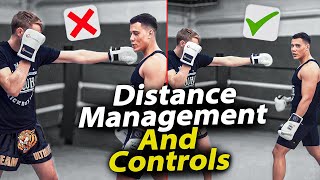
Be A Master Of DISTANCE MANAGEMENT: The Most Important Part Of Fighting | BAZOOKATRAINING.COM
Bazooka Joe Valtellini