3 No-Gi Guard Passes That Work at All Levels
0
Guard Top·Gold BJJ
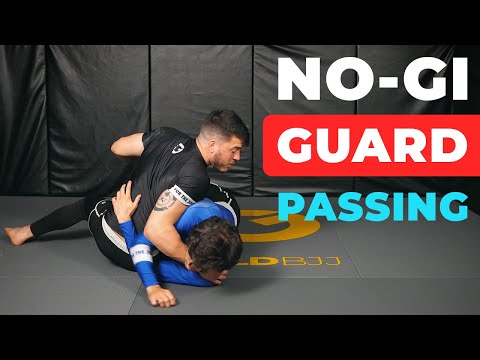
Black belt athlete and competitor Juan Carlos Lopez shows a few of his favorite No-Gi guard passing techniques. Follow …
Translation: Guard top
The Guard Top group covers all positions, techniques, and strategies for the fighter on top when the opponent is playing guard — the offensive counterpart to the guard player's sweeps and submissions. [1] Being in someone's guard requires a specific skill set: maintaining posture to prevent being pulled into submissions, establishing base to resist sweeps, and systematically working to pass the guard to achieve a dominant position. [1],[2] In MMA, guard top includes the critical skill of ground-and-pound — delivering strikes from inside the guard while avoiding submission attempts — which is one of the most common ways fights are finished on the ground. [2],[3] The top player must balance defensive awareness (avoiding triangles, armbars, and guillotines) with offensive progression (passing the guard to side control or mount). [3]
Guard top strategy developed as a necessary counterpart to the Gracie family's guard innovations in BJJ — once the guard became offensively viable, the top player needed systematic approaches to survive and advance from inside guard. [1] Early BJJ guard top work was primarily about posture and guard break before passing, but the skill set expanded significantly as guard systems became more sophisticated. [1],[2] In MMA, guard top strategy took on additional dimensions with the integration of ground-and-pound, which was pioneered by fighters like Mark Coleman and Tito Ortiz and later refined by Khabib Nurmagomedov's ground-and-pound system. [2],[3]
Guard top is a critical skill because it determines whether the top fighter can advance through the positional hierarchy or gets stuck in a neutral position. [1] In MMA, effective guard top work (ground-and-pound combined with guard passing) is one of the strongest predictors of round wins in judging. [2] In BJJ competition, the ability to break and pass guard from the top is essential for any well-rounded competitor. [3]
Guard top strategy traces from the Gracie self-defence curriculum (where breaking and passing guard was essential for the mount-and-submit sequence) through modern sport BJJ's sophisticated passing systems. [1] MMA guard top work evolved separately through the development of ground-and-pound striking. [1],[2]
No images yet for this technique.
Sign in to suggest an image.
Black belt athlete and competitor Juan Carlos Lopez shows a few of his favorite No-Gi guard passing techniques. Follow …
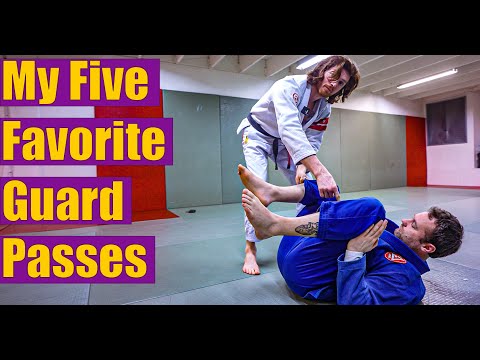
So I often get asked what is my favourite guard pass so I thought I would do a video about 5 of my favourite passes from…
No instructional courses yet for this technique.
Sign in to suggest a course.
Risk of injury to the person this technique is applied to
The guard top position exposes the top player to submission attempts (triangle, armbar, guillotine, kimura from guard); in MMA, the top player risks being cut with elbows from the bottom; poor posture inside guard is dangerous
Skill level needed to execute this technique reliably
Whether this technique is allowed under major competition rule sets
Jiu-Jitsu University (Saulo Ribeiro, 2008)
Description sources — [1] Jiu-Jitsu University (Ribeiro, 2008) on posture and base fundamentals [2] Mastering Jujitsu (Gracie & Danaher, 2003) on positional hierarchy [3] MMA ground-and-pound evolution
Description sources — [1] Jiu-Jitsu University (Ribeiro, 2008) on posture and base fundamentals [2] Mastering Jujitsu (Gracie & Danaher, 2003) on positional hierarchy [3] MMA ground-and-pound evolution
postural strength (maintaining upright posture under the guard player's pulling force), grip strength (fighting for grip dominance), base stability (resisting sweeps)
heavy bodyweight (more difficult for the guard player to sweep or submit), long arms (easier to posture and strip grips), strong core (maintaining posture)
erector spinae (posture), forearms (grip fighting), quadriceps (standing in guard), core (balance and base)
Every move, in any martial art, shares a few universal traits. Mix and match below to pinpoint the right tool — or compare equivalents across styles.
The Fundamental Guard Top family covers the essential skills for maintaining dominant top position when facing an opponent's guard — the basic posture, base, and grip management techniques that every grappler must master before developing advanced passing systems. [1] This includes combat base (one knee up, one knee down), standing posture inside closed guard, grip stripping fundamentals, and the basic guard-breaking sequence that initiates all passing attempts. [1,2] These fundamentals apply regardless of which specific guard the opponent plays — the principles of posture management, base stability, and grip dominance are universal top-position skills. [2,3]
The TKD Ground Position family covers ground fighting positions and techniques within Taekwondo's curriculum, which though primarily a striking and kicking art, includes ground awareness and basic positional skills for self-defence application. [1] Traditional Taekwondo (particularly ITF-style under General Choi Hong Hi's system) includes some ground fighting elements influenced by Japanese jujutsu and judo, while modern Olympic-style (WT/WTF) Taekwondo focuses almost exclusively on kicking. [1,2] TKD ground positions primarily cover getting back to standing after being taken down, basic ground control concepts, and defensive ground awareness rather than submission grappling — reflecting Taekwondo's philosophy that the fight should be conducted standing. [2,3]
Guard top — the position of the fighter inside the opponent's guard — requires passing to advance. In MMA, guard top allows ground-and-pound strikes but in pure grappling, the guard top player must pass or risk being swept or submitted. (Ribeiro, Jiu-Jitsu University; MMA training manuals)
Jon Thomas emphasizes centering your opponent first by moving them from their side to a centered position, which allows you to get their hips down and keep them flat—the foundation for finishing guard passes effectively.
Jon Thomas controls the leg by trapping it and pinning the hips down to the floor using your hand on the shin or pant leg, which prevents them from bringing their knee back up and allows you to progress the pass.
Jon Thomas notes that when your opponent is on their side, it's harder to drive through and finish the pass, even if you control their leg—but when you steer them flat, you can apply pressure much more effectively and complete the technique.
The Guard Top group covers all positions, techniques, and strategies for the fighter on top when the opponent is playing guard — the offensive counterpart to the guard player's sweeps and submissions. Being in someone's guard requires a specific skill set: maintaining posture to prevent being pulled into submissions, establishing base to resist sweeps, and systematically working to pass the guard to achieve a dominant position.
Guard top strategy developed as a necessary counterpart to the Gracie family's guard innovations in BJJ — once the guard became offensively viable, the top player needed systematic approaches to survive and advance from inside guard. Early BJJ guard top work was primarily about posture and guard break before passing, but the skill set expanded significantly as guard systems became more sophisticated.
IBJJF: legal — Legal — guard is fundamental to BJJ, sweeps from guard score 2 points; IJF: restricted — Guard pulling penalized as non-combativity — groundwork from guard permitted …; ADCC: legal — Legal, guard pull penalized -1 point in points portion; Unified MMA: legal — Legal — no penalty for playing guard; FIAS Sport Sambo: legal — Legal
Danger rating 4/10. Moderate — the guard top position exposes the top player to submission attempts (triangle, armbar, guillotine, kimura from guard); in MMA, the top player risks being cut with elbows from the bottom; poor posture inside guard is dangerous
The standard setup chain: Establish Posture → Grip Fight → Break Guard → Initiate Pass → Navigate Legs → Consolidate.
Standard counters include: Posture Break — pulling the top player's head and shoulders down to set up attacks / Sweep — using hooks, grips, and hip movement to reverse the position / Submission from Guard — triangles, armbars, and guillotines that attack the top player / Guard Retention — re-establishing guard when the top player begins to pass.
Common variants: Closed guard top (trapped inside the opponent's locked legs; posture and gu…); Open guard top (standing) (standing up in front of the opponent's open guard; enable…); Open guard top (kneeling) (kneeling in front of open guard; headquarters position fo…); Half guard top (one leg trapped in the opponent's half guard; crossface a…); Butterfly guard top (standing or kneeling against seated butterfly hooks; must…); MMA guard top (inside guard with striking; posture management for ground…).
Guard top work is scored indirectly through guard passes (3 points IBJJF/ADCC) and advantageous position advancement. In MMA, ground control time from guard top is a major judging metric.
Top errors to watch for: Broken posture inside closed guard — leaning forward with the head down inside closed guard is the most common beginn… / Hands on the mat inside guard — placing hands on the mat gives the guard player wrist control; keep hands on their bo… / Trying to pass from inside closed guard — the guard must be opened before passing; attempting to pass with legs locke… / Ignoring the guard player's grips — allowing the guard player to establish deep collar grips and sleeve control enabl….
The Guard Top is also known as Gādo Toppu, Top Position, Guard Top, Dominant Ground Position.