Overview and Application
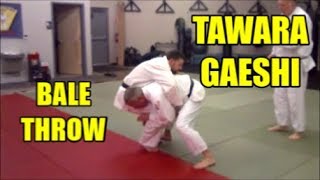
Tawara Gaeshi is a sacrifice throw executed by landing on one's back, primarily used as a counter to an opponent's double-leg takedown. The technique can also be applied offensively to conclude with a submission hold.
Etymology and Mechanics
The name 'Tawara Gaeshi' translates to 'rice bag reversal,' derived from the motion of hoisting a heavy sack of rice onto one's shoulder. The throwing motion mirrors this lifting action: dropping down, scooping the opponent up, and rotating them onto one's shoulder before standing.
Initial Setup Against Double-Leg
As the opponent commits to a double-leg takedown and begins lifting, the defender must secure both legs by hooking the inner thighs before the opponent gains sufficient height. Timing is critical—the hooks must be established before the opponent can establish a dominant lifting position.
The Reversal and Top Position
Upon securing both inner-thigh hooks, the defender curls into a ball and rolls with the opponent's forward momentum, using the opponent's own lifting force to propel the defender to the top. The result is a high mount position with minimal opportunity for the opponent to bridge or roll out.
Aggressive Variant with Submission
The technique can be executed offensively by pulling the opponent downward while securing a half-choke grip. The defender then drives forward, wrapping the opponent's torso while maintaining the choke grip against their own body.
Finishing the Choke
With the half-choke established, the defender brings their heels into position and extends their body by looking upward, creating tension and elongating the torso. This positioning tightens the choke and completes the submission.
Judo for MMA - Tawara Gaeshi
Key Takeaways
- •Overview and Application
- •Etymology and Mechanics
- •Initial Setup Against Double-Leg
- •The Reversal and Top Position
Judo for MMA (http://judo4mma.com) - How to do Tawara Gaeshi - Rice Bale/Bag Reversal. This method of Tawara Gaeshi is used as a counter/defense to a double leg takedown or as a continuation (renraku waza) of an unsuccessful guillotine choke attempt. This is part of a series of videos by the Kakure Judo Club, adapting traditional Judo techniques to Mixed Martial Arts or self defense fighting. Please check us out online at http://judo4mma.com
Related Techniques
Frequently Asked Questions
What does this video teach about tawara gaeshi?
This video covers overview and application, etymology and mechanics, initial setup against double-leg. It provides detailed instruction from Judo4MMA.
How long does it take to learn tawara gaeshi?
The basic mechanics can be understood in a single session, but developing reliable execution requires consistent drilling over weeks of practice. This 6-part breakdown helps structure your training by isolating each phase of the technique.
What are the key details for finishing tawara gaeshi?
The technique can be executed offensively by pulling the opponent downward while securing a half-choke grip. The defender then drives forward, wrapping the opponent's torso while maintaining the choke grip against their own body.