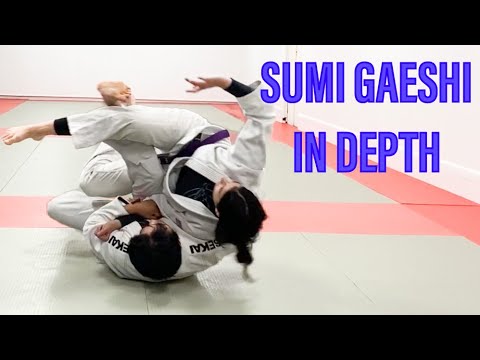
Sumi gaeshi in depth
0
Sumi Gaeshi·Shintaro Higashi
Sumi gaeshi in depth for Judo, BJJ and Sambo. In this video, we cover how to do sumi gaeshi in a RvL losing position. S…
Translation: corner reversal
Sumi Gaeshi, the corner reversal throw, is a rear sacrifice technique in which tori drops underneath uke while hooking the inside of uke's thigh with one leg and rolling backward to sweep uke over. [1] The throw works by disrupting uke's balance to the rear corner (sumi) while tori's body acts as a fulcrum, creating a wheeling action that carries uke overhead. [1],[2] Sumi gaeshi is one of the original forty throws of the Kodokan gokyo and is classified as a ma sutemi waza (rear sacrifice technique). [2],[3] The technique is especially effective against opponents who adopt a defensive, bent-over posture, as their lowered centre of gravity can be exploited by the rolling action. [3]
Sumi gaeshi was included in the Kodokan gokyo from its earliest formulations, reflecting its importance in classical judo training. [1] The technique derives from older jujutsu methods of using an opponent's forward pressure against them. [1],[2] Modern competitors frequently use butterfly guard entries from BJJ as adaptations of the sumi gaeshi principle. [2],[3]
Sumi gaeshi is commonly scored in IJF competition and is a staple technique in BJJ competition. [1]
No images yet for this technique.
Sign in to suggest an image.
Sumi gaeshi in depth for Judo, BJJ and Sambo. In this video, we cover how to do sumi gaeshi in a RvL losing position. S…
Sumi Gaeshi is a popular and effective throwing technique in all grappling and combat sports. This video focuses on the …
No instructional courses yet for this technique.
Sign in to suggest a course.
Risk of injury to the person this technique is applied to
Ma-Sutemi-Waza; tori falls backward pulling uke over; spinal compression risk
Skill level needed to execute this technique reliably
Whether this technique is allowed under major competition rule sets
Kodokan Judo — Official Nage-waza Classification
Traditional Judo throwing technique terminology (Kodokan Institute)
Official Kodokan ground technique classification system
Standard Japanese martial arts terminology (kanji/hiragana)
Established Japanese martial arts naming convention — native Japanese term (和語/漢語)
Traditional Judo throwing technique terminology (Kodokan Institute)
precise timing, ankle coordination, upper body kuzushi ability
excellent balance and quick reflexes
tibialis anterior, calves, hip rotators, forearms (grip)
Every move, in any martial art, shares a few universal traits. Mix and match below to pinpoint the right tool — or compare equivalents across styles.
Sumi gaeshi (corner reversal) appears in 5 books in our corpus. A sacrifice throw where the attacker falls to their back while hooking the opponent's inner thigh, rolling them over. Commonly used as a counter to forward-driving opponents. (Kano, Kodokan Judo)
According to Welcome Mat Steve Scott, you want to secure a solid back grip on your opponent's middle back between the shoulder blades. When reaching around, use your thumb position and apply tension with the inside of your elbow against the opponent's deltoid rather than just reaching over the top.
Welcome Mat Steve Scott emphasizes standing with your toes pointing in the direction you're moving—your left foot steps in while your right foot jams as you roll back. Standing sideways is weak positioning and won't give you a strong base for the throw.
Welcome Mat Steve Scott notes that sumi gaeshi is considered a tall person's sacrifice throw, making it a good alternative to circle throws for taller practitioners or those of similar height to their opponent.
Shintaro Higashi recommends attacking your opponent's front leg with an ochi grip first to force their leg away and adjust their stance, which sets up the conditions for a successful sumi gaeshi entry. He also emphasizes establishing good head position and a two-on-one grip before executing the throw.
Sumi Gaeshi, the corner reversal throw, is a rear sacrifice technique in which tori drops underneath uke while hooking the inside of uke's thigh with one leg and rolling backward to sweep uke over. The throw works by disrupting uke's balance to the rear corner (sumi) while tori's body acts as a fulcrum, creating a wheeling action that carries uke overhead.
Sumi gaeshi was included in the Kodokan gokyo from its earliest formulations, reflecting its importance in classical judo training. The technique derives from older jujutsu methods of using an opponent's forward pressure against them.
IJF: legal — Legal throwing technique; IBJJF: legal — Legal at all belt levels; UWW: legal — Legal in both freestyle and Greco-Roman; Unified MMA: legal — Legal throwing technique; ADCC: legal — Legal; FIAS Sport Sambo: legal — Legal; FIAS Combat Sambo: legal — Legal
Danger rating 6/10. High — Ma-Sutemi-Waza; tori falls backward pulling uke over; spinal compression risk
The standard setup chain: Grip Setup (Kumi-kata) → Off-Balance (Kuzushi) → Entry (Tsukuri) → Execution (Kake) → Fall (Sutemi).
Standard counters include: Lower Centre of Gravity — bend knees and drop hips to make the throw harder to execute / Lift the Targeted Leg — raise the foot being attacked above the sweeping action / Counter-Throw — exploit the attacker's committed weight to throw them instead / Grip Break — deny the thrower their preferred gripping configuration.
Common variants: Forward sweep (sweeping the foot in the direction the opponent is stepping); Rear sweep (sweeping the foot backward as the opponent retreats); Combination sweep (chaining sweeps to both feet); Counter sweep (timing the sweep as the opponent initiates their own attack).
Sumi gaeshi is commonly scored in IJF competition and is a staple technique in BJJ competition.
Top errors to watch for: Hooking too deep (behind the knee) instead of on the inner thigh — reduces the lifting action / Throwing directly overhead like tomoe nage instead of diagonally — different throw, different direction / Not pulling uke's upper body to the side with the grips — the diagonal pull is what makes sumi gaeshi work / Falling straight back instead of at an angle — the diagonal fall matches the diagonal throw.
The Sumi Gaeshi is also known as Corner Reversal, Corner Throw, Sumi Gaeshi, Half Guard Sweep.