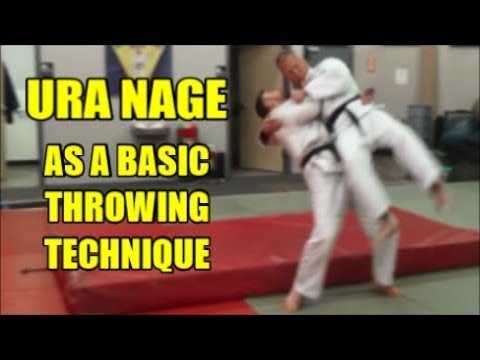
URA NAGE AS A BASIC THROWING TECHNIQUE
0
Ura Nage·welcomematstevescott
Ura Nage (Rear Throw) is a fundamentally important throwing technique and we teach it to our students at Welcome Mat ear…
Translation: rear throw
Ura Nage, the rear throw, is a powerful rear sacrifice technique in which tori wraps both arms around uke's torso from the front or side, arches backward, and bridges to lift and throw uke over tori's own body in a high arc. [1],[2] Unlike tomoe nage and sumi gaeshi, ura nage does not use a foot planted on the opponent's body; instead, the throwing force comes entirely from the hip extension, back arch, and arm pull. [2],[3] Ura nage is classified as a ma sutemi waza and is considered one of the more physically demanding sacrifice throws, requiring significant core and back strength. [3],[4]
Ura nage has its origins in sumo and classical jujutsu, where similar backward-arching throws were used to counter charging opponents. [1] Kodokan judo adopted ura nage into the gokyo, and the technique became a signature move of physically powerful competitors. [1],[2] In Greco-Roman wrestling, the souples (suplex) family shares biomechanical similarities with ura nage. [2],[3]
Ura nage scores high-value points in both IJF judo competition and Greco-Roman wrestling. [1]
No images yet for this technique.
Sign in to suggest an image.
Ura Nage (Rear Throw) is a fundamentally important throwing technique and we teach it to our students at Welcome Mat ear…
My favourite judokas doing Ura Nage. Khyar Walide / Lasha Shavdatuashvili / Mireia Lapuerta / Ryuju Nagayama / Beka Gvin…
No instructional courses yet for this technique.
Sign in to suggest a course.
Risk of injury to the person this technique is applied to
Ma-Sutemi-Waza; tori falls backward pulling uke over; spinal compression risk
Skill level needed to execute this technique reliably
Whether this technique is allowed under major competition rule sets
Kodokan Judo — Official Nage-waza Classification
Traditional Judo throwing technique terminology (Kodokan Institute)
Official Kodokan ground technique classification system
Standard Japanese martial arts terminology (kanji/hiragana)
Established Japanese martial arts naming convention — native Japanese term (和語/漢語)
Traditional Judo throwing technique terminology (Kodokan Institute)
hip rotation speed, core strength, lower back stability
strong hips and core, good flexibility for turning entry
hip rotators, core, quadriceps, latissimus dorsi
Every move, in any martial art, shares a few universal traits. Mix and match below to pinpoint the right tool — or compare equivalents across styles.
Ura nage (rear throw/suplex) appears in 5 passages across 3 books. The attacker lifts the opponent from the front and arches backward to slam them. One of the most dramatic throws in judo — used as a counter when the opponent drives forward aggressively. (Kano, Kodokan Judo)
According to Welcome Mat/Steve Scott, ura nage works both ways: as a counter when your opponent comes in and you drop your level to catch them, and as an aggressive movement where you rush in and catch your opponent. The core mechanics are similar, but the counter relies on timing and anticipation, while the aggressive version involves you initiating the attack.
Welcome Mat/Steve Scott emphasizes that your hips must be lower than your opponent's hips—you drop low immediately by squatting when they come in. This low hip position is critical for catching your opponent effectively and generating the throw.
Welcome Mat/Steve Scott explains that you maintain your high grip on the lapel with one hand while stepping in with the opposite side and shooting your other arm around the waist, gripping tightly. You then open, step in, slide around the waist, drop low, and use your legs to drive upward before rotating and arching back.
No—Welcome Mat/Steve Scott clarifies that while ura nage has some similar mechanics to a soup clutch, it is not the same technique. Ura nage requires more leg drive; you start low, rotate upward, then arch back and turn immediately.
Ura Nage, the rear throw, is a powerful rear sacrifice technique in which tori wraps both arms around uke's torso from the front or side, arches backward, and bridges to lift and throw uke over tori's own body in a high arc. Unlike tomoe nage and sumi gaeshi, ura nage does not use a foot planted on the opponent's body; instead, the throwing force comes entirely from the hip extension, back arch, and arm pull.
Ura nage has its origins in sumo and classical jujutsu, where similar backward-arching throws were used to counter charging opponents. Kodokan judo adopted ura nage into the gokyo, and the technique became a signature move of physically powerful competitors.
IJF: legal — Legal throwing technique; IBJJF: legal — Legal at all belt levels; UWW: legal — Legal in both freestyle and Greco-Roman; Unified MMA: legal — Legal throwing technique; ADCC: legal — Legal; FIAS Sport Sambo: legal — Legal; FIAS Combat Sambo: legal — Legal
Danger rating 6/10. High — Ma-Sutemi-Waza; tori falls backward pulling uke over; spinal compression risk
The standard setup chain: Grip Setup (Kumi-kata) → Off-Balance (Kuzushi) → Entry (Tsukuri) → Execution (Kake) → Fall (Sutemi).
Standard counters include: Lower Centre of Gravity — bend knees and drop hips to make the throw harder to execute / Block the Hip — post hand on the thrower's hip to prevent loading / Step Around — circle away from the throw direction to avoid being loaded / Grip Break — deny the thrower their preferred gripping configuration.
Common variants: Standard hip throw (full turn-in with hip below the opponent's centre of gravity); No-gi hip throw (adapted without gi grips, using overhook and collar tie); Drop hip throw (dropping to one knee to lower the fulcrum point); Combination hip throw (chaining from a failed foot technique or hand technique).
Ura nage scores high-value points in both IJF judo competition and Greco-Roman wrestling.
Top errors to watch for: Arching backward without first lifting uke's hips — they slide off the front instead of going over / Not securing the body lock tightly — uke slips free during the arch / Using only the back to arch without leg drive — the legs must straighten to generate lift / Throwing uke directly onto their head — ura nage must be controlled so they land on their upper back.
The Ura Nage is also known as Rear Throw, Back Throw, Ura Nage, Suplex, Brosok Prognuvshis (бросок прогнувшись).