Receptive Principle and Basic Mechanics
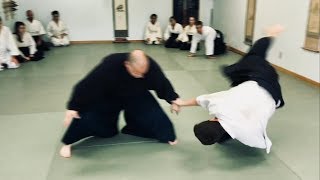
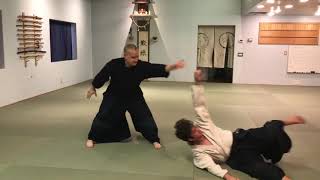
Kokyu nage is fundamentally a receptive technique in which the practitioner turns in the same direction as the attacker, flows with their arm, and redirects their center before returning energy through whole-body engagement. This principle allows the technique to be applied across various aikido styles and positions.
Moroate Dori Application
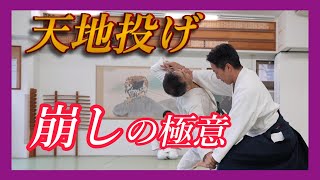
From a moroate dori grip, the practitioner enters, elevates the attacker's center while facing the same direction, and executes the throw. This variation is historically significant, appearing in classical aikido imagery including the famous statue of O Sensei.
Flying and Adjacent Variations
Kokyu nage can be executed as a flying technique when the attacker grabs and pulls the practitioner inward; the practitioner redirects the attacker upward and forward. The technique can also be performed while standing beside the partner, sometimes called dakiminage, by controlling above the elbow and extending the arm while pivoting with the front leg.
Stance and Contact Point Refinement
The practitioner avoids applying force below the elbow to prevent injury, instead working above the elbow joint. As the front leg steps forward, the practitioner extends energy through hand rotation and whole-body movement rather than downward arm pressure.
Multiple Attack Scenarios
Kokyu nage adapts to various attack angles: from standing punches (atemi), direct entries with elbow control, and transitions that blend similar throws like kaitanage or ikkio nage. These variations maintain the core principle of breaking balance through directional entry and whole-body engagement.
Receptive Defense Against Pushing Attacks
When the attacker pushes or holds the practitioner, the receptive kokyu nage involves stepping back without resistance, placing one hand inside to control the center and the other beneath the elbow. The practitioner then rotates like an opening door, spiraling the attacker's body as a wheel to execute the throw.
Shoulder-Level and Rear-Attack Variations
The hand positioning can shift to control the shoulders instead of elbows. Additional variations include rear-attack scenarios (ushiro de atadori) where the fundamental principles of energy redirection and balanced entry remain consistent across different angles of approach.
Key Technical Principles
Practitioners should avoid forcing the technique through muscular pressure, as tension in the attacker prevents execution. Instead, the method requires flowing with the attacker's motion, taking their energy, creating space, and providing subtle directional guidance to complete the throw.
All Aikido Kokyu Nage Explained!
Key Takeaways
- •Receptive Principle and Basic Mechanics
- •Moroate Dori Application
- •Flying and Adjacent Variations
- •Stance and Contact Point Refinement
This video contains an explanation of the main Aikido Kokyu Nage's! This is another Aikido Tutorial from a series we are making where you'll have everything you need to know about Aikido in one place! This project is going to be a big one, including explanation of Seiza, Traditions, Techniques, Attacks, Weapons and more. We will release new parts of the video each Tuesday and in the end - a full, all encompassing Aikido Tutorial! Follow our channel to support this project! ►► http://bit.ly/1KPZpv0 So far there are these tutorials: Basic Principles of All Techniques - https://youtu.be/pzmSAOFKgxQ All Aikido Grabs and Attacks - https://youtu.be/xmxDtN60Wx0 Tai Sabaki (steps) - https://youtu.be/lbgtIH7ZhTs Shiko (Knee Walking) - https://youtu.be/xIFFFSfYF14 Bowing in and meditation - https://youtu.be/-VN-9sb_l14 Seiza (sitting on knees) - https://youtu.be/bAJSawy-_Ys Instructor: Rokas Leonavicius Sensei Uke: Martynas Martišauskis (Shodan) Editing: Danguole Garškaitė Camera: Eduardas Girjotas Dodzo is a full time Dojo focusing on self-development through Aikido and Yoga. The Dojo is run by Sensei Rokas Leonavicius.
Related Techniques
Frequently Asked Questions
What does this video teach about kokyu nage?
This video covers receptive principle and basic mechanics, moroate dori application, flying and adjacent variations. It provides detailed instruction from USDC by Rokas Leo.
How long does it take to learn kokyu nage?
The basic mechanics can be understood in a single session, but developing reliable execution requires consistent drilling over weeks of practice. This 8-part breakdown helps structure your training by isolating each phase of the technique.
What are the key details for finishing kokyu nage?
The hand positioning can shift to control the shoulders instead of elbows. Additional variations include rear-attack scenarios (ushiro de atadori) where the fundamental principles of energy redirection and balanced entry remain consistent across different angles of approach.