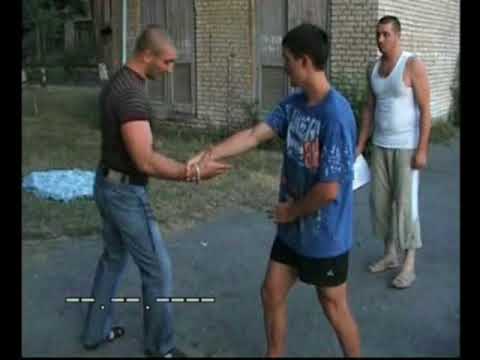
tenbin nage, ude kimi nage
0
Tenbin Nage·Denzel Aiki
Translation: balance / scale-beam throw
Tenbin Nage (literally 'scale-beam throw') is an aikido throw that off-balances the opponent by hyperextending their elbow joint while levering against the shoulder, treating the opponent's straightened arm as a tenbin (the beam of a balance scale). [1],[2] The throw is mechanically distinct from kokyu nage and kaiten nage in that it uses joint engagement as the primary off-balance vector — the elbow extension creates pain compliance that drives the opponent forward and down. [1],[3] Tenbin nage is most commonly applied from sumi-otoshi or katate-dori entries and is closely related to Daito-ryu's ude-nobashi (arm-extension) techniques. [2],[4] In Yoshinkan curricula it is sometimes classified separately from the pure aiki throws because of the joint-engagement element; in Aikikai and Iwama-ryu it is taught as a canonical aikido throw at intermediate levels. [3],[4] The throw is named for the visual analogy: the opponent's straightened arm becomes the beam of a scale, with the aikidoka's lever applied at the elbow as the fulcrum and the wrist as the load. [1],[2]
Tenbin nage was systematised by Morihei Ueshiba and his senior students during the 1930s-1950s, derived directly from the ude-nobashi (arm-extension) lever techniques of Daito-ryu aiki-jujutsu under Sokaku Takeda. [1],[2] The naming references the Japanese word for a scale-beam (tenbin), with the opponent's straightened arm forming the beam of the balance. [1],[3] The throw appears in standard aikido curricula and was formalised in textbooks by Kisshomaru Ueshiba, Gozo Shioda, and Morihiro Saito in the 1950s-1970s. [3],[4]
Tenbin nage is highly effective when the opponent's arm can be straightened — the lever mechanics are reliable. [1] It is harder to apply against opponents with bent-arm positions or against grappling-trained opponents who refuse to extend. [2] The throw is rarely seen in modern MMA in pure form, but the standing armbar that emerges from the same mechanics (ude-hishigi-juji-gatame from standing) is occasionally seen. [3] In Tomiki / Shodokan competitive aikido, tenbin nage appears in tanto-randori (knife defence randori). [2],[3]
No images yet for this technique.
Sign in to suggest an image.
No instructional courses yet for this technique.
Sign in to suggest a course.
Risk of injury to the person this technique is applied to
High — joint engagement at the elbow can damage the joint if applied with full force or speed. The throw is typically practiced slowly with cooperative ukemi; in non-cooperative contexts the elbow hyperextension can produce hyperextension injury or even ligament damage
Skill level needed to execute this technique reliably
Whether this technique is allowed under major competition rule sets
Aikido (Kisshomaru Ueshiba, 1957)
Description sources — [1] Aikido (K. Ueshiba 1957); [2] Daito-ryu Aikijujutsu Conversations (Pranin); [3] Total Aikido (Shioda); [4] Traditional Aikido Vol 2 (Saito)
Lineage sources — [1] Daito-ryu Aikijujutsu Conversations (Pranin); [2] Aikido (K. Ueshiba 1957); [3] Traditional Aikido (Saito); [4] Total Aikido (Shioda)
Effectiveness sources — [1] Aikikai pedagogy; [2] Tomiki/Shodokan competition records; [3] modern critique (Aikido Journal)
Aikido technique naming conventions
Standard Japanese martial arts terminology (kanji/hiragana)
Established Japanese martial arts naming convention — native Japanese term (和語/漢語)
Description sources — [1] Aikido (K. Ueshiba 1957); [2] Daito-ryu Aikijujutsu Conversations (Pranin); [3] Total Aikido (Shioda); [4] Traditional Aikido Vol 2 (Saito)
Lineage sources — [1] Daito-ryu Aikijujutsu Conversations (Pranin); [2] Aikido (K. Ueshiba 1957); [3] Traditional Aikido (Saito); [4] Total Aikido (Shioda)
Effectiveness sources — [1] Aikikai pedagogy; [2] Tomiki/Shodokan competition records; [3] modern critique (Aikido Journal)
precise lever placement, hip mobility, sensitivity to uke's joint tolerance
forearms (lever application), lats (extending uke's arm), hip rotators (off-line step), core
Tenbin Nage (balance/scale-beam throw) — uses the opponent's straightened arm as a lever, treating it as the beam of a balance scale. Joint engagement at the elbow distinguishes it from pure aiki throws like kokyu nage. Closely related to Daito-ryu's ude-nobashi.
Tenbin Nage (literally 'scale-beam throw') is an aikido throw that off-balances the opponent by hyperextending their elbow joint while levering against the shoulder, treating the opponent's straightened arm as a tenbin (the beam of a balance scale). The throw is mechanically distinct from kokyu nage and kaiten nage in that it uses joint engagement as the primary off-balance vector — the elbow extension creates pain compliance that drives the opponent forward and down.
Tenbin nage was systematised by Morihei Ueshiba and his senior students during the 1930s-1950s, derived directly from the ude-nobashi (arm-extension) lever techniques of Daito-ryu aiki-jujutsu under Sokaku Takeda. The naming references the Japanese word for a scale-beam (tenbin), with the opponent's straightened arm forming the beam of the balance.
IBJJF: legal — Legal as throw; ADCC: legal — Legal; Unified MMA: legal — Legal as standing throw; sustained elbow hyperextension would qualify as a se…; IJF: legal — Legal as a throw entry; standing armbars (ude-hishigi-juji-gatame from standi…
Danger rating 6/10. Moderate-high — joint engagement at the elbow can damage the joint if applied with full force or speed. The throw is typically practiced slowly with cooperative ukemi; in non-cooperative contexts the elbow hyperextension can produce hyperextension injury or even ligament damage
The standard setup chain: Receive Wrist Grab or Strike → Step Off-line → Extend and Straighten Uke's Arm → Apply Elbow Lever with Shoulder as Fulcrum → Project Forward and Down → Release Lever Cleanly.
Standard counters include: Bend the elbow — refuse the straightened-arm position the lever needs / Release the gripped wrist before the lever forms / Pivot toward the thrower to relieve the lever angle / Stable grappling base with bent elbow positioning.
Common variants: Standard tenbin-nage (Lever applied at the elbow with shoulder as fulcrum); Compact form (Yoshinkan) (Tighter lever with less travel; militarily-precise); Iwama-ryu form (Saito) (Emphasis on ki extension through the lever); Suwari-waza tenbin-nage (Kneeling form (formal training)).
Appears in Tomiki / Shodokan tanto-randori (knife defence) and toshu-randori. Generally non-competitive in Aikikai and Yoshinkan.
Top errors to watch for: Applying the lever before the arm is straight — bent-elbow application produces an arm-twist, not a balance-beam throw / Using strength instead of leverage — tenbin nage works on lever mechanics; if force is required, the placement was wrong / Forgetting to off-balance forward — the throw needs uke's centre to be moving forward; static application fails / Rushing the lever — joint engagement requires sensitive timing; speed produces injury risk.
The Tenbin Nage is also known as Tenbin-nage, Tenbin Nage, Balance Throw, Scale-Beam Throw, Seesaw Throw.