All Aikido Kokyu Nage Explained!
0
Kokyu Nage·USDC by Rokas Leo
This video contains an explanation of the main Aikido Kokyu Nage's! This is another Aikido Tutorial from a series we ar…
Translation: breath throw / breath power throw
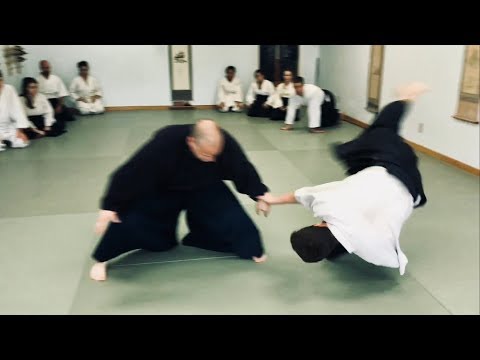
Kokyu Nage (literally 'breath throw') is the most fundamental and widely-practiced throw in aikido — a category of throws unified by the principle of using kokyū (the Japanese concept of unified breath, timing, and ki) to project an opponent without apparent muscular effort. [1],[2] Unlike a hip throw or a sacrifice throw, kokyu nage is not defined by a specific mechanical entry but by the quality of the connection: the thrower's centre, breath, and body move as one with the opponent's incoming force, redirecting it into a forward extension that drops the opponent face-down or onto their back. [1],[3] Many practitioners describe kokyu nage as 'the throw with no technique' because the apparent throwing action is minimal — the visible motion is mostly the uke (receiver) running themselves into the throw on the wave of their own attack. [2],[4] The canonical entries are from katate-dori (single wrist grab), shomen-uchi (overhead strike), and ryote-dori (two-hand grab); each version uses the same kokyū principle expressed through a different point of contact. [3] In Aikikai, Yoshinkan, and Iwama-ryu lineages, kokyu nage is taught from the earliest belt levels because it embodies the core aiki principle — and is also the throw most practitioners struggle with longest, because the principle is felt rather than performed. [1],[2]
Kokyu nage as a named technique was systematised by Morihei Ueshiba (1883-1969) and his senior students during the 1930s-1950s, derived directly from the kokyū principles he learned in Daito-ryu aiki-jujutsu under Sokaku Takeda. [1],[2] The throw appears in nearly every aikido curriculum; the term itself was popularised by Kisshomaru Ueshiba in his 1957 textbook Aikido and is now standard across all aikido lineages. [2],[3] In Yoshinkan (Gozo Shioda), the throw is sometimes called 'sokumen iriminage' depending on context; in Iwama-ryu (Morihiro Saito), it appears in multiple variations across the syllabus. [3],[4]
Kokyu nage is the highest-frequency throw in aikido practice — it appears in nearly every class and demonstration. [1] Effectiveness in non-cooperative contexts is debated: against committed attacks it is highly effective, but it is famously hard to apply against a non-committing or grappling-trained opponent who refuses the kuzushi. [2] In competitive Tomiki / Shodokan aikido it appears in toshu-randori. [3] Kokyu nage's true legacy is as the canonical demonstration of aiki principle — it is the throw that beginners chase for years and senior practitioners refine for decades. [1],[4]
No images yet for this technique.
Sign in to suggest an image.
This video contains an explanation of the main Aikido Kokyu Nage's! This is another Aikido Tutorial from a series we ar…
Aikido at Senshin Center www.senshincenter.com www.facebook.com/senshincenter Subscribe to our podcast on iTunes and So…
No instructional courses yet for this technique.
Sign in to suggest a course.
Risk of injury to the person this technique is applied to
Moderate — kokyu nage is the lowest-injury aikido throw because there is no joint engagement; risk is purely from the breakfall (ukemi). Forward roll-out is the standard ukemi response
Skill level needed to execute this technique reliably
Whether this technique is allowed under major competition rule sets
Aikido (Kisshomaru Ueshiba, 1957) — earliest authoritative description of kokyu nage in print
Description sources — [1] The Spirit of Aikido (K. Ueshiba); [2] Total Aikido (Shioda); [3] Traditional Aikido Vol 1 (Saito); [4] Aikido and the Dynamic Sphere (Westbrook & Ratti)
Lineage sources — [1] Daito-ryu Aikijujutsu Conversations (Pranin); [2] Aikido (K. Ueshiba 1957); [3] Total Aikido (Shioda); [4] Traditional Aikido (Saito)
Effectiveness sources — [1] Aikikai pedagogy; [2] modern competitive aikido critique (Aikido Journal); [3] Tomiki/Shodokan competition records; [4] biomechanics literature (Pranin archive)
Aikido technique naming conventions
Standard Japanese martial arts terminology (kanji/hiragana)
Established Japanese martial arts naming convention — native Japanese term (和語/漢語)
Description sources — [1] The Spirit of Aikido (K. Ueshiba); [2] Total Aikido (Shioda); [3] Traditional Aikido Vol 1 (Saito); [4] Aikido and the Dynamic Sphere (Westbrook & Ratti)
Lineage sources — [1] Daito-ryu Aikijujutsu Conversations (Pranin); [2] Aikido (K. Ueshiba 1957); [3] Total Aikido (Shioda); [4] Traditional Aikido (Saito)
Effectiveness sources — [1] Aikikai pedagogy; [2] modern competitive aikido critique (Aikido Journal); [3] Tomiki/Shodokan competition records; [4] biomechanics literature (Pranin archive)
hip rotation, ukemi (breakfall) skill, sensitivity in the contact point
relaxed rather than tense muscle tone
hip rotators, core (rotation control), lats (extending arm), forearms (release/redirection grip)
Kokyu nage (breath throw) is the most fundamental aikido throw — taught from earliest belt levels and refined for decades. Defined by quality of connection rather than mechanical entry. Many lineages call it 'the throw with no technique' because the visible motion is minimal — the receiver runs themselves into the projection on the wave of their own attack.
Don't try to force or push your opponent down. Instead, receive their energy, give space, and guide them through the technique. Rokas Leo emphasizes that forcing the technique will fail if your opponent becomes tense.
Kokyu Nage relies on internal leverage and skeletal alignment flexing off your center, not muscle strength. According to senshinone, you gain mechanical advantage by flexing off your center rather than using shoulder or arm power alone.
Grab above the elbow rather than at the elbow joint itself, so you don't traumatize the joint. As you move forward with your front leg, extend the arm with a tilt by turning the hand to bring out your opponent's center.
Yes, the receptive form of Kokyu Nage is one of the most common variations and is very practical in randori and multiple attacker scenarios.
Kokyu Nage (literally 'breath throw') is the most fundamental and widely-practiced throw in aikido — a category of throws unified by the principle of using kokyū (the Japanese concept of unified breath, timing, and ki) to project an opponent without apparent muscular effort. Unlike a hip throw or a sacrifice throw, kokyu nage is not defined by a specific mechanical entry but by the quality of the connection: the thrower's centre, breath, and body move as one with the opponent's incoming force, redirecting it into a forward extension that drops the opponent face-down or onto their back.
Kokyu nage as a named technique was systematised by Morihei Ueshiba (1883-1969) and his senior students during the 1930s-1950s, derived directly from the kokyū principles he learned in Daito-ryu aiki-jujutsu under Sokaku Takeda. The throw appears in nearly every aikido curriculum; the term itself was popularised by Kisshomaru Ueshiba in his 1957 textbook Aikido and is now standard across all aikido lineages.
IBJJF: legal — Legal as throw; ADCC: legal — Legal; Unified MMA: legal — Legal as standing throw
Danger rating 3/10. Low-moderate — kokyu nage is the lowest-injury aikido throw because there is no joint engagement; risk is purely from the breakfall (ukemi). Forward roll-out is the standard ukemi response
The standard setup chain: Receive Wrist Grab or Incoming Strike → Step Off-line (Irimi or Tenkan) → Extend Through Uke's Centre → Maintain Single Connection Point → Project Along Uke's Forward Vector → Recover Centre.
Standard counters include: Refuse the wrist grab — kokyu nage typically begins from a grab; deny the grip / Drop the centre of gravity — make the kuzushi impossible / Stiff-arm at distance — break the connection before the spiral forms / Stable grappling base — fundamental defence against any aiki throw.
Common variants: Irimi kokyu nage (Aikidoka enters deeply along the line of attack); Tenkan kokyu nage (Aikidoka pivots around the opponent's force); Sokumen kokyu nage (Side-of-body application); Ushiro kokyu nage (From rear-grab attacks); Suwari-waza kokyu nage (Kneeling form (formal training)); Hanmi-handachi kokyu nage (Thrower kneeling, uke standing).
Appears in Tomiki / Shodokan toshu-randori. Generally non-competitive in Aikikai and Yoshinkan.
Top errors to watch for: Trying to muscle the throw — kokyu nage requires zero force when timed correctly; if you have to push, the timing was… / Stopping mid-throw — the extension must continue all the way through to projection; halfway extensions produce failed… / Connecting only at the wrist — the connection must reach the spine through the joint chain / Pulling instead of leading — you extend uke's existing motion; you do not yank them off-line.
The Kokyu Nage is also known as Kokyū-nage, Kokyū Nage, Kokyu-nage, Breath Throw, Breath Power Throw.