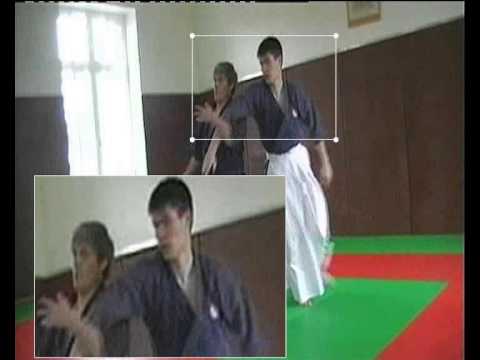
Koshi Nage. Part 4 2013.
0
Koshi Nage·Aikido: A Cooperating Process / Marc Bachraty
Dans cette vidéo, je vous montre comment réaliser ce mouvement: Koshi Nage. Aïkido Marc Bachraty #marcbachraty. #aikido.…
Translation: hip throw (aikido form)
Koshi Nage is the aikido hip throw — distinct from judo's koshi-waza in that the entire body, not just the hip, serves as the throwing axis. [1],[2] In aikido koshi-nage, the thrower turns deeply under the opponent's centre of gravity (a position similar to judo o-goshi or harai-goshi) but uses an arm extension and full-body rotation to project the opponent over the back, rather than relying on the hip as a discrete fulcrum. [1],[3] The result is a longer, more spiraling throw: the opponent travels over the thrower's lower back rather than being snapped over a hip-only fulcrum. [2],[4] The classic aikido entries are from katate-dori (single wrist grab) and ryote-dori (two-hand grab); the aikidoka pivots inside the line of attack, drops their centre, extends through uke's arm, and projects them across their back. [3],[4] Koshi nage is taught at intermediate-to-advanced levels in most aikido lineages because it requires confident ukemi (a long forward roll-out) and committed entry. [1],[2]
Koshi nage was systematised by Morihei Ueshiba and his senior students during the 1930s-1950s. [1] The throw shares mechanical heritage with both Daito-ryu aiki-jujutsu (Ueshiba's parent art) and the koshi-waza of judo (which Ueshiba was familiar with through cross-style exposure). [1],[2] Yoshinkan (Gozo Shioda) and Iwama-ryu (Morihiro Saito) both formalised koshi-nage variants in their post-war textbooks; Aikikai includes it in standard intermediate-to-advanced syllabi. [3],[4]
Koshi nage is among the more visually dramatic aikido throws — the long spiral projection is striking and effective in cooperative demonstration. [1] In competitive contexts (Tomiki / Shodokan), it appears occasionally in toshu-randori. [2] In MMA and non-cooperative grappling, the throw is rarely seen because committed forward energy from uke is required. [3] Its effectiveness in real altercations depends heavily on the opponent providing the committed energy that aikido throws need. [2],[3]
No images yet for this technique.
Sign in to suggest an image.
Dans cette vidéo, je vous montre comment réaliser ce mouvement: Koshi Nage. Aïkido Marc Bachraty #marcbachraty. #aikido.…
Voiçi donc O koshi nage , une technique de projection de hanche connue sous le nom de O goshi en Judo. N'oubliez pas que…
No instructional courses yet for this technique.
Sign in to suggest a course.
Risk of injury to the person this technique is applied to
High — long projection requires uke to take a substantial forward breakfall (forward ukemi over a curved back). Insufficient ukemi can produce shoulder or back injury
Skill level needed to execute this technique reliably
Whether this technique is allowed under major competition rule sets
Aikido (Kisshomaru Ueshiba, 1957)
Description sources — [1] Aikido (K. Ueshiba 1957); [2] Total Aikido (Shioda); [3] Traditional Aikido Vol 1 (Saito); [4] Aikido and the Dynamic Sphere (Westbrook & Ratti)
Lineage sources — [1] Daito-ryu Aikijujutsu Conversations (Pranin); [2] Total Aikido (Shioda); [3] Traditional Aikido (Saito); [4] Aikido (K. Ueshiba 1957)
Effectiveness sources — [1] Aikikai pedagogy; [2] Tomiki/Shodokan competition records; [3] modern critique (Aikido Journal)
Aikido technique naming conventions
Standard Japanese martial arts terminology (kanji/hiragana)
Established Japanese martial arts naming convention — native Japanese term (和語/漢語)
Description sources — [1] Aikido (K. Ueshiba 1957); [2] Total Aikido (Shioda); [3] Traditional Aikido Vol 1 (Saito); [4] Aikido and the Dynamic Sphere (Westbrook & Ratti)
Lineage sources — [1] Daito-ryu Aikijujutsu Conversations (Pranin); [2] Total Aikido (Shioda); [3] Traditional Aikido (Saito); [4] Aikido (K. Ueshiba 1957)
Effectiveness sources — [1] Aikikai pedagogy; [2] Tomiki/Shodokan competition records; [3] modern critique (Aikido Journal)
hip mobility, balance under load, deep pivot strength, breakfall (long forward ukemi) skill
hip rotators, glutes, quadriceps (deep pivot), lats (extending arm), core (rotation control)
Koshi Nage is aikido's hip throw — uses the entire body as the throwing axis (not just the hip as a fulcrum, like judo's koshi-waza). Long spiral projection over the lower back. Requires confident long forward ukemi from the receiver.
Koshi Nage is the aikido hip throw — distinct from judo's koshi-waza in that the entire body, not just the hip, serves as the throwing axis. In aikido koshi-nage, the thrower turns deeply under the opponent's centre of gravity (a position similar to judo o-goshi or harai-goshi) but uses an arm extension and full-body rotation to project the opponent over the back, rather than relying on the hip as a discrete fulcrum.
Koshi nage was systematised by Morihei Ueshiba and his senior students during the 1930s-1950s. The throw shares mechanical heritage with both Daito-ryu aiki-jujutsu (Ueshiba's parent art) and the koshi-waza of judo (which Ueshiba was familiar with through cross-style exposure).
IBJJF: legal — Legal as throw; ADCC: legal — Legal; Unified MMA: legal — Legal as standing throw; IJF: legal — Legal as throw if entered cleanly (judo would call this a koshi-waza variant)
Danger rating 5/10. Moderate-high — long projection requires uke to take a substantial forward breakfall (forward ukemi over a curved back). Insufficient ukemi can produce shoulder or back injury
The standard setup chain: Receive Wrist or Sleeve Grab → Pivot Inside Uke's Line → Drop Centre Below Uke's Centre of Gravity → Extend Through Uke's Arm → Project Across Lower Back → Recover Centre.
Standard counters include: Refuse the wrist or sleeve grab — koshi nage typically begins from a grab; deny the grip / Drop the centre — make the deep pivot impossible by lowering uke's hips / Stiff-arm at distance — break the connection before the spiral forms / Counter throw (ushiro-goshi or tani-otoshi) — at advanced level.
Common variants: Standard koshi-nage (Single-hand entry; full pivot under uke's centre); Two-hand koshi-nage (From ryote-dori; both hands engaged in the projection); Suwari-waza koshi-nage (Kneeling form (formal training; uncommon)); Yoshinkan compact form (Tighter rotation, more linear projection); Iwama-ryu form (Saito) (Emphasis on the ki extension through uke's arm).
Tomiki / Shodokan toshu-randori. Generally non-competitive in Aikikai and Yoshinkan.
Top errors to watch for: Treating it as a judo hip throw — relying on hip snap rather than full-body extension produces a shorter, weaker throw / Incomplete pivot — partial pivots fail to load uke properly / Pulling rather than extending — the arm path is forward extension, not backward yank / Standing too tall — the thrower must drop their centre below uke's centre of gravity.
The Koshi Nage is also known as Koshi-nage, Koshi Nage, Aikido Hip Throw, 腰投, Aiki Hip Throw.