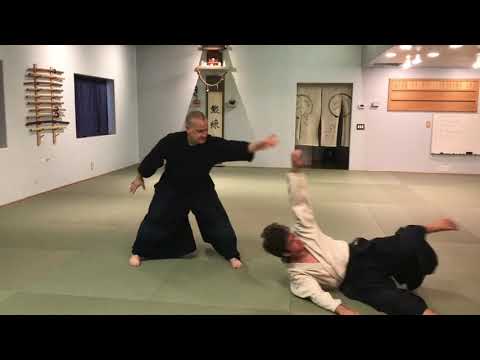
Aikido: Ude Garami/Juji Nage
0
Juji Nage·senshinone
Aikido at Senshin Center www.senshincenter.com www.facebook.com/senshincenter Subscribe to our podcast on iTunes, Spoti…
Translation: cross throw / X throw
Juji Nage (literally 'cross throw' or 'X throw', from juji 十字 — the kanji shape of the cross) is an aikido throw in which the aikidoka crosses the opponent's arms over each other and then off-balances them through the structural failure that the crossed-arms position creates. [1],[2] The cross can be created in two main ways: by drawing one of the opponent's arms across their own body to meet the other, or by stepping under one arm to cross it over the other from below. [1],[3] Once the arms are crossed, the opponent's structure is fundamentally compromised — they cannot use both arms independently to recover, and their centre is exposed. [2],[4] The aikidoka then projects them through the cross by either driving forward (a forward sacrifice variant) or by stepping back and pulling them through (a backward variant). [3] Juji nage is taught at intermediate-to-advanced levels because it requires careful timing and a clean entry — premature crossing without off-balance produces a tangled position rather than a clean throw. [1],[2] The throw is closely related to Daito-ryu's juji-garami (cross-entanglement) techniques. [3],[4]
Juji nage was systematised by Morihei Ueshiba and his senior students during the 1930s-1950s, derived from juji-garami (cross-entanglement) techniques in Daito-ryu aiki-jujutsu under Sokaku Takeda. [1],[2] The 'cross' or 'X' naming references both the kanji shape of juji (十字) and the visual cross that the opponent's arms form during the throw. [1],[3] The throw is documented in standard aikido textbooks from at least Kisshomaru Ueshiba's 1957 Aikido onward and appears in all major lineage curricula. [2],[3]
Juji nage is among the harder aikido throws to apply against committed resistance because it requires both of uke's arms to be within reach simultaneously. [1] In cooperative practice it is reliable and visually clean. [2] In competitive Tomiki / Shodokan formats it appears occasionally in toshu-randori. [3] The closely-related juji-garami arm-entanglement (used as a submission rather than a throw) is occasionally seen in MMA and BJJ. [3],[4]
No images yet for this technique.
Sign in to suggest an image.
Aikido at Senshin Center www.senshincenter.com www.facebook.com/senshincenter Subscribe to our podcast on iTunes, Spoti…
No instructional courses yet for this technique.
Sign in to suggest a course.
Risk of injury to the person this technique is applied to
Crossed-arm positions can stress the elbows or shoulders if the projection is not aligned; insufficient ukemi (uke must roll forward over their own crossed arms) creates risk. The throw is typically practiced slowly with cooperative ukemi
Skill level needed to execute this technique reliably
Whether this technique is allowed under major competition rule sets
Aikido (Kisshomaru Ueshiba, 1957)
Description sources — [1] Aikido (K. Ueshiba 1957); [2] Daito-ryu Aikijujutsu Conversations (Pranin); [3] Total Aikido (Shioda); [4] Traditional Aikido Vol 1 (Saito)
Lineage sources — [1] Daito-ryu Aikijujutsu Conversations (Pranin); [2] Aikido (K. Ueshiba 1957); [3] Traditional Aikido (Saito)
Effectiveness sources — [1] Aikikai pedagogy; [2] Tomiki/Shodokan competition records; [3] modern critique (Aikido Journal); [4] BJJ juji-garami applications
Aikido technique naming conventions
Standard Japanese martial arts terminology (kanji/hiragana)
Established Japanese martial arts naming convention — native Japanese term (和語/漢語)
Description sources — [1] Aikido (K. Ueshiba 1957); [2] Daito-ryu Aikijujutsu Conversations (Pranin); [3] Total Aikido (Shioda); [4] Traditional Aikido Vol 1 (Saito)
Lineage sources — [1] Daito-ryu Aikijujutsu Conversations (Pranin); [2] Aikido (K. Ueshiba 1957); [3] Traditional Aikido (Saito)
Effectiveness sources — [1] Aikikai pedagogy; [2] Tomiki/Shodokan competition records; [3] modern critique (Aikido Journal); [4] BJJ juji-garami applications
bilateral hand coordination, sensitivity to both wrists simultaneously, hip mobility
forearms (dual grip), lats (drawing arms together), hip rotators (off-line step), core (bilateral coordination)
Juji Nage (cross throw / X throw) — opponent's arms are crossed into a juji (十字) shape, then projected through the cross. Closely related to Daito-ryu's juji-garami arm-entanglement. The cross must form simultaneously with off-balance — crossing balanced arms produces a tangle, not a throw.
Juji Nage (literally 'cross throw' or 'X throw', from juji 十字 — the kanji shape of the cross) is an aikido throw in which the aikidoka crosses the opponent's arms over each other and then off-balances them through the structural failure that the crossed-arms position creates. The cross can be created in two main ways: by drawing one of the opponent's arms across their own body to meet the other, or by stepping under one arm to cross it over the other from below.
Juji nage was systematised by Morihei Ueshiba and his senior students during the 1930s-1950s, derived from juji-garami (cross-entanglement) techniques in Daito-ryu aiki-jujutsu under Sokaku Takeda. The 'cross' or 'X' naming references both the kanji shape of juji (十字) and the visual cross that the opponent's arms form during the throw.
IBJJF: legal — Legal as throw; ADCC: legal — Legal; Unified MMA: legal — Legal as standing throw
Danger rating 5/10. Moderate — crossed-arm positions can stress the elbows or shoulders if the projection is not aligned; insufficient ukemi (uke must roll forward over their own crossed arms) creates risk. The throw is typically practiced slowly with cooperative ukemi
The standard setup chain: Receive Two-Hand Grab or Bilateral Threat → Step Off-line → Cross Uke's Arms (One Drawn Across to Meet the Other) → Project Through the Cross → Recover Centre.
Standard counters include: Refuse the second hand — keep one hand back and out of reach to prevent the cross from forming / Pull arms apart at the moment of crossing — interrupt the structural failure before it forms / Drop the centre of gravity — make the off-line step less effective / Stable grappling base.
Common variants: Forward juji-nage (Cross uke's arms then project forward through the cross); Backward juji-nage (Cross then step back and pull uke through); Suwari-waza juji-nage (Kneeling form (formal training)); Standing-and-kneeling (hanmi-handachi) (Thrower kneeling, uke standing).
Appears occasionally in Tomiki / Shodokan toshu-randori. Generally non-competitive in Aikikai and Yoshinkan.
Top errors to watch for: Crossing the arms before off-balancing — produces a tangle, not a throw / Forgetting to step off-line — the cross plus an off-line step is what creates the projection vector / Crossing the arms too high or too low — the cross point should be at chest height for clean projection / Trying to muscle through the cross — the throw works on structural compromise, not on force.
The Juji Nage is also known as Juji-nage, Jūji-nage, Juji Nage, Cross Throw, X Throw.