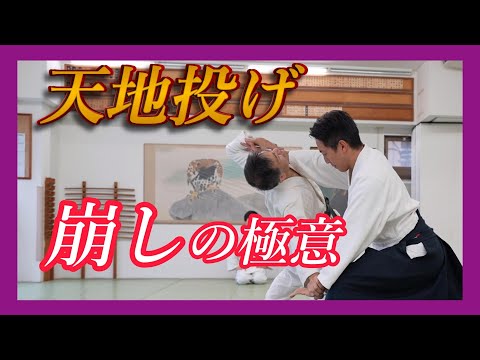
両手持ち天地投げ(二) 崩しのメカニズム Ryōte-mochi Tenchi-nage (2) – Mechanism of Kuzushi
0
Tenchi Nage·Aikido Naoya Uchikawa
この技では、左右それぞれの手に相手を崩すための大事な役割があります。自分の肘をどれだけ上手く使えるかがポイントです。 また、ブレない軸で回転すること、そして投げた後にしっかり残心を保つこともとても重要です。 In this techniq…
Translation: heaven-and-earth throw / sky-and-ground throw
Tenchi Nage (heaven and earth throw) is one of the canonical aikido throws — a bidirectional throw in which one of the opponent's hands is driven up (heaven, ten 天) while the other is driven down (earth, chi 地), splitting their structure into two opposing vectors and collapsing their balance through the gap between them. [1],[2] The throw is most commonly entered from ryote-dori (two-hand grab), where the opponent grabs both of the aikidoka's wrists; the aikidoka extends one hand up and forward (often as if reaching to the sky) while the other drops behind the opponent's near hip (toward the earth), simultaneously stepping off the line of attack. [1],[3] The bidirectional split makes recovery nearly impossible — the opponent cannot resist both vectors at once, and their structure collapses backward. [2],[4] Tenchi nage is taught in essentially every aikido lineage and appears in the curricula of Aikikai, Yoshinkan, Iwama-ryu, and Tomiki schools. [3] The Yoshinkan form is particularly compact (Gozo Shioda was known for tight, militarily-precise applications); the Iwama-ryu form (Saito) is more elongated and ki-extension-focused. [3],[4]
Tenchi nage was systematised by Morihei Ueshiba and his senior students during the 1930s-1950s, derived from bidirectional principles found in Daito-ryu aiki-jujutsu under Sokaku Takeda. [1],[2] The 'heaven and earth' naming reflects Ueshiba's spiritual cosmology — heaven (ten) and earth (chi) as fundamental opposing forces — and the throw is often used in his writings as a metaphor for the unifying principle of aiki. [1],[3] The throw appears in Kisshomaru Ueshiba's 1957 Aikido textbook and has been standard in all major lineages since. [2],[3]
Tenchi nage is among the more demonstrable aikido throws — the bidirectional split produces a clean backward projection that is visually striking and reliable in cooperative practice. [1] In competitive Tomiki / Shodokan formats it appears in toshu-randori. [2] Its applicability to non-cooperative contexts depends on whether the opponent commits to a two-hand grab; against a non-grappling opponent it is rarely seen, but in grappling contexts (where wrist grabs are less common) it is also rarely applied. [3] Its main role today is as foundational aiki vocabulary — a throw that demonstrates the aiki principle of using the opponent's structure against them. [1],[2]
No images yet for this technique.
Sign in to suggest an image.
この技では、左右それぞれの手に相手を崩すための大事な役割があります。自分の肘をどれだけ上手く使えるかがポイントです。 また、ブレない軸で回転すること、そして投げた後にしっかり残心を保つこともとても重要です。 In this techniq…
No instructional courses yet for this technique.
Sign in to suggest a course.
Risk of injury to the person this technique is applied to
The backward projection requires uke to know rear breakfall (ushiro ukemi); insufficient ukemi creates risk to back, head, or shoulders. The vector split itself is not joint-engaging, so the throw is lower-risk than tenbin-nage or juji-nage in that respect
Skill level needed to execute this technique reliably
Whether this technique is allowed under major competition rule sets
Aikido (Kisshomaru Ueshiba, 1957)
Aikido technique naming conventions
Description sources — [1] Aikido (K. Ueshiba 1957); [2] The Spirit of Aikido (K. Ueshiba); [3] Total Aikido (Shioda); [4] Traditional Aikido Vol 1 (Saito)
Lineage sources — [1] Daito-ryu Aikijujutsu Conversations (Pranin); [2] Aikido (K. Ueshiba 1957); [3] Traditional Aikido (Saito)
Effectiveness sources — [1] Aikikai pedagogy; [2] Tomiki/Shodokan competition records; [3] modern critique (Aikido Journal)
Standard Japanese martial arts terminology (kanji/hiragana)
Established Japanese martial arts naming convention — native Japanese term (和語/漢語)
Description sources — [1] Aikido (K. Ueshiba 1957); [2] The Spirit of Aikido (K. Ueshiba); [3] Total Aikido (Shioda); [4] Traditional Aikido Vol 1 (Saito)
Lineage sources — [1] Daito-ryu Aikijujutsu Conversations (Pranin); [2] Aikido (K. Ueshiba 1957); [3] Traditional Aikido (Saito)
Effectiveness sources — [1] Aikikai pedagogy; [2] Tomiki/Shodokan competition records; [3] modern critique (Aikido Journal)
balance, simultaneous coordination of both hands, sensitivity, breakfall (rear ukemi) skill
shoulders (heaven hand extension), lats (earth hand drop), hip rotators (off-line pivot), core (bilateral coordination)
Tenchi Nage (heaven and earth throw) — bidirectional throw splitting opponent's structure into opposing vectors. Heaven hand drives up-and-forward, earth hand drops down-and-back behind uke's hip. Canonical aikido throw, taught in all major lineages. Named after Ueshiba's spiritual cosmology of heaven (ten) and earth (chi) as fundamental opposing forces.
Tenchi Nage (heaven and earth throw) is one of the canonical aikido throws — a bidirectional throw in which one of the opponent's hands is driven up (heaven, ten 天) while the other is driven down (earth, chi 地), splitting their structure into two opposing vectors and collapsing their balance through the gap between them. The throw is most commonly entered from ryote-dori (two-hand grab), where the opponent grabs both of the aikidoka's wrists; the aikidoka extends one hand up and forward (often as if reaching to the sky) while the other drops behind the opponent's near hip (toward the earth), simultaneously stepping off the line of attack.
Tenchi nage was systematised by Morihei Ueshiba and his senior students during the 1930s-1950s, derived from bidirectional principles found in Daito-ryu aiki-jujutsu under Sokaku Takeda. The 'heaven and earth' naming reflects Ueshiba's spiritual cosmology — heaven (ten) and earth (chi) as fundamental opposing forces — and the throw is often used in his writings as a metaphor for the unifying principle of aiki.
IBJJF: legal — Legal as throw; ADCC: legal — Legal; Unified MMA: legal — Legal as standing throw
Danger rating 4/10. Moderate — the backward projection requires uke to know rear breakfall (ushiro ukemi); insufficient ukemi creates risk to back, head, or shoulders. The vector split itself is not joint-engaging, so the throw is lower-risk than tenbin-nage or juji-nage in that respect
The standard setup chain: Receive Two-Hand Grab (Ryote-dori) → Step Off-line → Heaven Hand Extends Up-and-Forward → Earth Hand Drops Down-and-Back → Project Through Bidirectional Split → Recover Centre.
Standard counters include: Refuse the two-hand grab — tenchi nage requires uke to commit both hands; deny the dual-grip / Release one wrist as the throw begins — without bilateral connection, the structural split fails / Drop the centre of gravity — make the off-line step less effective / Stable grappling base.
Common variants: Standard tenchi-nage (Heaven hand goes high-and-forward, earth hand drops behin…); Yoshinkan compact (Tighter, more linear application (Shioda lineage)); Iwama-ryu form (Saito) (Emphasis on ki extension through the heaven hand); Suwari-waza tenchi-nage (Kneeling form (formal training)).
Appears in Tomiki / Shodokan toshu-randori. Generally non-competitive in Aikikai and Yoshinkan.
Top errors to watch for: Heaven hand rising too late — must move simultaneously with the earth hand for the structural split to occur / Forgetting the off-line step — without the step, the heaven extension just pulls uke forward instead of splitting them / Earth hand dropping straight down — must drop diagonally behind uke's near hip / Trying to muscle one vector — the throw works through the SIMULTANEOUS application of both vectors, not the strength ….
The Tenchi Nage is also known as Tenchi-nage, Tenchi Nage, Heaven and Earth Throw, Sky-and-Ground Throw, 天地投.