Setup and Leg Hook
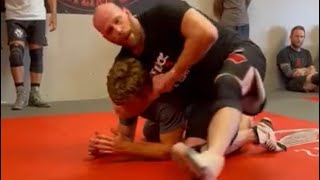
The practitioner begins by positioning alongside the opponent and hooking the opponent's back leg with the right foot. The timing of the hook may vary depending on the opponent's stance—it can be executed while stationary or while moving. The practitioner then backs up while maintaining control.
Vice Grip and Transition
With the leg hooked, the practitioner applies a vice grip (likely with the arms) and brings the opponent over. Rather than passing through to a different position, the practitioner sits their belt line onto the opponent's shoulders while facing the mat, maintaining the vice grip throughout.
Hip Thrust and Leg Configuration
The vice grip naturally rotates on its own without requiring manual adjustment. The practitioner threads their legs through and executes a hip thrust while pulling their hands free and drawing their legs back. This creates the foundational structure of the submission.
Sweep and Positioning
The practitioner sweeps the opponent and sits over them, positioning their hips directly over the opponent's torso. A secondary knee bar may naturally occur as a byproduct of this position. The belt line placement on the shoulders combined with hip positioning applies pressure to the neck.
Finishing Mechanics
The finish involves minimal movement: slight hip thrusts combined with arm pressure applied behind the body while driving the hips upward. The opponent's neck experiences significant bending during this phase, and the combination of joint pressure and positional control completes the technique.
All-Fours Variation
An alternative entry exists from an all-fours position where the practitioner controls the opponent from above. The practitioner moves over the opponent and applies the same shoulder and hip positioning used in the primary method, creating similar finishing mechanics.
Choke vs. Crank Distinction
The technique can function as either a choke or a crank depending on execution speed. Slower, controlled application emphasizes the crank effect due to neck extension and head positioning. Faster execution transitions the mechanism toward a choke as the arm and shoulder configuration restricts blood flow.
Japanese necktie
Key Takeaways
- •Setup and Leg Hook
- •Vice Grip and Transition
- •Hip Thrust and Leg Configuration
- •Sweep and Positioning
This is a nasty choke. A last minute addition to the end of the seminar by request. Nice rash guards too ;) Oh, and check out the look on Zac's face at 3:57... hilarious.
Related Techniques
Frequently Asked Questions
What does this video teach about japanese necktie?
This video covers setup and leg hook, vice grip and transition, hip thrust and leg configuration. It provides detailed instruction from jes03070.
How long does it take to learn japanese necktie?
The basic mechanics can be understood in a single session, but developing reliable execution requires consistent drilling over weeks of practice. This 7-part breakdown helps structure your training by isolating each phase of the technique.
What are the key details for finishing japanese necktie?
An alternative entry exists from an all-fours position where the practitioner controls the opponent from above. The practitioner moves over the opponent and applies the same shoulder and hip positioning used in the primary method, creating similar finishing mechanics.
Related videos
The Japanese Necktie
Absolute MMA St Kilda - Melbourne
High Wrist Guillotine Choke Submission in Turtle. Arm In, High Elbow, Side Control, Mount, Butterfly
Pica Pau Jiu Jitsu & Grappling
HOW TO DO THE REVERSE GUILLOTINE CHOKE EXECUTIONER BJJ JIU JITSU
Redneckjiujitsu
The Peruvian Necktie - Use all 4 limbs to finish this exotic choke
Keenan Cornelius
Catch Wrestling: Front Headlock into 10 Finger Guillotine & Bulldog Choke: Snake Pit U.S.A.
Snake Pit U.S.A. Original No-Gi