Overview of the Front Headlock System
The front headlock is a dominant control position in no-gi grappling that extends beyond submission techniques to shut down takedown attempts, control scrambles, and facilitate back takes. Unlike gi jiu-jitsu, no-gi grappling lacks traditional grips such as sleeve and collar controls, making the front headlock particularly valuable for managing opponent posture and spinal alignment. This position allows practitioners to initiate offense before achieving conventional dominant positions like side control or mount.
Foundational Structure and Control
The front headlock is established with the opponent's head positioned beneath the grappler's chest, with one hand securing a chin strap grip and the second arm controlling either the back of the tricep or seeking an underhook. The grappler maintains heavy shoulder pressure on the back of the opponent's neck while keeping their head down on the opponent's back to prevent escape. A preferred positioning uses one knee on the floor and one leg elevated to maintain mobility while continuously dragging the opponent downward.
Primary Offensive Threats
Three major threat categories emerge from the front headlock: submission techniques, rolling the opponent over to secure top position, and rotating to take the back. The fundamental objective is maintaining the opponent on their knees and elbows while using chin strap and tricep control to prevent them from rebuilding their posture. This control foundation enables the remaining offensive systems to function effectively.
Multiple Entry Points
The front headlock can be accessed from numerous positions throughout a match, including standing snap downs and reactionary responses to failed takedown attempts. Entries occur during guard passing at both standing and half-guard ranges, during guard play with snap downs, and throughout scrambles whenever the grappler achieves a position above the opponent's head height. One effective entry involves transitioning to a front headlock when falling off during a back take attempt, converting a chaotic transition into controlled positioning.
Guillotine Choke Variations
Two primary guillotine variations exist: the arm-in guillotine where both the opponent's head and arm are enclosed within the choke, and the traditional guillotine involving only the neck between the grappler's arms. The arm-in variation provides greater control but requires increased precision and power for completion, while the traditional guillotine generates stronger finishing force with reduced control. The high-wrist guillotine variation, where the arm wraps completely around the neck with the knuckles positioned above the shoulder line, creates a powerful blood choke rather than an air choke.
Finishing Positions for Guillotine Attacks
Three primary finishing positions are utilized when attacking guillotines: closing the guard for maximum control (though difficult against skilled opponents), using one leg as a hip frame with the other leg thrown over the back to prevent lateral escape, and the inverted front headlock created when opponents roll through to escape. The inverted front headlock position—where both grapplers' backs contact the mat—allows the top grappler to roll with the opponent and achieve mount or side control, or to finish the choke from the advantageous position.
Head and Arm Choke Family
Beyond guillotine variations, head and arm chokes constitute a distinct submission family including the darce choke (which enters through the armpit and exits at the neck) and the anaconda choke (entering through the neck and exiting at the armpit). Both variations provide substantial control and transition effectively from the inverted front headlock position, particularly when opponents attempt rolling escapes from guillotine attacks. These chokes represent essential components of a comprehensive front headlock game at high competitive levels.
High-Level Submission Priorities
The most frequently used front headlock submissions at elite competition levels are the high-wrist guillotine, arm-in guillotine, darce choke, and anaconda choke. While additional front headlock submission variations exist and function effectively, these four techniques represent the core technical arsenal for practitioners developing a foundational front headlock system. The emphasis on these particular submissions reflects their effectiveness and prevalence in modern no-gi competition.
The Front Headlock Might Be the Best System in No-Gi
Key Takeaways
- •Overview of the Front Headlock System
- •Foundational Structure and Control
- •Primary Offensive Threats
- •Multiple Entry Points
The front headlock might be the best system in modern no-gi. In this video, we break down why the front headlock is so effective, how it fits into today’s wrestling-heavy meta, and why it creates some of the strongest control and submission dilemmas in grappling. This isn’t just a position. It’s a complete system. From snap downs and go-behinds to guillotines, anacondas, darces, and back takes, the front headlock gives elite athletes a way to punish bad shots, control scrambles, and create constant finishing threats. If you enjoy analytical no-gi breakdowns, make sure to like, subscribe, and let me know in the comments: **Do you think the front headlock is the best system in no-gi right now?** Time Stamps: 00:00 Intro 00:39 Front Headlock 01:58 Why The Front Headlock? 03:08 Entries 04:08 Submissions/Guillotines 06:45 Darce/Anaconda 07:57 Back Takes 08:42 Dilemma 09:03 Outro --- **Music Credit:** Track: **White Hot** Artist: **White Hot** --- **Copyright / Fair Use Disclaimer:** This video may contain short clips, images, or references used for the purposes of commentary, criticism, education, and analysis under **Fair Use** as defined by Section 107 of the U.S. Copyright Act of 1976. All rights and credit go to their respective owners. No copyright infringement is intended. --- #bjj #nogi #jiujitsu #grappling #submissiongrappling #frontheadlock #darce #anaconda #guillotine
Related Techniques
Frequently Asked Questions
What does this video teach about fulcrum front headlock?
This video covers overview of the front headlock system, foundational structure and control, primary offensive threats. It provides detailed instruction from Grappling Theory.
How long does it take to learn fulcrum front headlock?
The basic mechanics can be understood in a single session, but developing reliable execution requires consistent drilling over weeks of practice. This 8-part breakdown helps structure your training by isolating each phase of the technique.
What are the key details for finishing fulcrum front headlock?
Beyond guillotine variations, head and arm chokes constitute a distinct submission family including the darce choke (which enters through the armpit and exits at the neck) and the anaconda choke (entering through the neck and exiting at the armpit). Both variations provide substantial control and transition effectively from the inverted front headlock position, particularly when opponents attempt rolling escapes from guillotine attacks. These chokes represent essential components of a comprehensive front headlock game at high competitive levels.
Related videos
High Wrist Guillotine Choke Submission in Turtle. Arm In, High Elbow, Side Control, Mount, Butterfly
Pica Pau Jiu Jitsu & Grappling

HOW TO DO THE REVERSE GUILLOTINE CHOKE EXECUTIONER BJJ JIU JITSU
Redneckjiujitsu
The Peruvian Necktie - Use all 4 limbs to finish this exotic choke
Keenan Cornelius

Catch Wrestling: Front Headlock into 10 Finger Guillotine & Bulldog Choke: Snake Pit U.S.A.
Snake Pit U.S.A. Original No-Gi
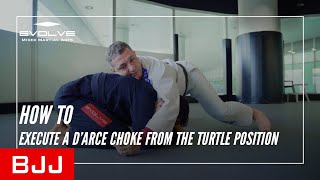
BJJ | How To Execute A D’Arce Choke From The Turtle Position
Evolve Mixed Martial Arts