Foundational Stance and Grip
Begin with a secure stance, keeping the non-striking arm locked in position for stability. The practitioner establishes proper grip mechanics on the stick, which serves as the foundation for all subsequent blocking and disarming techniques in the Angle Five Strike system.
Angle One: Block and Automatic Grab
When defending against an incoming strike to angle one, the practitioner blocks by sliding the stick to intercept the attack. The blocking hand automatically initiates a grab on the opponent's stick while the other hand drives downward, creating an immediate control position that prevents counterattack.
Angle Two: Disarming Technique
Angle two begins with the opponent's stick positioned high. The defender's open hand grabs the opponent's stick while the striking arm cuts across to separate the weapon from their grasp. This simultaneous grab-and-cut action results in a clean disarm, allowing the defender to immediately transition into an offensive attack.
Angle Three: Inside Defense with Shoulder Protection
The angle three defense requires the practitioner to move inside the opponent's attack while protecting the shoulder and elbow. The defending hand makes contact with the incoming stick and automatically drives downward while the other hand secures a controlling grab, establishing a strong defensive position.
Angle Four: Continuous Flow and Stick Separation
In angle four, the defending hand remains positioned low while executing the block. The practitioner cuts the opponent's stick away with a smooth sliding motion, then redirects the movement in a circular pattern to maintain control and prevent any immediate counterattack.
Angle Five: Standing Position with Upward Defense
Angle five is executed from a standing position with the defender moving inside to close distance. The practitioner blocks while simultaneously closing the guard with the free hand, then transitions into an aggressive push-grab combination. This technique culminates in a downward cut followed by a secure hold, establishing complete control over the opponent's weapon.
Integration: Five-Angle System Mastery
The Angle Five Strike system emphasizes consistent principles across all five angles: receiving the strike, executing an automatic grab, and performing a decisive cut or disarm. Practitioners should practice these angles in sequence to develop muscle memory and ensure fluid transitions between defensive and offensive movements.
Basics Of Arnis | Cinco Terro Strike Blocks & Disarming. Arnis Stick / Kali/ Eskrima Training.
Key Takeaways
- •Foundational Stance and Grip
- •Angle One: Block and Automatic Grab
- •Angle Two: Disarming Technique
- •Angle Three: Inside Defense with Shoulder Protection
Basics of Arnis Training\ Arnis Stick Fighting | Arnis Advance Strikes | PG-2-GP Fitness Master Rubin Teaches How To Block Arnis Basic Strikes And Disarm Opponents. Defending Strikes and Disarming .Martial arts training will protect you. Arnis also includes hand-to-hand combat, joint locks, grappling techniques. Arnis, also known as Kali or Eskrima/Escrima, is the national martial art of the Philippines. Advance Arnis Tutorial you can protect you from your opponent. Karatey training you can learn arnis. #martialarts #arnis #karate
Related Techniques
Frequently Asked Questions
What does this video teach about angle five strike?
This video covers foundational stance and grip, angle one: block and automatic grab, angle two: disarming technique. It provides detailed instruction from PG-2-GP Fitness.
How long does it take to learn angle five strike?
The basic mechanics can be understood in a single session, but developing reliable execution requires consistent drilling over weeks of practice. This 7-part breakdown helps structure your training by isolating each phase of the technique.
What are the key details for finishing angle five strike?
Angle five is executed from a standing position with the defender moving inside to close distance. The practitioner blocks while simultaneously closing the guard with the free hand, then transitions into an aggressive push-grab combination. This technique culminates in a downward cut followed by a secure hold, establishing complete control over the opponent's weapon.
Related videos
The First 5 Strikes You Need to Know in Filipino Martial Arts | Anastacio Kali
Mark Anastacio
5 Stick Strikes & Counters In Martial Arts | Kali | Stick Defense| Arnis | Eskrima | PG-2-GP fitness
PG-2-GP Fitness
Bruce Chiu Teaching the 12 Basic Strikes of Modern Arnis
Black and Blue Video
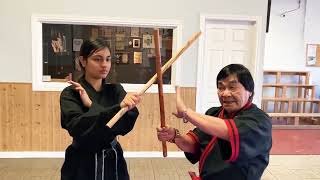
Basics Of Arnis | Cinco Terro Strike Blocks & Disarming. Arnis Stick / Kali/ Eskrima Training.
PG-2-GP Fitness
5 Stick Strikes & Counters In Martial Arts | Kali | Stick Defense| Arnis | Eskrima | PG-2-GP fitness
PG-2-GP Fitness