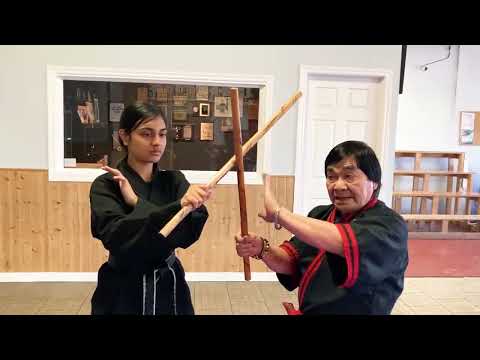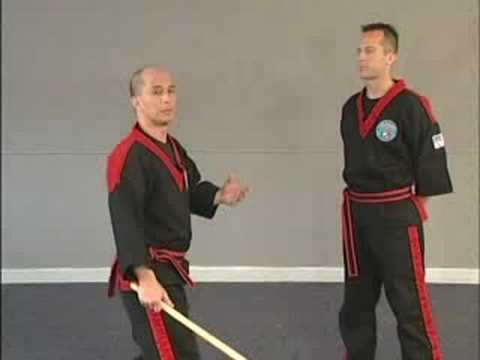
Bruce Chiu Teaching the 12 Basic Strikes of Modern Arnis
0
Angle Two Strike·Black and Blue Video
This is from his New Instructional DVD series Bruce Chiu Teaching the 12 Basic Strikes of Modern Arnis. This video was v…
Translation: angle two strike
The Angle Two Strike is a backhand diagonal downward strike targeting the opponent's right temple (from the attacker's perspective), travelling from the attacker's left shoulder to the opponent's right temple or collarbone area. [1] Angle Two is the mirror image of Angle One, using the backhand trajectory, and together they form the fundamental X-pattern that defines the basic offensive framework of Filipino martial arts. [1],[2] The backhand diagonal requires more training than the forehand because it travels against the dominant hand's natural mechanics, but it is equally important for developing the bilateral striking ability that Filipino martial arts demand. [2],[3]
Angle Two is the second fundamental strike in Filipino martial arts, paired with Angle One as the two diagonal strikes that form the basic X-pattern of attack. [1] Developing equal power and speed on both the forehand and backhand diagonals is a primary training objective in all Filipino martial arts systems. [2],[3]
Angle Two (backhand diagonal downward strike to the right temple) is the natural complement to Angle One, attacking from the opposite diagonal. [1] It is mechanically slightly weaker than Angle One for right-handed strikers but essential for creating continuous striking patterns (the 'heaven six' combination of Angles 1-2 in alternation). [2]
Angle two (backhand strike to the temple) is defined across most FMA systems as the second of the numbered angles of attack. [1]
Angle two strikes are used in WEKAF single-stick and double-stick competition. [1]
No images yet for this technique.
Sign in to suggest an image.
This is from his New Instructional DVD series Bruce Chiu Teaching the 12 Basic Strikes of Modern Arnis. This video was v…
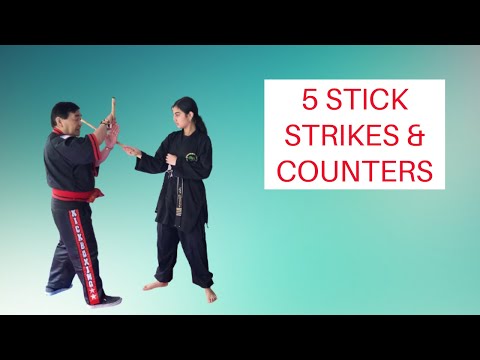
Basics of Arnis Training\ Arnis Stick Fighting | Arnis Advance Strikes | PG-2-GP Fitness Master Rubin Teaches How To Bl…
Hello Friends, In this video Master Rubin,s demonstrate 5 stick or arnis strikes and counter attacks. Here we discus…
The Angle Two Strike, known as the second angle in the classical cinco terro (five strikes) system of Filipino martial arts, targets an upward or mid-line trajectory and is fundamental to both offensive and defensive training in Arnis, Eskrima, and Kali. According to PG-2-GP Fitness instructors, Angle Two involves a high-line attack where the defender blocks with the stick held upward, allowing the hand to naturally catch and control the incoming weapon. The blocking hand makes contact on the stick and immediately begins a disarming sequence: the defender slides the stick downward, applies pressure, and executes a counter-strike before dropping and removing the opponent's weapon. PG-2-GP Fitness emphasizes that this angle requires the stick to remain engaged with the opponent's weapon throughout the technique, with the blocking hand maintaining constant contact to facilitate both the disarm and the follow-up strike. Bruce Chiu's Modern Arnis framework, while presenting the 12 basic strike system, provides foundational context that angles such as number two (backhand strike to the head) establish the directional patterns that practitioners defend against. Both instructors stress the importance of footwork coordination, hand positioning, timing development, and practicing the technique on both sides of the body to build competency and speed.
Synthesized from 3 instructors
No instructional courses yet for this technique.
Sign in to suggest a course.
Risk of injury to the person this technique is applied to
Arnis/Escrima/Kali stick and blade techniques; designed for close-range lethality
Skill level needed to execute this technique reliably
Whether this technique is allowed under major competition rule sets
The Filipino Martial Arts (Dan Inosanto, 1980)
Alias sources — [1] Filipino Martial Arts (Wiley, 1994) [2] Filipino Martial Arts (Wiley, 1994) [3] Filipino Martial Arts (Wiley, 1994)
Effectiveness sources — [1] Wiley, M., Filipino Martial Arts (Charles E. Tuttle, 1994) [2] Inosanto, D., The Filipino Martial Arts (Know Now Publishing, 1980)
Established Japanese martial arts naming convention — native Japanese term (和語/漢語)
Alias sources — [1] Filipino Martial Arts (Wiley, 1994) [2] Filipino Martial Arts (Wiley, 1994) [3] Filipino Martial Arts (Wiley, 1994)
Effectiveness sources — [1] Wiley, M., Filipino Martial Arts (Charles E. Tuttle, 1994) [2] Inosanto, D., The Filipino Martial Arts (Know Now Publishing, 1980)
wrist speed, hand coordination (especially double stick), cardiovascular endurance
quick hands, conditioned forearms, coordination
forearms, wrists, shoulders, core rotators
After blocking, keep your hand in contact with the opponent's stick and use your free hand to grab it, then pull it away. PG-2-GP Fitness emphasizes that your hand must be touching the stick during the block so you can immediately control and disarm it in one fluid motion.
Follow the disarm with a counter-attack strike. PG-2-GP Fitness teaches that disarming and counter-attack are combined techniques—once you've secured the stick, you immediately strike back at your opponent.
Bruce Chiu teaches using laid-out sticks as guides to ensure proper foot positioning—don't leave your foot behind, trail it, or cross your feet. Step at the correct angle both offensively and defensively to maintain your ability to block, check, counter, and hit effectively.
Yes, Bruce Chiu emphasizes that you should always train with your left hand as well as your right hand to develop balanced proficiency.
The Angle Two Strike is a backhand diagonal downward strike targeting the opponent's right temple (from the attacker's perspective), travelling from the attacker's left shoulder to the opponent's right temple or collarbone area. Angle Two is the mirror image of Angle One, using the backhand trajectory, and together they form the fundamental X-pattern that defines the basic offensive framework of Filipino martial arts.
Angle Two is the second fundamental strike in Filipino martial arts, paired with Angle One as the two diagonal strikes that form the basic X-pattern of attack. Developing equal power and speed on both the forehand and backhand diagonals is a primary training objective in all Filipino martial arts systems.
WEKAF: legal — Legal in padded stick competition; HEMA: legal — Legal in applicable weapon categories
Danger rating 8/10. Very High — Arnis/Escrima/Kali stick and blade techniques; designed for close-range lethality
The standard setup chain: Ready Position → Distance Control → Execute Technique → Return to Guard.
Standard counters include: Guard Position — return to a defensive ready stance / Distance Management — control the measure to avoid being in range / Counter-Attack — strike during the opponent's recovery or between movements.
Common variants: Angle 1 (forehand diagonal) (downward diagonal strike from the dominant side); Angle 2 (backhand diagonal) (downward diagonal strike from the off side); Angle 5 (thrust) (straight thrust with the tip of the stick); Redonda (continuous) (flowing circular strikes chaining multiple angles).
Angle two strikes are used in WEKAF single-stick and double-stick competition.
Top errors to watch for: Generating less power on the backhand than the forehand — train both sides equally for balanced striking / Using only the wrist for angle two — the backhand requires hip rotation just like the forehand / Not protecting the exposed side during the backhand — the backhand opens the right side; the live hand must cover / Pausing between angle one and angle two — the combination should flow continuously without hesitation.
The Angle Two Strike is also known as Dai-ni Kakudo Uchi, Angle #2, Backhand Diagonal, Numero Dos.