Introduction to the Five Angles
This instructional segment introduces the foundational five angles of stick striking in Eskrima/Arnis. The instructor establishes the basic framework that will be progressively refined through blocking, disarming, and counter-attack techniques.
Angle One: Blocking and Disarming Fundamentals
Angle One establishes the basic blocking position where the defender's hand contacts the attacking stick. From this contact point, the defender executes a two-count disarm sequence: the initial block transitions into a grip control, followed by stick removal and immediate counter-strike.
Angle Two: High Guard Catch and Counter
In Angle Two, the defender catches the incoming strike with an elevated hand position while the stick remains in contact. The counter-attack sequence follows: block, catch, strike, remove the stick, and deliver a second offensive strike.
Angle Three: Elbow Target and Sequential Striking
Angle Three incorporates targeting the opponent's elbow as a secondary strike point. The fundamental blocking and disarming mechanics remain consistent with previous angles, with the addition of this intermediate striking opportunity before final stick removal.
Angle Four: Low Guard Disarm with Knee Strike
Angle Four features a lower guard position where the defender catches incoming attacks and executes a knee-level counter-strike before disarming. This angle demonstrates how directional variation of the counter-attack integrates with the core disarming sequence.
Angle Five: The Foundational Drill
Angle Five is presented as the fundamental baseline technique. The progression requires the defender to catch, strike, drop the stick, and deliver a final counter-strike. This angle forms the essential base pattern upon which practitioners develop combinations.
Developing Core Competencies
Successful execution of these five angles requires systematic development of footwork, hand positioning, timing, and situational awareness. Practitioners must maintain consistent stick contact throughout defensive movements and coordinate lower body positioning with upper body technique.
Progressive Combination Training
Practitioners should begin with isolated single angles before progressing to combinations of angles one, two, and five. Training emphasizes that offensive positioning can be initiated from any angle without telegraphing, allowing adaptive responses to variable attack patterns.
Essential Training Methodology
Consistent practice with proper stick length and controlled repetition develops speed, confidence, footwork discipline, and precise timing. The structured five-angle framework provides the foundation upon which students build advanced Eskrima/Arnis capability.
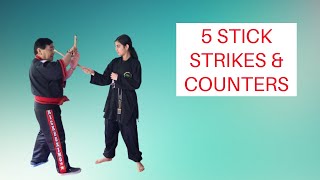
5 Stick Strikes & Counters In Martial Arts | Kali | Stick Defense| Arnis | Eskrima | PG-2-GP fitness
Key Takeaways
- •Introduction to the Five Angles
- •Angle One: Blocking and Disarming Fundamentals
- •Angle Two: High Guard Catch and Counter
- •Angle Three: Elbow Target and Sequential Striking
Hello Friends, In this video Master Rubin,s demonstrate 5 stick or arnis strikes and counter attacks. Here we discuss the most common 5 strikes taught in a majority of FMA systems. We also show the various counters you can do within each angle of attack. Counters can vary on short, medium or long range. How To Learn Arnis Training? Arnis Stick Fighting | Arnis Advance Strikes | PG-2-GP Fitness Master Rubin Teaches How To Block Arnis Basic Strikes And Disarm Opponents. Defending Strikes and Disarming .Martial arts training will protect you. Arnis also includes hand-to-hand combat, joint locks, grappling techniques .Arnis, also known as Kali or Eskrima/Escrima, is the national martial art of the Philippines. Advance Arnis Tutorial you can protect you from your opponent. Karate training you can learn arnis. 5 Stick Strikes & Counters In Martial Arts | Kali | Stick Defense| Arnis | Eskrima | PG-2-GP fitness #stickfight #arnis #escrima
Related Techniques
Frequently Asked Questions
What does this video teach about angle five strike?
This video covers introduction to the five angles, angle one: blocking and disarming fundamentals, angle two: high guard catch and counter. It provides detailed instruction from PG-2-GP Fitness.
How long does it take to learn angle five strike?
The basic mechanics can be understood in a single session, but developing reliable execution requires consistent drilling over weeks of practice. This 9-part breakdown helps structure your training by isolating each phase of the technique.
What are the key details for finishing angle five strike?
Practitioners should begin with isolated single angles before progressing to combinations of angles one, two, and five. Training emphasizes that offensive positioning can be initiated from any angle without telegraphing, allowing adaptive responses to variable attack patterns.
Related videos
The First 5 Strikes You Need to Know in Filipino Martial Arts | Anastacio Kali
Mark Anastacio
Basics Of Arnis | Cinco Terro Strike Blocks & Disarming. Arnis Stick / Kali/ Eskrima Training.
PG-2-GP Fitness
Bruce Chiu Teaching the 12 Basic Strikes of Modern Arnis
Black and Blue Video
Basics Of Arnis | Cinco Terro Strike Blocks & Disarming. Arnis Stick / Kali/ Eskrima Training.
PG-2-GP Fitness
5 Stick Strikes & Counters In Martial Arts | Kali | Stick Defense| Arnis | Eskrima | PG-2-GP fitness
PG-2-GP Fitness