The First 5 Strikes You Need to Know in Filipino Martial Arts | Anastacio Kali
0
Angle Five Strike·Mark Anastacio
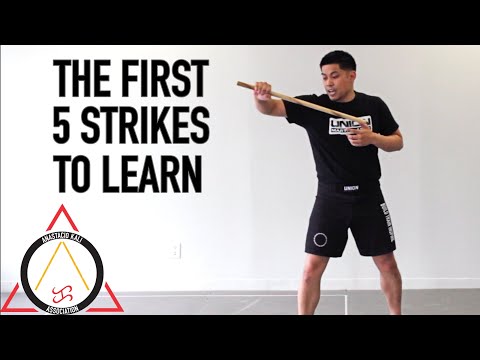
TRAIN AT MY GYM: Union Martial Arts Academy - NW Calgary 102 - 345 Sage Valley Common NW Calgary, AB T3R 1T8 — CONNECT W…
Translation: angle five strike
The Angle Five Strike is a straight thrust (estocada) directed at the opponent's centreline — typically the solar plexus, throat, or face — delivered by driving the tip of the stick or blade straight forward. [1] Angle Five is fundamentally different from Angles One through Four because it is a linear thrust rather than an angular cut, targeting the centreline with a piercing rather than striking motion. [1],[2] In blade application, the Angle Five thrust is the most lethal single attack, as a direct thrust to the torso penetrates deeper and causes more damage than a cut. [2],[3]
Angle Five completes the five universal angles of attack in Filipino martial arts, adding the thrust to the four cutting angles. [1] The centreline thrust has been a primary weapon technique across all fighting traditions worldwide, and its inclusion as the fifth angle reflects its critical importance in Filipino weapon combat. [2],[3]
Angle Five (straight thrust to the solar plexus or abdomen) is the primary thrusting attack in FMA, targeting the body's centre line. [1] With a blade, it is the fastest and most direct attack because it travels the shortest distance to the target. In stick application, it targets the solar plexus with a punyo (butt) or tip thrust. [2]
Angle five (thrust to the solar plexus or face) is defined in most FMA systems as a direct thrusting attack along the centre line. [1]
Angle five (thrust) strikes are used in FMA competition, particularly effective for breaking the opponent's rhythm. [1]
No images yet for this technique.
Sign in to suggest an image.
TRAIN AT MY GYM: Union Martial Arts Academy - NW Calgary 102 - 345 Sage Valley Common NW Calgary, AB T3R 1T8 — CONNECT W…
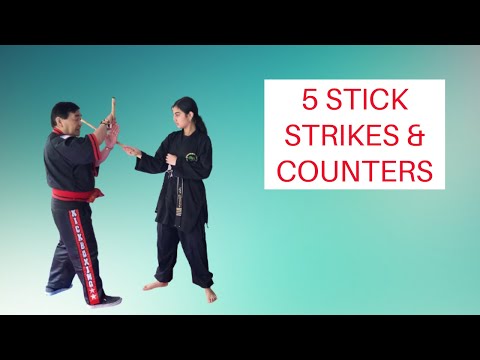
Hello Friends, In this video Master Rubin,s demonstrate 5 stick or arnis strikes and counter attacks. Here we discus…
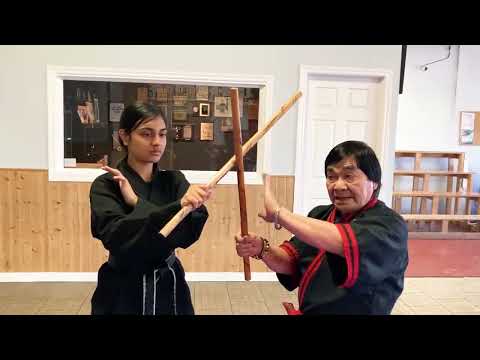
Basics of Arnis Training\ Arnis Stick Fighting | Arnis Advance Strikes | PG-2-GP Fitness Master Rubin Teaches How To Bl…
Angle Five Strike, also called the reverse strike or reverse angle, is a fundamental upward diagonal slash in Filipino martial arts single-stick training. Instructors PG-2-GP Fitness and Mark Anastacio agree on its basic mechanics: the strike travels from bottom-right to top-left, opposite to Angle One's trajectory. PG-2-GP Fitness emphasizes Angle Five as part of the foundational five-angle blocking and disarming sequence, teaching it alongside counter-attack applications where the defender blocks the incoming strike, simultaneously grabs the opponent's stick, and executes Angle Five as a follow-up strike before removing the weapon. Anastacio provides additional tactical context, noting that Angle Five is difficult for opponents to see due to the lower load on the initial setup, making it effective as a deceptive follow-up or closing strike. He highlights its versatility: practitioners can apply it traditionally as a linear slash, modify it into a wintick (circular, compressive variant targeting the hands at close range), or use it to shift into defensive positions like the umbrella block. Both instructors stress that Angle Five, combined with footwork and timing development, forms part of the essential striking vocabulary for Filipino martial arts practitioners, with Anastacio recommending it as one of the first five strikes students should master.
Synthesized from 3 instructors
No instructional courses yet for this technique.
Sign in to suggest a course.
Risk of injury to the person this technique is applied to
Arnis/Escrima/Kali stick and blade techniques; designed for close-range lethality
Skill level needed to execute this technique reliably
Whether this technique is allowed under major competition rule sets
The Filipino Martial Arts (Dan Inosanto, 1980)
Alias sources — [1] Filipino Martial Arts (Wiley, 1994) [2] Filipino Martial Arts (Wiley, 1994) [3] Filipino Martial Arts (Wiley, 1994)
Effectiveness sources — [1] Wiley, M., Filipino Martial Arts (Charles E. Tuttle, 1994) [2] Inosanto, D., The Filipino Martial Arts (Know Now Publishing, 1980)
Established Japanese martial arts naming convention — native Japanese term (和語/漢語)
Alias sources — [1] Filipino Martial Arts (Wiley, 1994) [2] Filipino Martial Arts (Wiley, 1994) [3] Filipino Martial Arts (Wiley, 1994)
Effectiveness sources — [1] Wiley, M., Filipino Martial Arts (Charles E. Tuttle, 1994) [2] Inosanto, D., The Filipino Martial Arts (Know Now Publishing, 1980)
wrist speed, hand coordination (especially double stick), cardiovascular endurance
quick hands, conditioned forearms, coordination
forearms, wrists, shoulders, core rotators
After blocking the incoming strike, keep your hand in contact with their stick and use the momentum to push it down while simultaneously grabbing it to remove it from their control. According to PG-2-GP Fitness, the key is maintaining hand contact on the stick during the block, which allows you to transition directly into the disarm.
The basic combination is strikes one, two, and five—involving blocking, disarming, and counter-attacking in sequence. PG-2-GP Fitness emphasizes that this one-two-five combination is foundational, and from there you can develop your own variations using the footwork and hand positioning you've already learned.
Yes, mixing angles is very important in Filipino martial arts. Mark Anastacio explains that changing angles—such as combining angle strikes with thrusts or different slash directions—allows you to vary the range and keeps your opponent guessing, making your combinations more effective.
The Angle Five Strike is a straight thrust (estocada) directed at the opponent's centreline — typically the solar plexus, throat, or face — delivered by driving the tip of the stick or blade straight forward. Angle Five is fundamentally different from Angles One through Four because it is a linear thrust rather than an angular cut, targeting the centreline with a piercing rather than striking motion.
Angle Five completes the five universal angles of attack in Filipino martial arts, adding the thrust to the four cutting angles. The centreline thrust has been a primary weapon technique across all fighting traditions worldwide, and its inclusion as the fifth angle reflects its critical importance in Filipino weapon combat.
WEKAF: legal — Legal in padded stick competition; HEMA: legal — Legal in applicable weapon categories
Danger rating 8/10. Very High — Arnis/Escrima/Kali stick and blade techniques; designed for close-range lethality
The standard setup chain: Grip and Stance → Chamber → Strike → Recovery.
Standard counters include: Parry (Absetzen) — deflect the incoming blade with a counter-displacement / Void (Step Back) — withdraw from measure to avoid the cutting arc / Counter-Cut (Nachreisen) — strike into the opponent's opening during their attack.
Common variants: Angle 1 (forehand diagonal) (downward diagonal strike from the dominant side); Angle 2 (backhand diagonal) (downward diagonal strike from the off side); Angle 5 (thrust) (straight thrust with the tip of the stick); Redonda (continuous) (flowing circular strikes chaining multiple angles).
Angle five (thrust) strikes are used in FMA competition, particularly effective for breaking the opponent's rhythm.
Top errors to watch for: Pushing rather than thrusting — the thrust should be a sharp, snapping extension, not a slow push / Over-extending on the thrust — the body should remain balanced; over-extension creates vulnerability to counter-attacks / Not retracting immediately after the thrust — the stick must return quickly; a committed thrust that stays extended i… / Telegraphing with the shoulder — the thrust should initiate from the arm without a visible shoulder wind-up.
The Angle Five Strike is also known as Dai-go Kakudo Uchi, Angle #5, Centre Thrust, Numero Sinko.