Initial Pressure and Space Creation
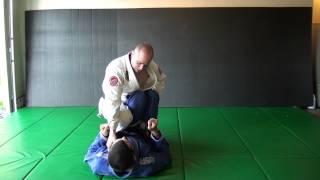
The instructor begins by applying downward pressure to create separation and opening in the opponent's guard. This directional push clears sufficient space to allow the passer's body to establish position on the inside of the guard.
Forward Advance and Grip Establishment
The passer advances forward into the cleared space and secures an underhook grip with the left hand. This grip provides control and prevents the opponent from re-establishing guard closure.
Tripod Positioning
From the underhook position, the passer elevates into a tripod stance using their feet and the left-hand connection. This stance provides stability and bases the passer against the opponent's defensive reactions.
Hook Defense and Elevation Management
As the opponent elevates their hips and attempts a hook with their leg, the passer maintains the underhook connection to control the movement. The tripod base allows the passer to ride out the hook without losing positional advantage.
Pummeling Option
If the opponent's hook remains sticky and prevents the pass, the passer can transition to a pummeling sequence by driving the underhook deeper. This move establishes an inside position while neutralizing the hook threat.
Inside Position Control
Regardless of whether the pass succeeds immediately or requires pummeling, the passer secures a dominant inside position. This position becomes the foundation for transitioning to higher control points.
Progression to Mount Finish
From the inside position, the passer locks up higher control points and works toward establishing mount position. This final progression completes the half-butterfly pass and establishes full positional dominance.
1/2 Butterfly Pass - Add this to your game!
Key Takeaways
- •Initial Pressure and Space Creation
- •Forward Advance and Grip Establishment
- •Tripod Positioning
- •Hook Defense and Elevation Management
Thanks for watching 😊 Want to support this channel? Check out my BJJ Fanatics instructionals, where we go deep into the systems, principles and techniques you see in these videos. https://bjjfanatics.com/products/pressure-drop-dynamic-guard-passing-standing-vs-supine-by-brian-glick?_ab=0&_fd=0&_sc=1 https://bjjfanatics.com/products/only-way-out-dynamic-pin-escapes-by-brian-glick https://bjjfanatics.com/products/only-way-out-front-headlock-and-turtle-escapes-by-brian-glick . . . . . . . . . . . . WHO AM I? ⭐ ➡️ MY BIO BY JOHN DANAHER - https://bit.ly/3gUMU5R . . . . . . . . . . . . . FIND ME: 🚨 INSTAGRAM: http://www.instagram.com/bzglick 🚨 FACEBOOK: http://www.facebook.com/bzglick 👊 ALL MY INSTRUCTIONAL VIDEOS: https://bjjfanatics.com/collections/all/fighter_BRIAN-GLICK .
Frequently Asked Questions
What does this video teach about butterfly pass?
This video covers initial pressure and space creation, forward advance and grip establishment, tripod positioning. It provides detailed instruction from Brian Glick.
How long does it take to learn butterfly pass?
The basic mechanics can be understood in a single session, but developing reliable execution requires consistent drilling over weeks of practice. This 7-part breakdown helps structure your training by isolating each phase of the technique.
What are the key details for finishing butterfly pass?
Regardless of whether the pass succeeds immediately or requires pummeling, the passer secures a dominant inside position. This position becomes the foundation for transitioning to higher control points.
Related videos
Butterfly Guard Guide In Gi & Nogi | BJJ Fundamentals
Jordan Teaches Jiujitsu
What's The Best Way to Pass Butterfly Guard in BJJ ?
Chewjitsu
Passing Butterfly Guard: THREE (3) Guard Passes from the Knees (No Gi BJJ)
Brian Glick
A BJJ Butterfly Guard Pass So Smooth But Surprisingly Simple
Chewjitsu
BJJ Vault - Butterfly Pass & Omoplata Techniques
BJJ Vault