Introduction to Parry in Tierce
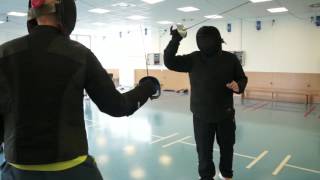
The parry in tierce is a fundamental defensive technique used to deflect incoming thrusts directed at the upper-right target area. This lesson focuses on the mechanics of executing a proper tierce parry and its application against direct thrust attacks. Mastering this parry provides the foundation for safe, controlled fencing practice.
Guard Position and Starting Stance
The fencer begins in a stable en garde position with the sword hand at chest height and the blade angled upward at approximately 45 degrees. The feet remain shoulder-width apart with the rear heel slightly raised, allowing for quick lateral movement. The off-hand is held defensively at waist level to maintain balance.
Blade Alignment for Tierce
In the tierce position, the sword hand is held at mid-torso height with the blade forming a diagonal line from lower-left to upper-right. The forte of the blade is kept strong and forward, ready to receive contact from an opponent's attack. The weapon hand's palm orientation naturally positions the blade to intercept attacks at the upper-right quadrant.
Executing the Parrying Action
The parry is executed through a controlled rotation of the forearm rather than an expansive arm movement. The fencer pivots the blade to meet the incoming thrust on the forte, using minimal hand displacement to maintain efficiency. The movement originates from the wrist and forearm, keeping the upper arm relatively stationary for better control.
Contact and Deflection Mechanics
Upon meeting the opponent's blade, the fencer applies gentle pressure to deflect the thrust safely away from the target area. The angle of deflection directs the incoming attack toward the off-side, removing the immediate threat. Proper blade contact prevents the opponent's weapon from sliding or binding, maintaining clear separation.
Recovery and Counterattack Readiness
After executing the parry, the fencer immediately returns the blade to a threatening position to prepare for a riposte. The body maintains its balanced stance, allowing for quick directional changes or distance adjustments. This rapid recovery is essential for competitive fencing, where the parrying action must seamlessly transition into an offensive response.
Hope Lesson Three: Parry in Tierce vs. Thrust
Key Takeaways
- •Introduction to Parry in Tierce
- •Guard Position and Starting Stance
- •Blade Alignment for Tierce
- •Executing the Parrying Action
Frequently Asked Questions
What does this video teach about parry of tierce?
This video covers introduction to parry in tierce, guard position and starting stance, blade alignment for tierce. It provides detailed instruction from Keith Myers.
How long does it take to learn parry of tierce?
The basic mechanics can be understood in a single session, but developing reliable execution requires consistent drilling over weeks of practice. This 6-part breakdown helps structure your training by isolating each phase of the technique.
What are the key details for finishing parry of tierce?
Upon meeting the opponent's blade, the fencer applies gentle pressure to deflect the thrust safely away from the target area. The angle of deflection directs the incoming attack toward the off-side, removing the immediate threat. Proper blade contact prevents the opponent's weapon from sliding or binding, maintaining clear separation.
Related videos
Parry seconde tierce reposted all
Beth Speedy
Hope Lesson Three: Parry in Tierce vs. Cut
Keith Myers
06 reposting tierce thrust Thrusting sabre livesteam 20 05 2020
The Old Sword Club
04 parries of tierce - Sabre fencing review lesson 03 06 2020
The Old Sword Club
Sabre parry tierce feint riposte head flank
Beth Speedy