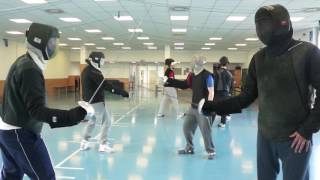
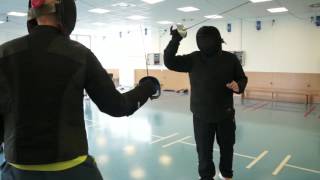
Introduction to Tierce Parry
The parry of tierce is the third-hand position in French foil numbering. The instructor demonstrates the fundamental grip and hand position required to execute this essential defensive technique in sabre fencing.
Hand Position and Blade Angle
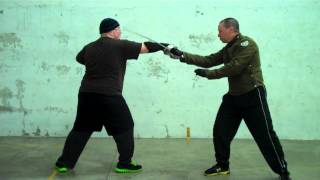
The practitioner turns the hand over to match the position used in cut number two, with the wrist kinked slightly and the pinky finger pulled toward the wrist base. The blade is held at approximately 45 degrees to create a deflection plane that guides the opponent's sword downward and away from the body.
Controlling Opponent's Trajectory
The 45-degree blade angle serves a dual purpose: it prevents the opponent from cutting over the parry while creating a surface for their blade to slide down and become trapped. This positioning gives the defender control for immediate ripostes or forces the opponent to commit additional actions to attack.
Tierce Parry Execution and Tip Positioning
The tierce parry is executed by raising the tip and turning the hand over, positioning the hand on one side of the body and the tip on the other. The key distinction between a tierce parry and a tierce guard lies in the height of the blade tip.
Low Tierce Variation
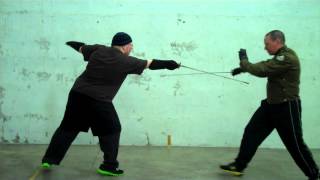
The low tierce parry is performed by opening the elbow with a straight arm, delivering a direct downward strike against the opponent's blade. This technique is particularly effective against refined low cuts where the opponent drops their sword after the initial attack.
High Tierce Variation
The high tierce parry requires raising the arm from the shoulder with minimal elbow bend, punching straight upward to intercept high cuts. The movement is generated from the shoulder joint rather than the elbow to maintain proper mechanics and control.
Shoulder Recovery and Conditioning
Practitioners should periodically shake out and loosen the shoulders between repetitions to prevent fatigue and tension. Windmilling motions and shoulder rotations help maintain mobility and prepare the body for continued practice.
Tierce Parry Combinations Drill
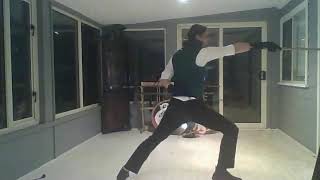
Practitioners execute rapid transitions between standard, high, and low tierce parries in response to instructor callouts, returning to guard position between each variation. This drill develops muscle memory and the ability to fluidly shift between tierce positions during live fencing.
04 parries of tierce - Sabre fencing review lesson 03 06 2020
Key Takeaways
- •Introduction to Tierce Parry
- •Hand Position and Blade Angle
- •Controlling Opponent's Trajectory
- •Tierce Parry Execution and Tip Positioning
how to form the parries of tierce. This lesson is part of a series teaching how to fence in the method common in late 19th century Britain. Techniques are derived from the works of Alfred Hutton, R.G Allinson-Winn, John Musgrave-Waite and Henry Angelo III. If you want more livestream lessons check out our facebook page at https://www.facebook.com/theoldswordclub And if you want to support us financially consider buying an online course at https://www.theoldswordclub.com/courses/
Frequently Asked Questions
What does this video teach about parry of tierce?
This video covers introduction to tierce parry, hand position and blade angle, controlling opponent's trajectory. It provides detailed instruction from The Old Sword Club.
How long does it take to learn parry of tierce?
The basic mechanics can be understood in a single session, but developing reliable execution requires consistent drilling over weeks of practice. This 8-part breakdown helps structure your training by isolating each phase of the technique.
What are the key details for finishing parry of tierce?
Practitioners should periodically shake out and loosen the shoulders between repetitions to prevent fatigue and tension. Windmilling motions and shoulder rotations help maintain mobility and prepare the body for continued practice.