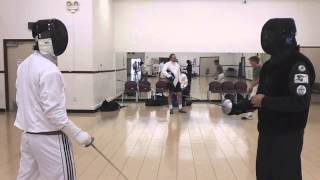
Course Overview
This lesson builds upon foundational on-guard position, footwork, thrust, and stop-thrust techniques from previous sessions. Instruction introduces the parry of quarte as a defensive technique covering the upper-right target area, combined with intermediate footwork modifications. Participants must complete a full warm-up before proceeding with training.
On-Guard Position Fundamentals
The on-guard stance begins with an L-shaped alignment created by the front foot and back heel, positioned approximately shoulder-width apart. Both knees bend equally to approximately 45 degrees, maintaining mobility and stability. The sword arm extends outside the front foot line with the thumb positioned at 12 o'clock, while the back arm remains relaxed but controlled to prevent excessive shoulder movement.
Intermediate Stance Modifications
The intermediate progression requires lifting the back heel off the floor while sinking the back hip deeper into the stance. This modification increases mobility and creates additional power storage in the calf and Achilles tendon during attacking movements. This elevated heel position should be maintained throughout all footwork and technique execution during the lesson.
Advanced Footwork Mechanics
Forward movement involves reaching with the front foot heel as the ball of the foot contacts the ground, then lifting and placing the back foot ball. Backward movement reverses this pattern: reaching with the back foot ball without the heel touching down, then bringing the front foot back in controlled succession. Effective footwork emphasizes reaching with the leading foot while pushing through the trailing leg's hip flexors and thigh muscles.
Fencing Strip Dimensions and Boundaries
The piste (playing area) measures 14 meters in length, bisected at the midway line. On-guard lines are positioned 2 meters from the midway mark on each side, with warning lines 3 meters further back. Retreating beyond the back boundary with both feet results in loss of point; understanding strip geography is essential for positional awareness during bouts.
Thrust Technique Execution
The thrust represents the most basic and shortest-range attacking movement, executed by pushing the thumb forward rather than engaging the shoulder. A slight knee bend during extension counteracts the tendency toward arm and leg straightening. Recovery utilizes a flat forearm position rather than a retracted karate-chop stance, maintaining control through smaller forearm and finger muscles.
Stop-Thrust as Counter-Attack
The stop-thrust functions as a counter-attacking thrust executed during the opponent's attacking time. Execution involves simultaneous arm extension and backward foot reach (1A and 1B occur together), immediately followed by front foot withdrawal (step 2). Precise timing ensures the fencer achieves full reach for only a split second before withdrawing to safety, combining offensive action with defensive positioning.
Learn to Fence: Lesson 3 - Intermediate Footwork & Parry Quarte Riposte
Key Takeaways
- •Course Overview
- •On-Guard Position Fundamentals
- •Intermediate Stance Modifications
- •Advanced Footwork Mechanics
Improve your footwork and learn how to execute a parry riposte to defend yourself against your opponent's attacks. This video also covers a thrust, stop hit and lunge - and provides three minutes of footwork drills so that you can react to different signals with the most appropriate technique.
Frequently Asked Questions
What does this video teach about parry of quarte?
This video covers course overview, on-guard position fundamentals, intermediate stance modifications. It provides detailed instruction from Paul Beasley.
How long does it take to learn parry of quarte?
The basic mechanics can be understood in a single session, but developing reliable execution requires consistent drilling over weeks of practice. This 7-part breakdown helps structure your training by isolating each phase of the technique.
What are the key details for finishing parry of quarte?
The thrust represents the most basic and shortest-range attacking movement, executed by pushing the thumb forward rather than engaging the shoulder. A slight knee bend during extension counteracts the tendency toward arm and leg straightening. Recovery utilizes a flat forearm position rather than a retracted karate-chop stance, maintaining control through smaller forearm and finger muscles.
![How to Think About Parry 4 | Fencing Tutorial [Bladework] (Foil, Epee)](https://img.youtube.com/vi/hQ8Tfj_6lIo/mqdefault.jpg)