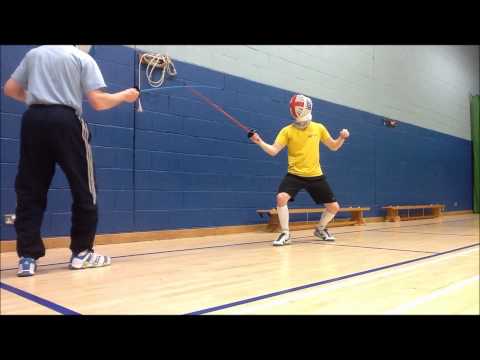
Learn to Fence: Lesson 3 - Intermediate Footwork & Parry Quarte Riposte
0
Parry of Quarte·Paul Beasley
Improve your footwork and learn how to execute a parry riposte to defend yourself against your opponent's attacks. This …
Translation: Quarte = fourth (French) — the fourth parry position in the French fencing system, defending the inside high line (the chest area on the sword-arm side)
The Parry of Quarte is the most fundamental defensive action in Western fencing, deflecting attacks directed to the inside high line — the area of the chest and torso on the sword-arm side — by moving the blade laterally to the inside with the hand in supination (palm facing upward). [1] Quarte is universally taught as the first parry a beginning fencer learns because it defends the most commonly attacked target: the chest, which is the largest scoring surface in foil and the most natural target for a right-handed attacker facing a right-handed defender. [1],[2] The mechanical execution is deceptively simple: from the en garde position, the fencer moves the blade approximately 4-6 inches to the inside (toward the torso), keeping the point slightly elevated and the hand in supination, using the forte (strong section) of their blade to deflect the incoming attack's foible (weak section). [1] This forte-to-foible contact is the key principle: by meeting the attacking blade's weakest section with the defending blade's strongest section, the parry requires minimal effort to redirect the attack off-target. [1],[2] The parry of quarte is followed immediately by a riposte — the return attack delivered after the successful parry — making quarte-riposte (parry four, then attack) the most practised two-move sequence in all of fencing. [1] Pollock, Grove, and Prevost wrote in 1902 that the quarte parry 'is the parry par excellence,' noting that it defends the widest target area, is the most natural defensive movement, and sets up the most direct riposte. [1] In competitive fencing, the quarte parry accounts for approximately 40-50% of all successful defensive actions in foil, making it by far the most commonly used parry at all levels from beginner to Olympic competition. [3]
The parry of quarte has been documented since the earliest systematic fencing treatises, with its formal codification occurring during the development of the French school of fencing in the 17th and 18th centuries. [1],[2] The French naming convention (prime, seconde, tierce, quarte, quinte, sixte, septime, octave) was established to standardise the eight parry positions, with quarte (fourth) designated as the inside high line defence. [2] Pollock, Grove, and Prevost (1902) noted that the development of systematic parrying took 'about two centuries and three-quarters' to refine from the chaotic defensive movements of medieval swordsmen into the precise, geometrical actions of modern fencing. [1] The Italian school used the equivalent term 'quarta' and developed the parry along similar lines but with different hand positions and footwork. [2] By the 19th century, the quarte parry had achieved its modern form: a small lateral blade displacement with the hand in supination, using forte-to-foible contact to redirect the attack. [1],[2] This technique has remained essentially unchanged for over 200 years, testifying to its biomechanical optimality. [1]
The parry of quarte is the most frequently used successful defensive action in competitive foil fencing, accounting for approximately 40-50% of all parries at all levels of competition. [3] Its effectiveness stems from three factors: (1) it defends the most commonly attacked line (inside high), (2) it uses the mechanically advantageous forte-to-foible contact, and (3) it sets up the most direct possible riposte (a straight thrust to the now-open line). [1] At the Olympic level, the quarte parry-riposte is the single most common two-move sequence in foil fencing. [3] The technique's universality across centuries and cultures demonstrates its fundamental soundness — any fencing system that develops a thrusting attack eventually develops a quarte-like parry to defend against it. [2]
The parry of quarte is the most commonly used successful defensive action in Olympic foil fencing. Every Olympic foil champion in history has relied on quarte as their primary parry. The quarte-riposte (parry four, riposte) is the most frequently scoring two-move sequence in competition foil fencing at all levels.
No images yet for this technique.
Sign in to suggest an image.
Improve your footwork and learn how to execute a parry riposte to defend yourself against your opponent's attacks. This …
FIE coaching course 2017
FIE coaching Course 2017
Hi All, Sorry for the huge delay in posting. We've been really busy working on a ton of projects, which we can't wait t…
Fencing - how to do parry 4 (aka quarte)
The parry of quarte is a fundamental defensive maneuver in fencing that protects the high-line quarter on the sword-arm side of the body. According to Paul Beasley, quarte represents one of four target quarters, with the parry executed as a lateral hand movement across the body rather than a reaching or pulling action. The technique begins from an on-guard position with the thumb at 12 o'clock, then the wrist rolls slightly so the thumb moves to approximately 11 o'clock—a semi-pronated position that provides superior control compared to a fully supinated position (thumb at 1 o'clock), which leaves exploitable gaps. Beasley emphasizes that the parry should end just over the opposite side of the body; insufficient distance creates space for renewed attacks, while excessive distance abandons defensive coverage elsewhere. The mechanical principle involves engaging the forte (bottom third of the blade) against the opponent's foible (top third), creating advantage through timing rather than strength. The parry is executed as a discrete one-two sequence with the riposte: first the defensive action, then immediately the offensive response, without blending the movements together. Beasley stresses maintaining proper distance and staying in place during the parry to ensure optimal riposte positioning, rather than stepping backward defensively. While S-Class, Beth Speedy, and other instructors appear in the provided transcripts, only Beasley's content contains substantive technical instruction on the parry of quarte itself.
Synthesized from 4 instructors
No instructional courses yet for this technique.
Sign in to suggest a course.
Risk of injury to the person this technique is applied to
The parry of quarte is a purely defensive blade action — it deflects the incoming attack and causes no injury to either fencer. In historical context with sharp weapons, the parry itself is defensive, but the riposte that follows can be lethal.
Skill level needed to execute this technique reliably
Whether this technique is allowed under major competition rule sets
Fencing (Pollock, Grove & Prevost, 1902)
description: [1] Pollock 1902 parry section, [2] Castle 1885 history
Standard katakana transliteration of Western martial arts terminology (外来語) — used in Japanese MMA, boxing, and BJJ communities
description: [1] Pollock 1902 parry section, [2] Castle 1885 history
Minimal physical requirements — the parry of quarte is accessible to all body types, ages, and fitness levels
good hand-eye coordination for timing the blade contact, wrist control for maintaining supination, finger sensitivity for feeling the blade contact (sentiment du fer)
Does NOT require strength, flexibility, or exceptional fitness
The technique can be learned in the first fencing lesson and refined over a lifetime
The parry of quarte protects the inside high line (the chest and inside of the torso) — the blade moves from outside to inside. One of the most fundamental fencing parries, used in foil and épée. (Fencing technique manuals; Biomechanics of Human Motion)
A stop hit (or stop thrust) is a counter-attack executed during your opponent's attack—you extend your arm as they advance and step back to create distance. A lunge, by contrast, is an attacking move where the arm extends first and you drive forward by pushing off the back foot. Paul Beasley emphasizes that reading your opponent's arm position and direction of travel helps you recognize which technique to use.
Push your thumb forward into space rather than using shoulder strength, which would turn it into a punch and reduce control. Dip your knees slightly as you thrust to maintain a stable position and counter the tendency to straighten your legs. Keep your forearm fairly flat during recovery instead of pulling back into what Paul Beasley calls a 'karate chop position.'
The Parry of Quarte is the most fundamental defensive action in Western fencing, deflecting attacks directed to the inside high line — the area of the chest and torso on the sword-arm side — by moving the blade laterally to the inside with the hand in supination (palm facing upward). Quarte is universally taught as the first parry a beginning fencer learns because it defends the most commonly attacked target: the chest, which is the largest scoring surface in foil and the most natural target for a right-handed attacker facing a right-handed defender.
The parry of quarte has been documented since the earliest systematic fencing treatises, with its formal codification occurring during the development of the French school of fencing in the 17th and 18th centuries. The French naming convention (prime, seconde, tierce, quarte, quinte, sixte, septime, octave) was established to standardise the eight parry positions, with quarte (fourth) designated as the inside high line defence.
Unified MMA: legal — Legal defensive technique; WBC/Boxing: legal — Legal — blocking and evasion are core boxing skills; WKF: legal — Legal — blocking is a fundamental karate skill; Kyokushin: legal — Legal; WT: legal — Legal; WAKO: legal — Legal; K: legal — 1/GLORY — Legal; IFMA: legal — Legal
Danger rating 1/10. The parry of quarte is a purely defensive blade action — it deflects the incoming attack and causes no injury to either fencer. In historical context with sharp weapons, the parry itself is defensive, but the riposte that follows can be lethal.
The standard setup chain: En garde → Opponent extends arm and lunges to the inside high line → Recognise the inside-line attack → Move the blade to the inside (quarte position): hand in supination, forte meets foible → Attacking blade is deflected past the body → IMMEDIATELY extend the arm for the riposte (direct riposte to the now-open line) → Riposte lands on the opponent's target → Score the touch → If the riposte is parried → Prepare for the counter-riposte exchange (parry-riposte chain).
Standard counters include: Disengage — passing the point under the quarte parry to attack the now-open outside line (the most common counter to … / One-two attack — feint to the inside (drawing quarte), then disengage to the outside / Coupé (cutover) — passing the point OVER the quarte blade instead of under it / Counter-disengage — if the defender takes circular quarte, making a full circle to return to the original inside line.
Common variants: Direct quarte (the standard lateral parry with no blade opposition); Opposition quarte (maintaining blade contact with the attacking blade throug…); Yielding quarte (ceding parry) (instead of meeting the attack with force, yielding with t…); Counter-quarte (circular quarte) (a circular blade motion that collects the opponent's blad…); Beat quarte (a sharp percussive parry that not only deflects but knock…); Quarte with displacement (combining the parry with a step backward or sideways for …).
The parry of quarte is the most commonly used successful defensive action in Olympic foil fencing. Every Olympic foil champion in history has relied on quarte as their primary parry.
Top errors to watch for: Parrying too wide — sweeping the blade too far to the inside (more than 6 inches) leaves the outside line completely … / Moving the hand instead of the blade — the hand should move minimally; the blade's angular displacement creates the d… / Pronating the hand — turning the palm downward changes the parry from quarte (inside) to tierce (outside), defending … / Dropping the point — allowing the blade tip to drop below horizontal during the parry makes the riposte slow and tele….
The Parry of Quarte is also known as Karuto Parī (from French: parade de quarte), Quarte, Parry 4, Fourth Parry, Parade de Quarte.
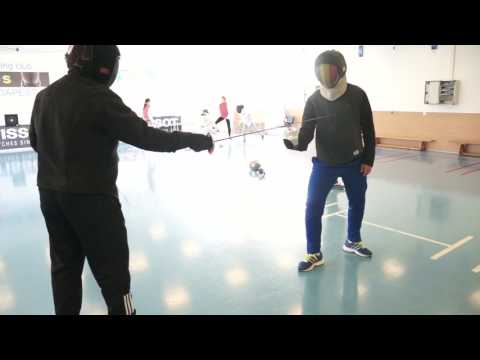
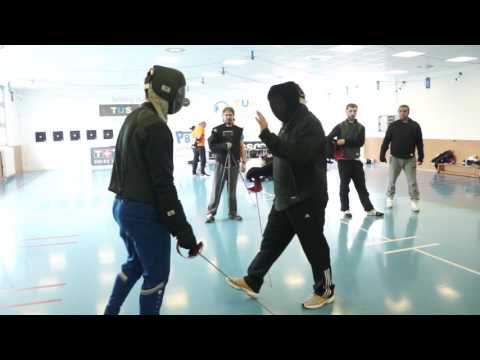
![How to Think About Parry 4 | Fencing Tutorial [Bladework] (Foil, Epee)](https://img.youtube.com/vi/hQ8Tfj_6lIo/hqdefault.jpg)