The Inside Defense Fundamentals
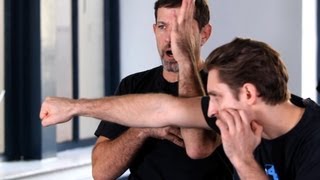
The inside defense begins with a straight punch directed at the body. The defender executes an inside defense by maintaining a vertical forearm position with the hand raised to protect the face. This positioning is critical to the technique's effectiveness and safety.
Common Beginner Error: The 360 Block Position
A frequent mistake among beginners is dropping the hand downward into a 360 block position. This error exposes the face and significantly reduces defensive coverage. The correct technique requires the forearm to remain vertical with the hand staying elevated.
Vertical Arm Position: Coverage and Face Protection
Maintaining a vertical forearm creates a continuous defensive plane that protects both the face and torso. With the hand positioned high, the defender can redirect punches at any level of the body while keeping facial vulnerability minimal. Dropping the hand compromises both defensive zones simultaneously.
Larger Blocking Surface and Margin of Error
The vertical arm position provides multiple contact points along the forearm to intercept incoming strikes at the head, chest, or lower torso. This extended surface area compensates for timing variations and punch trajectory changes. Conversely, a dropped hand narrows the effective blocking zone and increases the likelihood of technique failure.
Body Rotation: The Foundation of Inside Defense
Proper body rotation is essential to reduce reliance on arm defense alone. By blading the torso correctly, the defender allows incoming punches to pass harmlessly past the body. Without adequate rotation, the defender must compensate with excessive arm movement, leading to poor form and dropped hands.
Palm Orientation and Range of Motion
Rotating the palm inward increases the defender's range of motion while maintaining the vertical arm position. When the palm faces outward, restricted mobility forces the hand downward to compensate. This palm inversion also provides protection against edge weapon attacks by shielding the vulnerable inner wrist from potential lacerations.
Adjusting for Lower Target Attacks
When an attacker targets the lower abdomen or groin, the defender can adjust shoulder height while maintaining arm verticality. Additionally, bending the knees and lowering the body level allows the defender to intercept low strikes without dropping the hand. These adjustments preserve the fundamental structure of the inside defense.
Technical Summary and Key Principles
The inside defense requires maintaining a vertical forearm, adequate body rotation, inward palm orientation, and postural adjustment when necessary. These elements work synergistically to maximize coverage, protect the face, and maintain a margin of error. Avoiding the 360 block position ensures the defender remains protected throughout the entire encounter.
Krav Maga - Inside Defense Low (Correct Arm Position)
Key Takeaways
- •The Inside Defense Fundamentals
- •Common Beginner Error: The 360 Block Position
- •Vertical Arm Position: Coverage and Face Protection
- •Larger Blocking Surface and Margin of Error
The most common mistake beginners make while performing the Inside Defense Low is dropping their hand two low (similar to a 360 Degree Defense position). This videos explains the correct arm position for this defense in order to avoid this mistake. Also, it shows several fine details in hand and body positioning that helps you perform it consistently correct. In addition, it explains multiple tactical reasons why the correct arm position is vital for this particular defense. Additional videos and information about our self defense, fighting, and fitness programs are available at http://www.kravmagatraining.com/ The videos on this YouTube channel are NOT a replacement for actual instruction. They do not teach techniques, but instead isolate and fix problems within the technique or its individual components. The videos are designed to help the student who has already learned the technique under the instruction of a qualified instructor. Important Note: These videos are specific to the techniques and curriculum taught to the students at our facility. Students from other Krav Maga schools and organizations are more than welcome to watch and use these videos and we hope they find them useful! However, variations may be taught that are different from the techniques taught at other Krav Maga locations. This doesn't mean one variation is wrong or the other is right. They are just variations...plain and simple. The most important question for any technique or defense should be this: Does it work for the individual who is performing it? As long as it does, then the technique or variation has merit, regardless of where it comes from! That's the number one principle that we emphasize at our school. Transcript: "Hello, this is Randall and Glenda with KravMagaTraining.com. This video we're going to discuss the proper arm positioning on the inside defense low. So when Glenda throws the straight punch to the body and I do the inside defense low, this is a common beginner mistake is dropping their hand down like they're doing a 360 block. What it should be is like this. Notice how my forearm is vertical. My hand stays up to protect my face. This is really important for several reasons. One is, when she throws that punch at me, and I start dropping my hand down like this, it's starting to leave my face open. Which is obviously unacceptable. Instead, when I do the inside defense and I keep my arm vertical in case I need to protect my face, notice that my hand is still up. Also, the reason why keeping your arm vertical is important is because it allows you to defend not a specific point on your torso but your entire torso. So if Glenda throws a punch, could you punch with your right hand, she punches at my chest, I'll end up blocking with the middle part of my forearm or maybe up closer by my wrist. She punches a little bit lower, that's okay. If she punches me real low, I catch it more with the elbow area. So by having my arm in this position it gives you a much larger blocking surface and a larger margin of error. As soon as you start dropping your hand down, notice that the distance of this is starting to shrink. And once I start getting too low now I'm really leaving myself open. Whether it's protecting my face or maybe I was just a little off and she's punching me in the chest. Now one of the reasons, a couple of reasons why people, beginners, do this wrong is because, one is they don't rotate their body far enough. So when she throws the punch and I just rely on my hand defense that's why people start dropping their hand down. Now, if you remember to twist your torso like you were taught and allow your body to rotate you don't have to rely on your arm defense nearly as much because the punch ends up flying past you. So blading your body properly is extremely important. Another reason that helps is, I like to turn my palm towards me as I do the inside defense because it increases your range of motion. If you keep your palm turned towards her as she's punching, that's what's causing people to start dropping their hand because your range of motion is decreased. As soon as I turned my palm towards me, I found that your range of motion increases with the ability to still keep your arm in a vertical position..." Krav Maga Worldwide Official Training Center - Self Defense * Fighting * Fitness - Pompano Beach, FL (South Florida).
Related Techniques
Frequently Asked Questions
What does this video teach about inside defense?
This video covers the inside defense fundamentals, common beginner error: the 360 block position, vertical arm position: coverage and face protection. It provides detailed instruction from Krav Maga Worldwide - Fort Lauderdale, Florida.
How long does it take to learn inside defense?
The basic mechanics can be understood in a single session, but developing reliable execution requires consistent drilling over weeks of practice. This 8-part breakdown helps structure your training by isolating each phase of the technique.
What are the key details for finishing inside defense?
When an attacker targets the lower abdomen or groin, the defender can adjust shoulder height while maintaining arm verticality. Additionally, bending the knees and lowering the body level allows the defender to intercept low strikes without dropping the hand. These adjustments preserve the fundamental structure of the inside defense.
Related videos

Inside Defense v. Straight Punch
John Whitman

Inside Defense against Punches, Part 2 | Krav Maga Defense
Howcast
Inside Defense against Punches, Part 1 | Krav Maga Defense
Howcast

How to Fight Inside Like a Pro in Boxing | Close Range Fighting Techniques
Tony Jeffries

Self Defense - Inside Defense Against a Straight Punch
Krav Maga Animation