DEFENSE AGAINST HOOK PUNCH COVERED
0
Defence Against Hook Punch·YourKravMaga
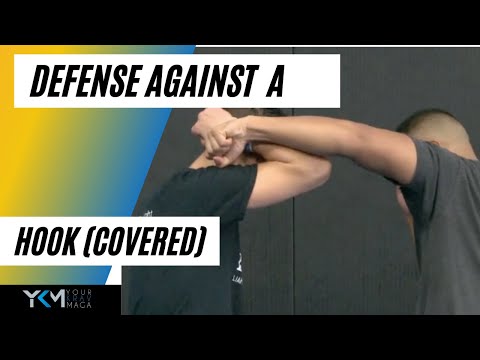
This is a more covering defense. The advantage is that there is very little margin for error. This is a higher level def…
Translation: Defence against hook punch — the Krav Maga defensive response to a circular hook punch, using a raised forearm shield combined with body angling and simultaneous counter-strike
The Defence Against Hook Punch is the Krav Maga technique for defending against circular hook punches to the head or body, using a raised forearm shield that absorbs and deflects the hook's arc while simultaneously delivering a counter-strike with the opposite hand. [1] The hook punch is one of the most common and dangerous attacks in street violence — a wide, looping punch thrown by untrained attackers (the 'haymaker') and trained fighters alike — and is responsible for a disproportionate number of knockout and injury in real-world altercations. [1],[2] The Krav Maga defence addresses the hook by raising the forearm on the attacked side vertically alongside the head (the 'shield' position), creating a barrier that the hook's arc impacts before reaching the jaw or temple. [1] Critically — following the Krav Maga principle of simultaneous defence and attack — the opposite hand delivers a counter-strike to the attacker's face at the same moment the forearm shield absorbs the hook. [1],[2] The shield block is structurally different from a boxing shell or parry: the forearm is pressed flat against the side of the head (ear covered by the bicep, fist near the forehead), creating a surface that absorbs the hook through the hard ulnar bone rather than the thin temporal bone of the skull. [1] Yaron Lichtenstein documented this technique in The Book of Krav-Maga: The Bible as a core defence alongside the 360 Defence, Inside Defence, and Outside Defence, noting that the hook punch requires a DIFFERENT defensive mechanism than the straight punch: straight punches can be deflected (Inside/Outside Defence), but hook punches must be ABSORBED by a shield because their circular trajectory cannot be redirected effectively by deflection. [1]
The Defence Against Hook Punch was developed as part of the Krav Maga defensive curriculum by Imi Lichtenfeld and refined by subsequent Krav Maga instructors including Yaron Lichtenstein. [1],[2] The technique addresses one of the most common real-world attacks: the hook punch (or 'haymaker'), which accounts for a significant percentage of street violence injuries because of its knockout potential and the difficulty of defending against circular attacks with linear blocking methods. [1] Lichtenfeld recognised that the 360 Defence (which uses forearm blocks at various angles) and the Inside/Outside Defence (which uses palm deflections) were designed for straight-line attacks and were less effective against circular hooks — the shield block was developed specifically to address the hook's arc. [1] The shield concept (absorbing rather than deflecting circular attacks) has parallels in boxing (the shell/Philly Shell), Muay Thai (the forearm block against body hooks), and traditional karate (Age Uke variants against circular strikes). [1],[2]
The Defence Against Hook Punch is effective because it addresses the hook's fundamental characteristic — its circular trajectory — with an absorption mechanism (the shield) rather than a deflection mechanism (which works better against linear attacks). [1] The simultaneous counter-strike exploits the hook punch's inherent vulnerability: during the hooking motion, the attacker's chin is exposed on the non-hooking side, and their body is rotating in a direction that makes it impossible to simultaneously defend the counter. [1],[2] In street self-defence, the haymaker (wide, looping hook) is the most commonly thrown punch by untrained attackers, making this defence one of the most practically valuable techniques in the Krav Maga curriculum. [1]
Not applicable — Krav Maga is not a competitive sport. The Defence Against Hook Punch has been validated through real-world use by Israeli military, security forces, and civilian self-defence encounters.
No images yet for this technique.
Sign in to suggest an image.
This is a more covering defense. The advantage is that there is very little margin for error. This is a higher level def…
The Correct Way To Throw HOOKS in BOXING | Thumb Up or Thumb In. Do you want to know how to throw proper hooks in boxing…
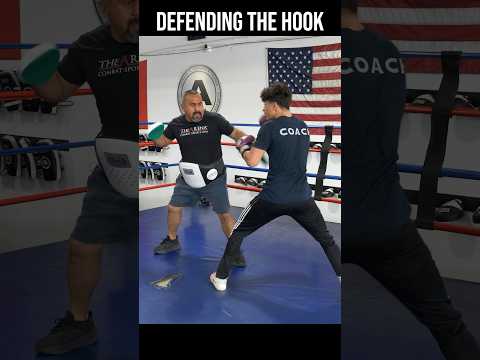
Learn essential hook defense techniques from The Arena’s Boxing coach Joe Vargas in this quick tutorial! Watch as Coach …
If you’re serious about leveling up your boxing, I’ve dropped all the best resources below to guide you. Start with the …
Join this channel to get access to perks: https://www.youtube.com/channel/UC5UHXD7eSL8MGe06z-_dtYw/join 👊 Self Defense…
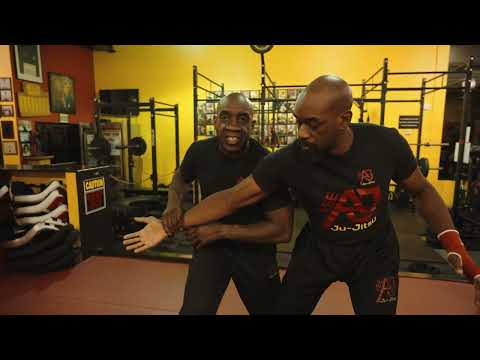
Defence against hook punches employs several distinct approaches depending on context and threat level. Vee AJ Jitsu emphasizes street-applicable self-defence, criticizing flow-drill techniques as impractical and stressing the critical need to address the opponent's second hand—the "other hand" that will exploit any opening. Their method prioritizes quick attachment to neutralize follow-up strikes, checking the hand, then transitioning safely behind the opponent before executing arm control. THE ARENA presents three boxing-focused options: regular blocking, ducking under, and leaning back, each executable with or without counter-striking. YourKravMaga details the "cover" defence, a three-point barrier created by wrapping the hand around the head with elbow forward and shoulder raised, which offers automatic counter-strike positioning but risks leaving the body exposed and provides inadequate protection against edged weapons—a key distinction from sport boxing. YourKravMaga further clarifies that standard block techniques taught in boxing are problematic in MMA (no knuckle protection) and Krav Maga (edged-weapon scenarios). All instructors agree that effective defence requires rapid response and awareness of multiple threats, though Vee AJ Jitsu and YourKravMaga specifically address self-defence contexts beyond sport, while THE ARENA and Tony Jeffries focus on boxing-specific mechanics.
Synthesized from 4 instructors
No instructional courses yet for this technique.
Sign in to suggest a course.
Risk of injury to the person this technique is applied to
The Defence Against Hook Punch is a defensive technique that causes no direct injury. The forearm shield absorbs impact, and the defender sustains minimal damage (forearm bruising at most). The simultaneous counter-strike, however, can cause significant damage to the attacker's exposed face.
Skill level needed to execute this technique reliably
Whether this technique is allowed under major competition rule sets
The Book of Krav-Maga: The Bible (Lichtenstein, 2007)
description: [1] Lichtenstein 2007, [2] Lichtenfeld 2001
Standard katakana transliteration of Western martial arts terminology (外来語) — used in Japanese MMA, boxing, and BJJ communities
description: [1] Lichtenstein 2007, [2] Lichtenfeld 2001
Minimal requirements — the forearm shield is a simple raised-arm position accessible to all body types
No special conditioning needed (though forearm conditioning from repeated blocking drills is beneficial)
The simultaneous counter-strike requires basic striking ability (a straight palm strike or punch)
Accessible to all ages and fitness levels
Hook punch defense in Krav Maga uses the forearm shield (raising the arm to absorb the hook) combined with simultaneous counter-attack — Krav Maga's signature principle of defending and attacking in the same motion. (Complete Krav Maga; Krav Maga training manuals)
According to YourKravMaga, you should wrap your hand around your head while keeping your elbow forward so your shoulder, hand, and forearm all protect the upper part of your arm. Keep your chin down to ensure your shoulder provides the protection, not your own head.
Yes, YourKravMaga explains that a cover defense has an automatic counter built in: if you step in with your elbow either towards the attacker's bicep or face, the tip of your elbow can strike if close enough. When throwing the same-side counter, your body turns into position to follow up with a hook or uppercut.
According to The Arena, you have three primary options: a regular block, ducking under, and countering with your own punch. Coach Anthony adds that you can also make an opponent miss by weaving or stepping away from the hook.
YourKravMaga notes that the high cover leaves your body more open, which skilled boxers will exploit. Additionally, if the attacker has a sharp object, this defense doesn't protect your throat and neck area, so keeping your shoulder raised helps minimize the risk of stabbing wounds.
The Defence Against Hook Punch is the Krav Maga technique for defending against circular hook punches to the head or body, using a raised forearm shield that absorbs and deflects the hook's arc while simultaneously delivering a counter-strike with the opposite hand. The hook punch is one of the most common and dangerous attacks in street violence — a wide, looping punch thrown by untrained attackers (the 'haymaker') and trained fighters alike — and is responsible for a disproportionate number of knockout and injury in real-world altercations.
The Defence Against Hook Punch was developed as part of the Krav Maga defensive curriculum by Imi Lichtenfeld and refined by subsequent Krav Maga instructors including Yaron Lichtenstein. The technique addresses one of the most common real-world attacks: the hook punch (or 'haymaker'), which accounts for a significant percentage of street violence injuries because of its knockout potential and the difficulty of defending against circular attacks with linear blocking methods.
Unified MMA: legal — Legal defensive technique; IBJJF: legal — Legal; IJF: legal — Legal defensive action; WBC/Boxing: legal — Legal; WKF: legal — Legal; WT: legal — Legal
Danger rating 2/10. The Defence Against Hook Punch is a defensive technique that causes no direct injury. The forearm shield absorbs impact, and the defender sustains minimal damage (forearm bruising at most). The simultaneous counter-strike, however, can cause significant damage to the attacker's exposed face.
The standard setup chain: Attacker initiates a hook punch (right hook to the head) → Defender raises the left forearm vertically alongside the left side of the head (shield position) → Hook impacts the ulnar surface of the raised forearm → Impact is absorbed by the bone, not the temple → SIMULTANEOUSLY: right hand fires a counter-strike (palm strike or punch) to the attacker's exposed face → The attacker's chin is exposed because their hooking arm is committed to the opposite side → Counter lands on the undefended face → Continue with follow-up combatives (additional punches, knees, elbows) → Disengage and escape OR control the attacker.
Standard counters include: Feint the hook, attack straight — feinting a hook to draw the shield, then attacking down the centreline (which is pa… / Double hook — throwing hooks from both sides in rapid succession, overwhelming the single-arm shield / Low hook to the body — if the shield is raised for a head hook, the body is exposed to a body-level hook / Feint hook then takedown — feinting the hook to draw the shield, then shooting for a takedown.
Common variants: Standard shield defence (forearm raised vertically alongside the head with simulta…); Double shield (both forearms raised for two-handed hook defence (sacrifi…); Shield with body angle (angling the body away from the hook during the shield, ad…); Shield to clinch (after absorbing the hook, clinching the attacker to preve…); Shield to takedown (after absorbing the hook, shooting for a takedown while t…); Shield with elbow counter (instead of a straight counter-strike, the defender fires …).
Not applicable — Krav Maga is not a competitive sport. The Defence Against Hook Punch has been validated through real-world use by Israeli military, security forces, and civilian self-defence encounters.
Top errors to watch for: Gap between the forearm and the head — if the forearm is not pressed tightly against the head, the hook's force slams… / Shielding without counter-striking — a passive shield gives the attacker a free second (and third, and fourth) hook; … / Wrong forearm position — the forearm must be VERTICAL (fist up, elbow down); a horizontal forearm exposes the face be… / Raising the shield too late — the hook is a fast attack; the shield must be raised at the first sign of the circular ….
The Defence Against Hook Punch is also known as Fukku Panchi Difensu, Hook Defence, Krav Hook Block, Shield Block Against Hook, Anti-Hook Defence.
![3 Easy Ways To Deal With Lead Hook! [Simple And Effective!]](https://img.youtube.com/vi/UV6OOXNiFDk/hqdefault.jpg)