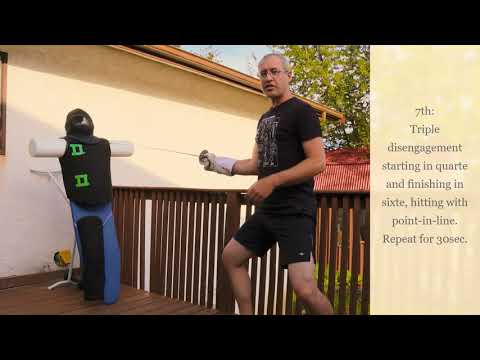
Foil Disengaging
0
Foil Parry·OSM Fencing
Work on developing and improving your skill at making tight and controlled disengagements in foil. Make sure that your o…
Translation: foil parry
The Foil Parry subfamily covers all blade-deflection actions in foil where the fencer uses their blade to redirect an incoming thrust away from the valid target area (torso), establishing the right to riposte. [1] Foil parries are governed by right-of-way rules: a successful parry transfers priority from the attacker to the defender, granting the defender the right to riposte — if the riposte and a subsequent counter-attack both land, only the riposte scores. [1],[2] The classical system defines eight parry positions protecting different lines (high/low, inside/outside), though in foil the most commonly used are quarte (4th — inside high), sixte (6th — outside high), septime (7th — inside low), and octave (8th — outside low). [2],[3]
The eight parry positions were codified by Italian and French masters to provide systematic coverage of all possible attack lines. [1] The four primary foil parries (quarte, sixte, septime, octave) became standard curriculum in fencing schools by the 18th century and remain the foundation of foil defence. [2],[3]
The parry system was codified by Italian and French fencing masters, with the numbered parry positions (prime through octave) established by the 18th century. [1]
Parry-riposte sequences are the most common scoring actions in Olympic foil competition, often deciding bout outcomes at the highest level. [1]
No images yet for this technique.
Sign in to suggest an image.
Work on developing and improving your skill at making tight and controlled disengagements in foil. Make sure that your o…
No instructional courses yet for this technique.
Sign in to suggest a course.
Risk of injury to the person this technique is applied to
Modern sport fencing uses blunted weapons and full protective gear; injury rate ~2.5 per 1000 exposures (Harmer 2008)
Skill level needed to execute this technique reliably
Whether this technique is allowed under major competition rule sets
The Art of Fencing (Luigi Barbasetti, 1932)
Alias sources — [1] FIE Rules of Competition [2] Classical Fencing (Rogers, 2014)
Effectiveness sources — [1] The Art and Science of Fencing (Evangelista, 1996) [2] FIE technical guidelines
Mixed Japanese-Western terminology — combines traditional Japanese terms with katakana loanwords
Alias sources — [1] FIE Rules of Competition [2] Classical Fencing (Rogers, 2014)
Effectiveness sources — [1] The Art and Science of Fencing (Evangelista, 1996) [2] FIE technical guidelines
explosive lunge speed, finger/wrist dexterity, cardiovascular endurance
long reach (tall, long arms), fast-twitch legs
quadriceps (lunge), calves, forearm/finger flexors, core
Every move, in any martial art, shares a few universal traits. Mix and match below to pinpoint the right tool — or compare equivalents across styles.
The Octave Parry (8th parry) defends the low outside line by moving the blade downward and to the outside, with the hand in supination (palm up) and the point lower than the hand, deflecting attacks directed at the lower torso on the weapon-arm side. [1] Octave is the mirror of septime, covering the low line on the opposite side, and is used to parry low-line attacks that target the flank or lower ribcage area. [1,2] The octave parry is less frequently used in modern foil than quarte or sixte but is essential for defending against opponents who attack the low line. [2,3]
The Quarte Parry (4th parry) defends the high inside line by moving the blade across the body to the inside (left side for a right-handed fencer), with the hand in pronation (palm down) or semi-supination, deflecting attacks directed at the inside of the torso. [1] Quarte is one of the two most frequently used parries in foil because a large proportion of attacks target the high inside line, which is the most direct path to the torso for a right-handed fencer attacking another right-hander. [1,2] The quarte parry requires precise lateral blade movement — enough to deflect the incoming point but not so wide as to leave the outside line open. [2,3]
The Septime Parry (7th parry) defends the low inside line by dropping the blade downward and to the inside, with the point lower than the hand and the blade angled to deflect attacks directed at the lower torso on the non-weapon side. [1] Septime covers the low-line attacks that pass under the arm, protecting the belly and lower ribs. [1,2] The septime parry is important against opponents who use low-line feints and attacks to draw the defender's blade high before attacking below. [2,3]
The Sixte Parry (6th parry) defends the high outside line by moving the blade to the outside (right side for a right-handed fencer), with the hand in supination (palm up) and the point slightly higher than the hand, deflecting attacks directed at the outside of the torso. [1] Sixte is paired with quarte as the two dominant high-line parries in foil — together they cover the entire high-line target area. [1,2] Sixte is particularly important for defending against disengages that change from the inside to the outside line, and it is the standard defensive position from which many fencers operate in the en garde stance. [2,3]
The major mistake is exaggerating the movement and making it larger than necessary, usually due to anxiety or uncertainty about how to perform the action. According to OSM Fencing, compensating with very large, animated disengagements is a sign you need to focus on controlled, precise footwork instead.
Before attempting disengagements, warm up your wrist and fingers through exercises and loosening movements. OSM Fencing emphasizes this is important because your wrist might not be warm initially, making it harder to feel the action with your fingers.
You can practice both ways. OSM Fencing recommends starting with disengagements from a static on-guard position, then progressing to fluid disengagements where you disengage as you are actively attacking, which adds complexity and keeps training fresh.
A broken time attack is a disengagement variation where your arm doesn't follow the parry—instead, as your opponent attempts to parry your lunge, you pull your arm back so the parry misses, then extend for the touch. OSM Fencing notes this can be very surprising to your opponent.
The Foil Parry subfamily covers all blade-deflection actions in foil where the fencer uses their blade to redirect an incoming thrust away from the valid target area (torso), establishing the right to riposte. Foil parries are governed by right-of-way rules: a successful parry transfers priority from the attacker to the defender, granting the defender the right to riposte — if the riposte and a subsequent counter-attack both land, only the riposte scores.
The eight parry positions were codified by Italian and French masters to provide systematic coverage of all possible attack lines. The four primary foil parries (quarte, sixte, septime, octave) became standard curriculum in fencing schools by the 18th century and remain the foundation of foil defence.
FIE: legal — Legal fencing technique — governed by FIE rules for foil, épée, and sabre; HEMA: legal — Legal in historical fencing competition
Danger rating 2/10. Low — modern sport fencing uses blunted weapons and full protective gear; injury rate ~2.5 per 1000 exposures (Harmer 2008)
The standard setup chain: En Garde → Advance/Lunge Preparation → Attack → Recovery.
Standard counters include: Beat Parry — deflect the blade with a sharp lateral beat before it reaches target / Displacement — move the body off the line while threatening with the point / Counter-Thrust — extend into the attacker's line during their advance.
Common variants: Simple attack (single blade action (disengage, beat, or direct) to score); Compound attack (multiple blade actions (feint then disengage) to create a…); Riposte (immediate counter after a successful parry); Counter-attack (attacking into the opponent's attack with priority or rig…).
Parry-riposte sequences are the most common scoring actions in Olympic foil competition, often deciding bout outcomes at the highest level.
Top errors to watch for: Making parries too large — oversized parries create openings and slow the riposte / Not riposting immediately after the parry — the right of way from the parry is temporary; the riposte must follow ins… / Using only one parry — develop all four primary parries and their circular variants / Parrying with a stiff arm — the parry should use the fingers and wrist primarily.
The Foil Parry is also known as Furūre Uke, Parade au Fleuret, Foil Defence.