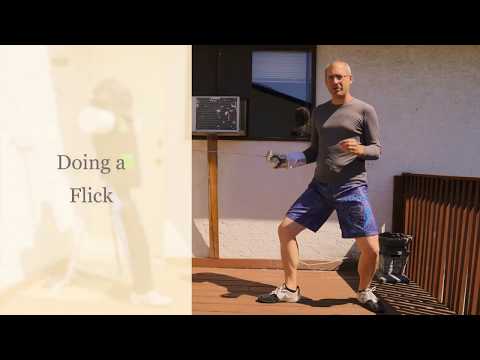
How to Flick (foil)
0
Foil·OSM Fencing
Learn how to make a flick in foil. A flick is a complicated and challenging action that requires plenty of examination a…
Translation: foil
The Foil family covers all techniques specific to the foil discipline, the lightest and most technical of the three fencing weapons, characterised by right-of-way (priority) rules, a target area restricted to the torso (front and back), and a thrusting-only attack mode. [1] Foil is traditionally the weapon on which all fencers learn the fundamentals of fencing because its rules enforce the classical principles of attack, parry, and riposte in a structured sequence governed by priority conventions. [1],[2] The right-of-way rule means that the fencer who initiates an attack has priority — the defender must parry or evade before their counter-attack will be scored, creating a tactical conversation of attack, defence, and riposte. [2],[3] Foil technique emphasises blade work, precision point control, and tactical phrasing — the ability to construct multi-action sequences that outmanoeuvre the opponent within the priority framework. [3]
The foil originated as a practice weapon for small sword training in the 17th century, with a flattened tip (the 'foil' or 'fleuret') to prevent injury during practice bouts. [1] The right-of-way convention was developed to teach proper duelling technique: the attacker who initiated correctly had the right to complete their action before the defender could counter. [2] Foil was included in the first modern Olympic Games in 1896, and women's foil was introduced in 1924, the first women's fencing event. [2],[3] Electronic scoring for foil was adopted in 1955, transforming the sport by objectively determining whether touches landed on the valid target area. [3]
Foil's right-of-way convention enforces classical attack-parry-riposte structure, making it the most technically disciplined of the three weapons. [1] The restricted torso target area and 500-gram touch threshold demand extreme point accuracy; high-level foilists routinely execute attacks within a 2-centimetre target zone at speeds exceeding 2 m/s. [2] Foil training is universally regarded as the best foundation for fencing, as its emphasis on bladework, priority, and tactical phrasing transfers to all three weapons. [2]
Foil originated as a practice weapon for small sword training in 17th-century France and Italy. [1] The French school refined foil technique through masters such as La Boessière and later Louis Rondelle, while the Italian school under Luigi Barbasetti and Salvatore Fabris emphasised a more aggressive approach. [2] The modern foil tradition was shaped significantly by the Soviet school, particularly Vitaliy Arkadyev, whose tactical treatise 'Тактика в фехтовании' (Tactics in Fencing, 1969) systematised foil strategy. [3]
Italy's Nedo Nadi won gold in all three weapons at the 1920 Antwerp Olympics, a feat never repeated. [1] France's Christian d'Oriola won two individual foil gold medals (1952, 1956). Italy's Valentina Vezzali won three consecutive individual foil gold medals (2000, 2004, 2008), making her the most decorated foil fencer in Olympic history. [2]
No images yet for this technique.
Sign in to suggest an image.
Learn how to make a flick in foil. A flick is a complicated and challenging action that requires plenty of examination a…
Here is a short video on the basics of foil. Apoorva covers equipment, the foil, and scoring in foil. Stay tuned for mor…
No instructional courses yet for this technique.
Sign in to suggest a course.
Risk of injury to the person this technique is applied to
Modern sport fencing uses blunted weapons and full protective gear; injury rate ~2.5 per 1000 exposures (Harmer 2008)
Skill level needed to execute this technique reliably
Whether this technique is allowed under major competition rule sets
The Art of Fencing (Luigi Barbasetti, 1932)
Alias sources — [1] FIE Fencing Rules [2] FIE Fencing Rules
Effectiveness sources — [1] Barbasetti, L., The Art of the Sabre and the Epée (E.P. Dutton, 1936) [2] Czajkowski, Z., Understanding Fencing (SKA Swordplay Books, 2005)
Standard katakana transliteration of Western martial arts terminology (外来語) — used in Japanese MMA, boxing, and BJJ communities
Alias sources — [1] FIE Fencing Rules [2] FIE Fencing Rules
Effectiveness sources — [1] Barbasetti, L., The Art of the Sabre and the Epée (E.P. Dutton, 1936) [2] Czajkowski, Z., Understanding Fencing (SKA Swordplay Books, 2005)
explosive lunge speed, finger/wrist dexterity, cardiovascular endurance
long reach (tall, long arms), fast-twitch legs
quadriceps (lunge), calves, forearm/finger flexors, core
Every move, in any martial art, shares a few universal traits. Mix and match below to pinpoint the right tool — or compare equivalents across styles.
The Foil Attack subfamily covers all offensive actions in foil where the fencer extends the arm and moves forward to land a thrust on the opponent's torso, establishing or maintaining right-of-way priority. [1] Foil attacks are governed by the priority convention: the fencer who extends their arm first and moves forward has the right of attack — if both fencers hit, only the attacker's touch counts. [1,2] This creates a rich tactical vocabulary of attacks: simple attacks (direct thrust, disengage, coupe), compound attacks (one-two, double disengage), and attacks on the blade (beat attack, press attack, froissement). [2,3] Mastering foil attack requires understanding how to establish and maintain priority through arm extension, forward footwork, and continuous threatening of the target. [3]
The Foil Footwork subfamily covers all movement techniques used in fencing to control distance, create attacking opportunities, and maintain defensive readiness. [1] Fencing footwork is the engine that drives all blade actions — without proper footwork, even perfect blade technique is ineffective because the fencer cannot reach the target or escape the opponent's attacks. [1,2] Core fencing footwork includes the advance (step forward), retreat (step backward), lunge (the primary attacking step), fleche (running attack), and balestra (jump forward into a lunge). [2,3]
The Foil Parry subfamily covers all blade-deflection actions in foil where the fencer uses their blade to redirect an incoming thrust away from the valid target area (torso), establishing the right to riposte. [1] Foil parries are governed by right-of-way rules: a successful parry transfers priority from the attacker to the defender, granting the defender the right to riposte — if the riposte and a subsequent counter-attack both land, only the riposte scores. [1,2] The classical system defines eight parry positions protecting different lines (high/low, inside/outside), though in foil the most commonly used are quarte (4th — inside high), sixte (6th — outside high), septime (7th — inside low), and octave (8th — outside low). [2,3]
The Foil Riposte subfamily covers all counter-attacking actions executed immediately after a successful parry, which under right-of-way rules gives the defender priority to score. [1] The riposte is the second half of the parry-riposte sequence — the fundamental defensive-offensive combination in foil — and it carries priority, meaning that if the riposte and a remise (renewed attack) both land, only the riposte scores. [1,2] Ripostes can be direct (thrusting immediately back in the same line as the parry), indirect (changing line via disengage or coupe before thrusting), or compound (using multiple blade movements before the final thrust). [2,3]
The foil is the lightest sport fencing weapon with the most restrictive target area (torso only) and right-of-way rules. Originally developed as a training weapon for the small sword. Olympic sport since 1896. (FIE fencing rules; Olympic records)
Right of way means that if both fencers score a touch, only one of them gets the point based on priority. The touch is awarded to the fencer with priority, making this a key distinction in foil compared to other weapons.
The three attributes are distance, elevation, and power. Distance allows you to find the target with the tip, elevation means keeping your hand higher than the tip so you land with the point rather than the blade, and power provides the force needed for a valid touch.
According to OSM Fencing, elevation is perhaps the most important component of a flick because if your hand is lower than your tip, you will land flat with the blade instead of the tip, which both fails to score a valid touch and can hurt your opponent.
Foil gloves must have no holes in them, otherwise they won't be approved for competition, to ensure that if someone hits you the tip cannot go inside the glove.
The Foil family covers all techniques specific to the foil discipline, the lightest and most technical of the three fencing weapons, characterised by right-of-way (priority) rules, a target area restricted to the torso (front and back), and a thrusting-only attack mode. Foil is traditionally the weapon on which all fencers learn the fundamentals of fencing because its rules enforce the classical principles of attack, parry, and riposte in a structured sequence governed by priority conventions.
The foil originated as a practice weapon for small sword training in the 17th century, with a flattened tip (the 'foil' or 'fleuret') to prevent injury during practice bouts. The right-of-way convention was developed to teach proper duelling technique: the attacker who initiated correctly had the right to complete their action before the defender could counter.
FIE: legal — Legal fencing technique — governed by FIE rules for foil, épée, and sabre; HEMA: legal — Legal in historical fencing competition
Danger rating 2/10. Low — modern sport fencing uses blunted weapons and full protective gear; injury rate ~2.5 per 1000 exposures (Harmer 2008)
The standard setup chain: En Garde → Advance/Lunge Preparation → Attack → Recovery.
Standard counters include: Beat Parry — deflect the blade with a sharp lateral beat before it reaches target / Displacement — move the body off the line while threatening with the point / Counter-Thrust — extend into the attacker's line during their advance.
Common variants: Simple attack (single blade action (disengage, beat, or direct) to score); Compound attack (multiple blade actions (feint then disengage) to create a…); Riposte (immediate counter after a successful parry); Counter-attack (attacking into the opponent's attack with priority or rig…).
Italy's Nedo Nadi won gold in all three weapons at the 1920 Antwerp Olympics, a feat never repeated. France's Christian d'Oriola won two individual foil gold medals (1952, 1956).
Top errors to watch for: Attacking without establishing right of way — in foil, the attack must be initiated with an extending arm to claim pr… / Hitting off-target deliberately — off-target hits stop the action and give the opponent a chance to reset / Using epee tactics in foil — foil's right of way rules fundamentally change the tactical approach / Not understanding the difference between attack and counter-attack in foil — only the attack has right of way.
The Foil is also known as Furūre, Foil Fencing, Fleuret.