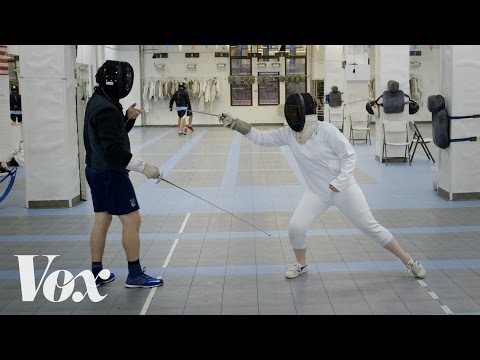
Sport fencing - how to make it more like real fencing
0
Fencing — Sport·scholagladiatoria
https://www.facebook.com/historicalfencing/
Translation: fencing — sport
The Fencing — Sport group covers all techniques within the three Olympic fencing disciplines — foil, epee, and sabre — as governed by the Federation Internationale d'Escrime (FIE). [1] Sport fencing is the direct descendant of European swordsmanship traditions, refined through centuries of duelling practice into a codified competitive format that emphasises speed, precision, tactical intelligence, and right-of-way conventions. [1],[2] Each of the three weapons has distinct rules, target areas, and tactical philosophies: foil is a thrusting weapon targeting the torso with right-of-way priority, epee is a thrusting weapon targeting the entire body with no priority rules, and sabre is a cutting-and-thrusting weapon targeting the upper body with right-of-way priority. [2],[3] Fencing has been part of every modern Olympic Games since 1896, making it one of the original Olympic sports, and its techniques represent the most highly refined and scientifically studied weapon combat system in competitive sport. [3],[4]
Modern sport fencing evolved from Italian and French schools of swordsmanship that transitioned from lethal duelling to regulated competition during the 17th-18th centuries. [1] The Italian master Domenico Angelo established the first fencing academy in London in 1763 and published 'The School of Fencing' (1763), which codified many techniques still used today. [2] The FIE was founded in 1913 to standardise international competition rules, and electronic scoring was introduced in epee in 1933, foil in 1955, and sabre in 1988, revolutionising the sport by eliminating subjective judging of touches. [2],[3] The sport has produced legendary champions including Aladar Gerevich (seven Olympic gold medals in sabre), Valentina Vezzali (six Olympic medals in foil), and Aron Szilagyi (three consecutive Olympic sabre gold medals). [3],[4]
Sport fencing is the most scientifically studied weapon combat system, with Olympic-level athletes demonstrating reaction times under 200 milliseconds and attack speeds exceeding 2 m/s at the point. [1] The training methodology produces exceptional hand-eye coordination, tactical intelligence, and explosive footwork transferable to other combat disciplines. [2] However, the sport's specialised rules (electrical scoring, right-of-way, restricted target areas) mean that direct self-defence applicability is limited compared to the original duelling arts from which it descends. [3]
Modern sport fencing descends from the Italian school (Agrippa, Capo Ferro, the Radaelli sabre system) and the French school (Domenico Angelo, La Boessière) that transitioned from lethal duelling to regulated competition in the 17th–18th centuries. [1] The Fédération Internationale d'Escrime (FIE), founded in 1913, standardised international rules and governs all Olympic and World Championship competition. [2] The Soviet/Russian school, developed by David Tyshler and Vitaliy Arkadyev, dominated sabre and foil for decades through systematic tactical analysis and state-supported training programmes. [3]
Fencing has been contested at every modern Olympic Games since Athens 1896, making it one of five sports present at every edition. [1] Hungary's Aladár Gerevich won six consecutive Olympic gold medals in team sabre (1932–1960), a record unmatched in any Olympic sport. [2] Italy's Valentina Vezzali holds six Olympic medals in foil (3 gold, 1 silver, 2 bronze, 2000–2012), and France's Christian d'Oriola won four Olympic gold medals in foil (1948–1956). [3]
No images yet for this technique.
Sign in to suggest an image.
https://www.facebook.com/historicalfencing/
Fencing is actually 3 different events. Here's how to tell them apart. Subscribe to our channel! http://goo.gl/0bsAjO …
No instructional courses yet for this technique.
Sign in to suggest a course.
Risk of injury to the person this technique is applied to
Modern sport fencing uses blunted weapons and full protective gear; injury rate ~2.5 per 1000 exposures (Harmer 2008)
Skill level needed to execute this technique reliably
Whether this technique is allowed under major competition rule sets
Bubishi: The Classic Manual of Combat (Patrick McCarthy, 2008)
Alias sources — [1] FIE Fencing Rules [2] FIE Fencing Rules [3] FIE Fencing Rules
Effectiveness sources — [1] Czajkowski, Z., Understanding Fencing (SKA Swordplay Books, 2005) [2] Evangelista, N., The Inner Game of Fencing (McGraw-Hill, 2000) [3] Gaugler, W., The History of Fencing (Laureate Press, 1998)
Mixed Japanese-Western terminology — combines traditional Japanese terms with katakana loanwords
Alias sources — [1] FIE Fencing Rules [2] FIE Fencing Rules [3] FIE Fencing Rules
Effectiveness sources — [1] Czajkowski, Z., Understanding Fencing (SKA Swordplay Books, 2005) [2] Evangelista, N., The Inner Game of Fencing (McGraw-Hill, 2000) [3] Gaugler, W., The History of Fencing (Laureate Press, 1998)
wrist control for edge alignment, grip endurance, footwork precision
quick wrists, strong forearms, good posture
forearm extensors/flexors, deltoids, core, calves
Every move, in any martial art, shares a few universal traits. Mix and match below to pinpoint the right tool — or compare equivalents across styles.
The Epee family covers all techniques specific to the epee discipline, the heaviest of the three fencing weapons, characterised by the absence of right-of-way rules, a target area covering the entire body from head to toe, and a thrusting-only attack mode. [1] Epee is considered the weapon closest to actual duelling because simultaneous touches are counted for both fencers (double touches), there is no priority convention, and any part of the body is a valid target — this creates a tactical environment that rewards patience, timing, and precise distance management above all else. [1,2] The epee blade is triangular in cross-section, stiffer than the foil blade, and the weapon weighs approximately 770 grams, making it the heaviest fencing weapon. [2,3] Epee fencing tends to produce longer, more strategic bouts with fewer actions than foil or sabre, as fencers must carefully manage risk when every attack can be met with a counter-attack to any exposed surface. [3]
The Foil family covers all techniques specific to the foil discipline, the lightest and most technical of the three fencing weapons, characterised by right-of-way (priority) rules, a target area restricted to the torso (front and back), and a thrusting-only attack mode. [1] Foil is traditionally the weapon on which all fencers learn the fundamentals of fencing because its rules enforce the classical principles of attack, parry, and riposte in a structured sequence governed by priority conventions. [1,2] The right-of-way rule means that the fencer who initiates an attack has priority — the defender must parry or evade before their counter-attack will be scored, creating a tactical conversation of attack, defence, and riposte. [2,3] Foil technique emphasises blade work, precision point control, and tactical phrasing — the ability to construct multi-action sequences that outmanoeuvre the opponent within the priority framework. [3]
The Sabre (Sport) family covers all techniques specific to the sabre discipline, the only fencing weapon that scores with both the edge and the point, targeting the entire body above the waist including the head and arms. [1] Sabre is the fastest and most aggressive of the three fencing weapons, characterised by explosive simultaneous attacks, rapid exchanges, and a right-of-way system that rewards the fencer who seizes the initiative through forward movement and blade speed. [1,2] The combination of cutting and thrusting attacks, the large target area (everything above the waist), and the aggressive tempo creates a dramatically different tactical environment from the patient, precise combat of foil and epee. [2,3] Sabre bouts are typically decided by the fencer who controls the initiative and the middle of the strip, as the weapon's speed and right-of-way rules punish hesitation and reward explosive offensive action. [3]
Sport fencing encompasses three weapons — foil, épée, and sabre — each with different target areas, scoring rules, and tactical approaches. An Olympic sport since 1896 (foil and sabre) and 1900 (épée). Modern fencing evolved from historical martial swordsmanship into a refined athletic competition. (FIE rules; Olympic records; fencing texts)
Saber fencers can score on any part of the upper body using slashes and thrusts, whereas foil has more restricted target areas. Because saber enforces right-of-way rules, saber fencers are more incentivized to attack first to gain scoring opportunity.
According to scholagladiatoria, the person who attacks first has the right of way, and the defender cannot score if they're simply responding to an attack. This rule applies to foil and sabre, though the mechanisms differ slightly between weapons.
Yes—scholagladiatoria emphasizes that sport fencing is a great foundation for any style of fencing, including historical sabre, rapier, or smallsword, because it teaches great movement, distance, and timing, with fundamentals that are the same across styles.
The Fencing — Sport group covers all techniques within the three Olympic fencing disciplines — foil, epee, and sabre — as governed by the Federation Internationale d'Escrime (FIE). Sport fencing is the direct descendant of European swordsmanship traditions, refined through centuries of duelling practice into a codified competitive format that emphasises speed, precision, tactical intelligence, and right-of-way conventions.
Modern sport fencing evolved from Italian and French schools of swordsmanship that transitioned from lethal duelling to regulated competition during the 17th-18th centuries. The Italian master Domenico Angelo established the first fencing academy in London in 1763 and published 'The School of Fencing' (1763), which codified many techniques still used today.
FIE: legal — Legal fencing technique — governed by FIE rules for foil, épée, and sabre; HEMA: legal — Legal in historical fencing competition
Danger rating 2/10. Low — modern sport fencing uses blunted weapons and full protective gear; injury rate ~2.5 per 1000 exposures (Harmer 2008)
The standard setup chain: Assume Guard (Kamae/Hut) → Measure Distance (Ma-ai) → Initiate Cut/Thrust → Follow Through (Zanshin).
Standard counters include: Parry (Absetzen) — deflect the incoming blade with a counter-displacement / Void (Step Back) — withdraw from measure to avoid the cutting arc / Counter-Cut (Nachreisen) — strike into the opponent's opening during their attack.
Common variants: Standard cut (primary cutting angle from the ready stance); Thrust (tsuki) (straight thrust targeting the throat, chest, or face); Rising cut (kiri-age) (upward diagonal cut from low to high); Diagonal cut (kesa-giri) (downward diagonal cut following the kimono line).
Fencing has been contested at every modern Olympic Games since Athens 1896, making it one of five sports present at every edition. Hungary's Aladár Gerevich won six consecutive Olympic gold medals in team sabre (1932–1960), a record unmatched in any Olympic sport.
Top errors to watch for: Confusing the rules between the three weapons — each weapon has distinct target areas and scoring rules / Using excessive force — fencing is about precision and timing, not power / Not maintaining proper en garde distance — distance management determines who can score / Dropping the guard hand — the weapon hand must stay in the guard position between actions.
The Fencing — Sport is also known as Fenshingu Kyōgi, Olympic Fencing, Sport Fencing, Modern Fencing.