Every WEAPONS Used In Martial arts Explained In 8 Minutes
0
Weapon·Qurio
Discover the fascinating world of martial arts weapons! From the sharp katana to the versatile bo staff, learn about the…
Translation: weapon arts
The Weapon class encompasses all fighting techniques that employ an external implement — whether bladed, blunt, flexible, or projectile — as the primary means of offence and defence. [1] Weapon-based combat is the oldest and most widespread category of martial practice in human history, predating unarmed fighting systems by millennia, as the use of tools for combat parallels the use of tools for survival itself. [1],[2] This class covers sport fencing (foil, epee, sabre under FIE rules), Filipino martial arts (Arnis/Eskrima/Kali stick and blade systems), polearm arts (naginata, sojutsu, halberd), sword arts (kenjutsu, HEMA longsword, iaido), short blades (knife fighting, tanto-jutsu), staff weapons (bojutsu, jodo), and thrown weapons (shuriken-jutsu, javelin). [2],[3] Weapon techniques fundamentally differ from unarmed combat in their biomechanics: the implement extends the fighter's reach, amplifies force through leverage, and introduces cutting, thrusting, and impact mechanics that do not exist in empty-hand fighting. [3],[4] The study of weapons also shaped unarmed martial arts — many empty-hand techniques in Japanese, Chinese, and Southeast Asian systems were derived from or designed to counter weapon attacks, making the Weapon class foundational to understanding the complete martial arts landscape. [4],[5]
Weapon combat is documented in the earliest human civilisations, with Egyptian tomb paintings depicting fencing with sticks circa 1200 BCE, Chinese bronze weapons accompanied by martial treatises from the Zhou Dynasty (1046-256 BCE), and Greek hoplite combat manuals from the classical period. [1] The medieval European tradition produced systematic fight books (Fechtbucher) by masters such as Johannes Liechtenauer (14th century), Fiore dei Liberi (1409), and Hans Talhoffer (1467), while Japan's koryu bujutsu schools formalised kenjutsu and sojutsu from the Kamakura period (1185-1333) onward. [2],[3] Southeast Asian weapon traditions, particularly the Filipino martial arts of Arnis/Eskrima/Kali, developed sophisticated stick and blade systems through centuries of inter-island conflict and resistance to colonial invasion. [3],[4] Modern weapon arts survive as competitive sports (Olympic fencing since 1896, kendo, naginata, HEMA tournaments), cultural preservation practices (koryu, wushu), and practical self-defence systems (Filipino martial arts, knife defence). [4],[5]
Weapon arts are among the oldest documented fighting systems. Ancient Egyptian, Greek, Chinese, and Japanese texts describe systematic weapon training dating back millennia. [1],[2] Every major martial arts tradition includes weapon curricula as either the primary focus or an advanced component. [1]
No images yet for this technique.
Sign in to suggest an image.
Discover the fascinating world of martial arts weapons! From the sharp katana to the versatile bo staff, learn about the…
► Learn Martial Arts In The Comfort Of Your Own Home: https://globalmartialarts.university/?ref=mzmyogq #martialarts #…
No instructional courses yet for this technique.
Sign in to suggest a course.
Risk of injury to the person this technique is applied to
Weapon techniques carry inherent lethal risk; severity depends on weapon type and protective equipment
Skill level needed to execute this technique reliably
Whether this technique is allowed under major competition rule sets
The Essence of Okinawan Karate-Do (Shoshin Nagamine, 1976)
Alias sources — [1] MMA Instruction Manual (UFC, 2008) [2] MMA Instruction Manual (UFC, 2008) [3] Kodokan Judo (Kano, 1986)
Effectiveness sources — [1] Comprehensive Asian Fighting Arts (Draeger & Smith, 1969) [2] The Martial Arts of Renaissance Europe (Anglo, 2000)
Established Japanese martial arts naming convention — native Japanese term (和語/漢語)
Alias sources — [1] MMA Instruction Manual (UFC, 2008) [2] MMA Instruction Manual (UFC, 2008) [3] Kodokan Judo (Kano, 1986)
Effectiveness sources — [1] Comprehensive Asian Fighting Arts (Draeger & Smith, 1969) [2] The Martial Arts of Renaissance Europe (Anglo, 2000)
wrist control for edge alignment, grip endurance, footwork precision
quick wrists, strong forearms, good posture
forearm extensors/flexors, deltoids, core, calves
Every move, in any martial art, shares a few universal traits. Mix and match below to pinpoint the right tool — or compare equivalents across styles.
The Fencing — Sport group covers all techniques within the three Olympic fencing disciplines — foil, epee, and sabre — as governed by the Federation Internationale d'Escrime (FIE). [1] Sport fencing is the direct descendant of European swordsmanship traditions, refined through centuries of duelling practice into a codified competitive format that emphasises speed, precision, tactical intelligence, and right-of-way conventions. [1,2] Each of the three weapons has distinct rules, target areas, and tactical philosophies: foil is a thrusting weapon targeting the torso with right-of-way priority, epee is a thrusting weapon targeting the entire body with no priority rules, and sabre is a cutting-and-thrusting weapon targeting the upper body with right-of-way priority. [2,3] Fencing has been part of every modern Olympic Games since 1896, making it one of the original Olympic sports, and its techniques represent the most highly refined and scientifically studied weapon combat system in competitive sport. [3,4]
The Filipino Martial Art group encompasses the weapon-based and empty-hand fighting systems indigenous to the Philippines, known collectively as Arnis, Eskrima, or Kali. [1] These arts represent one of the most comprehensive and practical weapon-based fighting systems in the world, distinguished by their emphasis on weapon training from the first day of instruction — the opposite of most martial arts which begin with empty-hand techniques and add weapons later. [1,2] The Filipino martial arts are characterised by the use of rattan sticks (baston), bladed weapons (bolo, barong, kris), stick-and-dagger combinations (espada y daga), double sticks (doble baston), and empty-hand translations of weapon movements (mano mano/panantukan). [2,3] The systems employ angle-based attack numbering (typically 5-12 angles of attack), flow drills for developing reflexes and coordination, and an emphasis on ambidextrous skill and weapon interchangeability — the principle that the same movements apply whether holding a stick, a blade, or an empty hand. [3,4]
The Polearm group encompasses all fighting techniques using long-shafted weapons — typically ranging from five to twelve feet in length — that combine reach advantage with the leverage provided by a long handle to deliver cuts, thrusts, sweeps, and hooking actions. [1] Polearms were the dominant battlefield weapons of virtually every pre-gunpowder civilisation because their superior reach allowed formations of soldiers to engage enemies before shorter weapons could close distance. [1,2] This group covers the Japanese naginata (curved-blade polearm), sojutsu (spear arts), and European HEMA halberd and pollaxe techniques, representing both Eastern and Western polearm traditions. [2,3] Polearm combat differs fundamentally from shorter weapon fighting because the long shaft enables lever-based mechanics — the practitioner uses the entire length of the weapon for deflections, sweeps, and strikes, with different grip positions dramatically changing the range and power of each action. [3,4]
The Short Blade group encompasses all combat techniques employing edged weapons shorter than a standard sword, including knives, daggers, and tantō. [1] Short blades have been carried as secondary weapons by warriors across virtually every martial culture, from the medieval European rondel dagger to the Japanese tantō and the Filipino balisong. [1,2] Because short blades require the user to fight at extremely close range, the techniques in this group emphasise rapid transitions between offence and defence, ambidextrous use, and integration with empty-hand grappling. [2,3] Short-blade combat is studied today in HEMA dagger programs, Filipino martial arts knife curricula, Russian Systema knife work, and traditional Japanese tantō-jutsu, making it one of the most broadly practised weapon categories worldwide. [3,4] The group is divided into three families — HEMA Dagger, Knife Fighting, and Tantō-Jutsu — reflecting the major cultural lineages of short-blade use. [4]
Techniques using long and short staff weapons, spanning Japanese bojutsu and jojutsu as well as European quarterstaff traditions.
The Sword group encompasses all combat techniques employing bladed weapons of sword length, spanning both East Asian and European traditions. [1] This group unifies the Japanese sword arts (kenjutsu, kendō, iaidō) with the European historical swordsmanship traditions (longsword, rapier, sabre, sword and shield) under a single taxonomic heading, reflecting the sword's universal status as the most culturally significant weapon class in martial history. [1,2] The Japanese sword tradition is anchored in an unbroken lineage from battlefield kenjutsu of the Kamakura period through the Edo-period refinement of iaidō to modern competitive kendō, while the European tradition is preserved in medieval and Renaissance fight-books and reconstructed by the Historical European Martial Arts movement. [2,3] Together these traditions represent thousands of individual techniques — cuts, thrusts, guards, binds, windings, draws, and disarms — each systematically organised within the curricula of their respective schools. [3,4] The sword remains the most widely practised weapon in martial arts worldwide, with kendō alone claiming over six million practitioners under the International Kendo Federation. [4,5]
Techniques for projecting weapons at a target from a distance, including Japanese shuriken, knife throwing, and javelin arts.
Weapon techniques span from ancient battlefield arts to modern sport fencing. 'Sword' appears in thousands of passages, 'dagger' in 1,746 across 113 books, 'naginata' in 207 across 30. Our corpus covers Japanese weapons (kenjutsu, naginata, bo, jo, tanto), European weapons (longsword, rapier, sabre, dagger, poleaxe), and Filipino weapons (solo baston, doble baston, espada y daga). (200+ books; Clements, Medieval Swordsmanship; Draeger, Classical Budo; Wiley, Filipino Martial Arts)
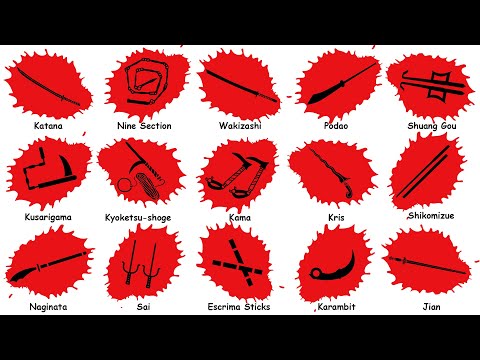
The Shikomizu is a discreet Japanese weapon designed for surprise attacks and espionage, exemplifying how martial arts innovation created tools that could be hidden for strategic advantage. Similarly, Filipino martial arts like escrima practice weapons that emphasize concealed carry and rapid deployment in combat.
The Podao is a single-edged weapon from ancient China with a 1-2 meter long handle that combines the deadly efficiency of a broadsword with extended reach. It earned the nickname 'Horse Cutter Sword,' reflecting its reputed role in cavalry warfare.
The Naginata was a formidable weapon in feudal Japan, characterized by its long reach and curved blade design.
The Weapon class encompasses all fighting techniques that employ an external implement — whether bladed, blunt, flexible, or projectile — as the primary means of offence and defence. Weapon-based combat is the oldest and most widespread category of martial practice in human history, predating unarmed fighting systems by millennia, as the use of tools for combat parallels the use of tools for survival itself.
Weapon combat is documented in the earliest human civilisations, with Egyptian tomb paintings depicting fencing with sticks circa 1200 BCE, Chinese bronze weapons accompanied by martial treatises from the Zhou Dynasty (1046-256 BCE), and Greek hoplite combat manuals from the classical period. The medieval European tradition produced systematic fight books (Fechtbucher) by masters such as Johannes Liechtenauer (14th century), Fiore dei Liberi (1409), and Hans Talhoffer (1467), while Japan's koryu bujutsu schools formalised kenjutsu and sojutsu from the Kamakura period (1185-1333) onward.
FIE: legal — Legal fencing technique — governed by FIE rules for foil, épée, and sabre; HEMA: legal — Legal in historical fencing competition
Danger rating 8/10. Very High — weapon techniques carry inherent lethal risk; severity depends on weapon type and protective equipment
The standard setup chain: Assume Guard (Kamae/Hut) → Measure Distance (Ma-ai) → Initiate Cut/Thrust → Follow Through (Zanshin).
Standard counters include: Parry (Absetzen) — deflect the incoming blade with a counter-displacement / Void (Step Back) — withdraw from measure to avoid the cutting arc / Counter-Cut (Nachreisen) — strike into the opponent's opening during their attack.
Common variants: Standard cut (primary cutting angle from the ready stance); Thrust (tsuki) (straight thrust targeting the throat, chest, or face); Rising cut (kiri-age) (upward diagonal cut from low to high); Diagonal cut (kesa-giri) (downward diagonal cut following the kimono line).
Weapon-based competition exists in fencing (Olympic since 1896), kendo (World Kendo Championships since 1970), HEMA tournaments (since 2000s revival), and Filipino martial arts (WEKAF since 1989).
Top errors to watch for: Training weapon techniques without understanding distance — weapon range fundamentally changes the fighting distance / Treating weapon training as separate from empty-hand training — the body mechanics are interconnected / Using excessive force instead of proper technique — weapon arts rely on precision and angles, not brute strength / Neglecting footwork in weapon training — footwork is even more important with weapons than without.
The Weapon is also known as Buki-jutsu, Armed Combat, Weapons-Based Martial Arts, Bukijutsu.