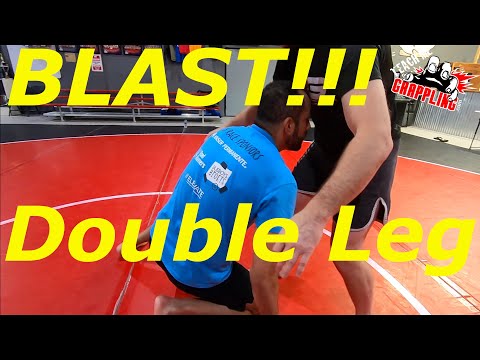
Avoid Submissions with a BLAST Double Leg Takedown!
0
Blast Double·TeachMeGrappling Coach Brian
PLEASE Click this link to SUPPORT the TeachMeGrappling Channel!!! https://www.patreon.com/TeachMeGrappling or https:/…
Translation: blast double (katakana)
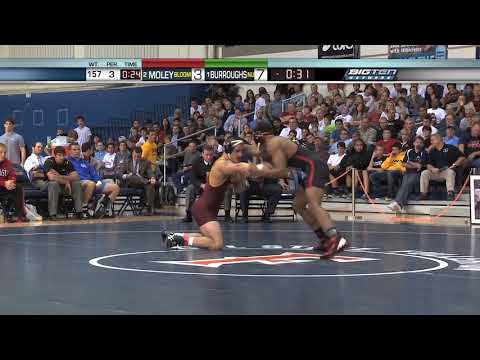
The Blast Double subfamily executes the double leg with maximum forward explosive force, driving straight through the opponent rather than lifting or redirecting. [1] The attacker shoots from distance with an explosive penetration step, contacts both legs at thigh level, and continues driving forward with the legs churning to blast the opponent backward and to the mat. [1],[2] The blast double relies on speed and power rather than finesse, overwhelming the opponent's defensive structure through sheer momentum. [2] This is the most aggressive and spectacular variant of the double leg. [2],[3]
The blast double is a staple of American folkstyle wrestling, particularly in heavyweight divisions where power finishing is emphasised over technical chain wrestling. [1]
The blast double is commonly used in NCAA heavyweight wrestling and in MMA by physically powerful fighters. [1]
No images yet for this technique.
Sign in to suggest an image.
PLEASE Click this link to SUPPORT the TeachMeGrappling Channel!!! https://www.patreon.com/TeachMeGrappling or https:/…
An easy instructional video on how to hit the blast double with 3 different setups. #1 - the snap and blast. #2 - the h…
No instructional courses yet for this technique.
Sign in to suggest a course.
Risk of injury to the person this technique is applied to
Double leg drives through opponent; moderate impact on landing
Skill level needed to execute this technique reliably
Whether this technique is allowed under major competition rule sets
Japanese amateur wrestling terminology
Japanese amateur wrestling terminology
Standard katakana transliteration of Western martial arts terminology (外来語) — used in Japanese MMA, boxing, and BJJ communities
Standard katakana transliteration used in Japanese wrestling (レスリング)
explosive lower body power, level change speed, forward drive
stocky build with strong legs and low centre of gravity
quadriceps, glutes, hamstrings, core, shoulders
Every move, in any martial art, shares a few universal traits. Mix and match below to pinpoint the right tool — or compare equivalents across styles.
According to Coach Brian at TeachMeGrappling, start in a square stance positioned right in front of your opponent at the correct range—close enough that you can almost touch them. This positioning keeps you out of vulnerable spots where submissions like a guillotine can be applied.
Coach Brian emphasizes that you must always drive through and complete the takedown rather than stopping mid-shot, as hesitating puts you in a poor position. Additionally, avoid creating space by pulling back, as this allows your opponent to jam or counter your technique.
Coach Brian notes that depending on how your opponent reacts or defends, a blast double attempt can potentially transition into a single leg, though the exact mechanics depend on the specific situation.
The Blast Double subfamily executes the double leg with maximum forward explosive force, driving straight through the opponent rather than lifting or redirecting. The attacker shoots from distance with an explosive penetration step, contacts both legs at thigh level, and continues driving forward with the legs churning to blast the opponent backward and to the mat.
Blast doubles became a signature of American collegiate wrestling, where wrestlers like Jordan Burroughs demonstrated their effectiveness with perfectly timed explosive entries. The technique transferred directly to MMA where knockout-power level changes became a primary offensive tool.
IJF: banned — Banned since 2010 leg grab prohibition — direct hansoku-make for touching opp…; IBJJF: legal — Legal at all belt levels, scored as takedown (2 points); UWW: restricted — Legal in freestyle (2-4 points), banned in Greco-Roman (no attacks below waist); Unified MMA: legal — Legal takedown technique; ADCC: legal — Legal, scored 2-4 points in second half of match; FIAS Sport Sambo: legal — Legal — all takedowns permitted; FIAS Combat Sambo: legal — Legal; NCAA Folkstyle: legal — Legal, scored as takedown (2 points)
Danger rating 4/10. Moderate — double leg drives through opponent; moderate impact on landing
The standard setup chain: Establish Contact → Create Off-Balance → Execute the Takedown → Follow to Ground.
Standard counters include: Sprawl — drop hips back and drive weight down to stuff the takedown attempt / Underhook — establish inside position to control distance and prevent the takedown entry / Post and Circle — post on the attacker's head and circle away to break their angle / Level Change Defence — recognize the shot early and react with appropriate hip defence.
Common variants: Blast double (high-impact forward drive through the opponent without ch…); Snatch double (pulling both legs together and driving laterally); Run-the-pipe double (running through the opponent in a linear drive); Low double (deep penetration step attacking below the knees).
The blast double is commonly used in NCAA heavyweight wrestling and in MMA by physically powerful fighters.
Top errors to watch for: Shooting the blast double from too far away — you need to be close enough that one step closes the distance / Slowing down on contact instead of accelerating through the opponent / Head on the outside, exposing yourself to the guillotine / Wrapping too low around the knees, so the opponent posts on your back and sprawls.
The Blast Double is also known as Burasuto Daburu, Power Double, Blast Double Leg, Drive-Through Double.