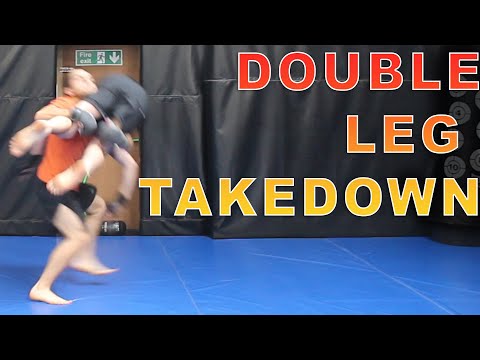
MMA Takedown- How to do a double leg take down
0
Double Leg Takedown·ArmBarCombatMedia
In this video I brake down the technique behind the double leg take down for MMA. The double leg take down can be broke…
Translation: double leg takedown (katakana)
The Double Leg Takedown family is one of the most important and frequently used takedown categories across all grappling and combat sports. [1] The double leg involves the attacker changing level with a penetration step, wrapping both arms around the opponent's legs (typically at thigh level), and driving forward to bring the opponent to the mat. [1],[2] Double legs are classified by the depth and style of penetration: blast doubles drive through the opponent with explosive forward momentum, low doubles attack below the knees, run-the-pipe doubles redirect the opponent laterally, and snatch doubles use a quick pull-and-lift without deep penetration. [2] The double leg is the most commonly attempted takedown in both wrestling and MMA competition. [2],[3]
The double leg takedown has roots in folk wrestling traditions worldwide but was systematised in modern form through American freestyle and folkstyle wrestling during the 20th century. [1] Dan Gable's University of Iowa programme was particularly influential in developing double-leg technique and drilling methodology. [2] The double leg became the single most important takedown in MMA history when wrestlers demonstrated its dominance in early UFC and PRIDE competition. [2],[3]
The double leg takedown is a fundamental technique in freestyle wrestling and was adapted into MMA and BJJ. [1] It has origins in traditional wrestling systems worldwide. [2] In modern grappling, the double leg was popularised in MMA by wrestlers like Mark Coleman, who used it to dominate early UFC events. [3]
The double leg is the most commonly attempted takedown in UFC history. [1] Mark Coleman won the UFC 10 and UFC 11 tournaments (1996) using double leg takedowns as his primary weapon, establishing the 'ground-and-pound' paradigm. [2] In Olympic freestyle wrestling, the double leg is the most frequently scored technique. [3]
No images yet for this technique.
Sign in to suggest an image.
In this video I brake down the technique behind the double leg take down for MMA. The double leg take down can be broke…
No instructional courses yet for this technique.
Sign in to suggest a course.
Risk of injury to the person this technique is applied to
Double leg drives through opponent; moderate impact on landing
Skill level needed to execute this technique reliably
Whether this technique is allowed under major competition rule sets
Japanese amateur wrestling terminology
Japanese amateur wrestling terminology
Standard katakana transliteration of Western martial arts terminology (外来語) — used in Japanese MMA, boxing, and BJJ communities
Standard katakana transliteration used in Japanese wrestling (レスリング)
explosive lower body power, level change speed, forward drive
stocky build with strong legs and low centre of gravity
quadriceps, glutes, hamstrings, core, shoulders
Every move, in any martial art, shares a few universal traits. Mix and match below to pinpoint the right tool — or compare equivalents across styles.
The Blast Double subfamily executes the double leg with maximum forward explosive force, driving straight through the opponent rather than lifting or redirecting. [1] The attacker shoots from distance with an explosive penetration step, contacts both legs at thigh level, and continues driving forward with the legs churning to blast the opponent backward and to the mat. [1,2] The blast double relies on speed and power rather than finesse, overwhelming the opponent's defensive structure through sheer momentum. [2] This is the most aggressive and spectacular variant of the double leg. [2,3]
The High Double Leg is a variation of the double leg takedown where the attacker secures the grip around the opponent's waist or above the hips rather than at the thighs — a blast-style takedown that drives through the opponent's centre of mass with maximum forward pressure. [1] The high double leg is often the result of a fast, explosive shot where the attacker comes up high on the grip rather than going deep to the thighs. [1,2]
The Low Double Leg subfamily attacks both legs below the knee, targeting the shins or ankles rather than the thighs. [1] The low double requires an extremely deep level change, often dropping to both knees during the penetration step, to reach the low target. [1,2] The advantage of the low attack is that it is difficult to sprawl against — the opponent's legs are attacked below the fulcrum point, so sprawling actually helps the attacker by loading the opponent's weight onto the already-captured legs. [2] The trade-off is the deep level change required, which can leave the attacker vulnerable if the shot is poorly timed. [2,3]
The Run-The-Pipe Double subfamily executes the double leg with a lateral running motion after securing the legs, driving the opponent sideways rather than straight back. [1] After the initial penetration and leg contact, the attacker 'runs the pipe' by stepping laterally while lifting the opponent's legs, forcing them to hop on one foot until they lose balance and topple sideways. [1,2] This lateral finishing method is effective when the opponent's initial sprawl or weight distribution prevents a direct forward drive. [2] The name 'run the pipe' refers to the circular running path the attacker takes while holding the opponent's legs. [2,3]
The Snatch Double subfamily executes the double leg with a quick snatch-and-pull motion rather than a deep penetration step, grabbing both legs from a short distance and pulling them toward the attacker. [1] The snatch double requires less forward commitment than the blast double, instead relying on fast hand speed and a sharp pull to destabilise the opponent's base. [1,2] This technique is often used at closer range, from the clinch or after a set-up feint, where a full penetration step would be too slow. [2] The snatch double is valued for its speed and the minimal exposure it creates for the attacker. [2,3]
The double leg takedown is the most commonly attempted takedown in MMA and freestyle wrestling. It has been a staple of wrestling since the ancient Greek Olympics. (Gable, Coaching Wrestling Successfully; UFC Stats)
According to ArmBarCombatMedia, beginners often shoot too shallow, not stepping deep enough with their front leg and failing to get close and tight to the opponent's knees and hips. They also frequently try to combine the level change and penetration step at the same time instead of executing them as two separate movements.
Keep your head tight to your opponent's ribs, almost looking upward. This prevents your opponent from wrapping a guillotine and allows you to drive forward if they attempt one.
Don't try to lift on the spot—instead, sprint and run your opponent down to get them off balance, then scoop your hips underneath them. This makes them feel lighter and requires far less energy than trying to muscle the lift right away.
Use punching combinations like a jab to the head and cross to the body to distract your opponent before shooting. Shooting a double leg "out in the wild" is a big movement that opponents will likely see and defend against, so setups are critical to success.
The Double Leg Takedown family is one of the most important and frequently used takedown categories across all grappling and combat sports. The double leg involves the attacker changing level with a penetration step, wrapping both arms around the opponent's legs (typically at thigh level), and driving forward to bring the opponent to the mat.
The double leg takedown has roots in folk wrestling traditions worldwide but was systematised in modern form through American freestyle and folkstyle wrestling during the 20th century. Dan Gable's University of Iowa programme was particularly influential in developing double-leg technique and drilling methodology.
IJF: banned — Banned since 2010 leg grab prohibition — direct hansoku-make for touching opp…; IBJJF: legal — Legal at all belt levels, scored as takedown (2 points); UWW: restricted — Legal in freestyle (2-4 points), banned in Greco-Roman (no attacks below waist); Unified MMA: legal — Legal takedown technique; ADCC: legal — Legal, scored 2-4 points in second half of match; FIAS Sport Sambo: legal — Legal — all takedowns permitted; FIAS Combat Sambo: legal — Legal; NCAA Folkstyle: legal — Legal, scored as takedown (2 points)
Danger rating 4/10. Moderate — double leg drives through opponent; moderate impact on landing
The standard setup chain: Setup with Strikes or Feint → Level Change → Penetration Step → Head in Chest → Lift and Drive.
Standard counters include: Sprawl — drop hips back and drive weight down to stuff the takedown attempt / Sprawl and Cross-Face — combine hip drop with head push to flatten the attacker / Guillotine Choke — wrap the head during the shot attempt and apply front headlock pressure / Knee Strike — time a rising knee to meet the incoming level change.
Common variants: Blast double (high-impact forward drive through the opponent without ch…); Snatch double (pulling both legs together and driving laterally); Run-the-pipe double (running through the opponent in a linear drive); Low double (deep penetration step attacking below the knees).
The double leg is the most commonly attempted takedown in UFC history. Mark Coleman won the UFC 10 and UFC 11 tournaments (1996) using double leg takedowns as his primary weapon, establishing the 'ground-and-pound' paradigm.
Top errors to watch for: Shallow penetration step that leaves you short — the opponent sprawls and you're stuck underneath / Diving head-first at the legs instead of stepping into the shot / Wrapping the knees instead of the thighs — the opponent easily pries your hands off / Stopping on contact instead of driving through — the double leg finishes with forward pressure.
The Double Leg Takedown is also known as Daburu Reggu Teikudaun, Double Leg, Double, Power Double.