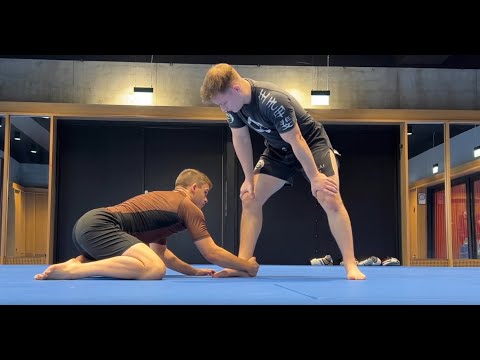
How to ANKLE PICK!!
0
Inside Ankle Pick·TeachMeGrappling Coach Brian
PLEASE Click this link to SUPPORT the TeachMeGrappling Channel!!! https://www.patreon.com/TeachMeGrappling or https:/…
Translation: inside ankle pick
The Inside Ankle Pick subfamily targets the opponent's near-side (inside) ankle, reaching between the opponent's legs or across the centreline to pick up the ankle on the same side as the controlling hand. [1] The inside angle of attack exploits the opponent's forward weight distribution by snapping the head and pulling the near ankle forward simultaneously. [1],[2] Inside ankle picks are often set up from collar tie or wrist control positions where the attacker can redirect the opponent's weight onto the target foot. [2],[3]
The inside ankle pick is a standard technique in American folkstyle and freestyle wrestling, taught from youth through senior-level competition. [1]
The inside ankle pick is commonly used in NCAA and freestyle competition, particularly as a counter-attack. [1]
No images yet for this technique.
Sign in to suggest an image.
PLEASE Click this link to SUPPORT the TeachMeGrappling Channel!!! https://www.patreon.com/TeachMeGrappling or https:/…
In this video, I cover one of my favorite ways to attack the ankle pick from seated guard against a standing opponent. O…
No instructional courses yet for this technique.
Sign in to suggest a course.
Risk of injury to the person this technique is applied to
Ankle pick uses minimal force; one of the lowest-impact takedowns
Skill level needed to execute this technique reliably
Whether this technique is allowed under major competition rule sets
Japanese amateur wrestling terminology
Japanese amateur wrestling terminology
Standard katakana transliteration of Western martial arts terminology (外来語) — used in Japanese MMA, boxing, and BJJ communities
Standard katakana transliteration used in Japanese wrestling (レスリング)
hand speed, snap-down power, timing
long arms for reaching the ankle, quick reflexes
deltoids, forearm grip, core, neck (for snap-down)
Every move, in any martial art, shares a few universal traits. Mix and match below to pinpoint the right tool — or compare equivalents across styles.
The most common mistake is penetrating too far forward with your knee, similar to how you would in a double leg takedown. Coach Brian emphasizes that with an ankle pick, you don't want to penetrate—instead, you should drop your knee to your toe while keeping good posture, letting your back leg do the pressure work.
You need to shift your opponent's weight onto the foot you're targeting by pulling their head down, which loads that leg and brings it close enough to attack. Position yourself with your lead foot forward on the same side as the foot you're picking.
If your opponent sprawls and gets a good angle on you, the position is lost and you should abandon the technique, circle away, and return to your guard. Coach Brian stresses the importance of keeping a good angle throughout to prevent this defensive sprawl.
After dropping your knee and securing control of the ankle, transition directly into a guard pass such as a leg drag pass to continue attacking.
The Inside Ankle Pick subfamily targets the opponent's near-side (inside) ankle, reaching between the opponent's legs or across the centreline to pick up the ankle on the same side as the controlling hand. The inside angle of attack exploits the opponent's forward weight distribution by snapping the head and pulling the near ankle forward simultaneously.
Inside ankle picks developed as a standard wrestling technique in American folkstyle and freestyle programmes, valued for their accessibility from common tie-up positions. The technique has been adopted across grappling disciplines for its low-risk, high-reward profile.
IJF: banned — Banned since 2010 leg grab prohibition — direct hansoku-make for touching opp…; IBJJF: legal — Legal at all belt levels, scored as takedown (2 points); UWW: restricted — Legal in freestyle (2-4 points), banned in Greco-Roman (no attacks below waist); Unified MMA: legal — Legal takedown technique; ADCC: legal — Legal, scored 2-4 points in second half of match; FIAS Sport Sambo: legal — Legal — all takedowns permitted; FIAS Combat Sambo: legal — Legal; NCAA Folkstyle: legal — Legal, scored as takedown (2 points)
Danger rating 3/10. Moderate — ankle pick uses minimal force; one of the lowest-impact takedowns
The standard setup chain: Establish Contact → Create Off-Balance → Execute the Takedown → Follow to Ground.
Standard counters include: Sprawl — drop hips back and drive weight down to stuff the takedown attempt / Underhook — establish inside position to control distance and prevent the takedown entry / Post and Circle — post on the attacker's head and circle away to break their angle / Level Change Defence — recognize the shot early and react with appropriate hip defence.
Common variants: Inside ankle pick (reaching to the near ankle from inside tie position); Outside ankle pick (reaching to the far ankle from outside angle); Snap-down to ankle pick (using a snap-down to expose the ankle for the pick).
The inside ankle pick is commonly used in NCAA and freestyle competition, particularly as a counter-attack.
Top errors to watch for: Reaching between the legs without controlling the head first — you'll eat a knee or crossface / Not snapping hard enough to genuinely load weight onto the target foot / Staying squared up during the pick, giving the opponent a straight line to sprawl / Picking the unloaded foot — always pick the foot carrying weight.
The Inside Ankle Pick is also known as Insaido Ankuru Pikku, Inside Ankle Grab, Near-Side Ankle Pick, Uchi Ashi-dori.