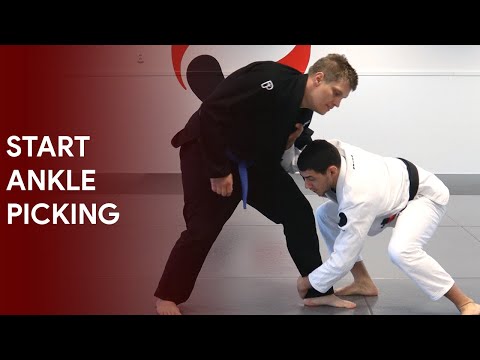
Ankle Pick for BJJ
0
Ankle Pick·Tarik BJJ
🔗 Links: Follow me on Instagram for more jiu-jitsu content: https://www.instagram.com/tarik_bjj/ Discover top-qualit…
Translation: ankle pick (katakana)
The Ankle Pick family covers takedowns where the attacker controls the opponent's upper body with one hand while reaching down to pick up or block the opponent's ankle with the other hand, collapsing their base. [1] The ankle pick is a snap-down-to-attack technique: the attacker uses a collar tie, wrist control, or post to snap the opponent's weight forward onto one foot, then reaches down to capture that loaded ankle and pulls it toward them. [1],[2] The technique requires minimal level change compared to full shots, making it energy-efficient and low-risk. [2] Ankle picks are effective in both gi and no-gi contexts and are commonly used as setups or chain-wrestling transitions. [2],[3]
Ankle picks have been part of wrestling technique since antiquity, though the modern systematised ankle pick was developed primarily in American folkstyle wrestling. [1] The technique gained broader recognition through its adoption in BJJ and MMA, where it serves as a low-risk standing attack. [2],[3]
The ankle pick is frequently used in NCAA wrestling and was notably employed by wrestlers like Kyle Dake in his four NCAA titles at four different weight classes (2010–2013). [1]
No images yet for this technique.
Sign in to suggest an image.
🔗 Links: Follow me on Instagram for more jiu-jitsu content: https://www.instagram.com/tarik_bjj/ Discover top-qualit…
No instructional courses yet for this technique.
Sign in to suggest a course.
Risk of injury to the person this technique is applied to
Ankle pick uses minimal force; one of the lowest-impact takedowns
Skill level needed to execute this technique reliably
Whether this technique is allowed under major competition rule sets
Japanese amateur wrestling terminology
Japanese amateur wrestling terminology
Standard katakana transliteration of Western martial arts terminology (外来語) — used in Japanese MMA, boxing, and BJJ communities
Standard katakana transliteration used in Japanese wrestling (レスリング)
hand speed, snap-down power, timing
long arms for reaching the ankle, quick reflexes
deltoids, forearm grip, core, neck (for snap-down)
Every move, in any martial art, shares a few universal traits. Mix and match below to pinpoint the right tool — or compare equivalents across styles.
The Inside Ankle Pick subfamily targets the opponent's near-side (inside) ankle, reaching between the opponent's legs or across the centreline to pick up the ankle on the same side as the controlling hand. [1] The inside angle of attack exploits the opponent's forward weight distribution by snapping the head and pulling the near ankle forward simultaneously. [1,2] Inside ankle picks are often set up from collar tie or wrist control positions where the attacker can redirect the opponent's weight onto the target foot. [2,3]
The Outside Ankle Pick subfamily targets the opponent's far-side (outside) ankle, reaching to the outside of the opponent's stance to capture the far foot. [1] The outside ankle pick requires creating an angle or using a cross-body reach to access the far ankle, often set up by pushing the opponent's weight to one side and then picking the weighted foot from the outside. [1,2] This angle of attack is less direct than the inside pick but can be more effective against opponents who maintain a squared stance. [2,3]
The ankle pick is a low-risk, high-percentage takedown that uses misdirection and timing rather than power. Cael Sanderson, the only undefeated NCAA wrestling champion (159-0), was renowned for his ankle pick. (Sanderson, Wrestling Tough)
Tarik BJJ recommends starting with a collar grip from standing position and using a fake guard pull to pull your opponent hunched forward, which exposes them for the ankle pick attempt.
You want to keep your opponent's shoulder tight to their knee—this positioning gives you the opportunity to execute the takedown successfully.
Tarik BJJ emphasizes that combining the ankle pick with different techniques makes it hard for opponents to anticipate and counter, rather than relying on the same setup repeatedly.
The Ankle Pick family covers takedowns where the attacker controls the opponent's upper body with one hand while reaching down to pick up or block the opponent's ankle with the other hand, collapsing their base. The ankle pick is a snap-down-to-attack technique: the attacker uses a collar tie, wrist control, or post to snap the opponent's weight forward onto one foot, then reaches down to capture that loaded ankle and pulls it toward them.
Ankle picks have been part of wrestling technique since antiquity, though the modern systematised ankle pick was developed primarily in American folkstyle wrestling. The technique gained broader recognition through its adoption in BJJ and MMA, where it serves as a low-risk standing attack.
IJF: banned — Banned since 2010 leg grab prohibition — direct hansoku-make for touching opp…; IBJJF: legal — Legal at all belt levels, scored as takedown (2 points); UWW: restricted — Legal in freestyle (2-4 points), banned in Greco-Roman (no attacks below waist); Unified MMA: legal — Legal takedown technique; ADCC: legal — Legal, scored 2-4 points in second half of match; FIAS Sport Sambo: legal — Legal — all takedowns permitted; FIAS Combat Sambo: legal — Legal; NCAA Folkstyle: legal — Legal, scored as takedown (2 points)
Danger rating 3/10. Moderate — ankle pick uses minimal force; one of the lowest-impact takedowns
The standard setup chain: Establish Contact → Create Off-Balance → Execute the Takedown → Follow to Ground.
Standard counters include: Sprawl — drop hips back and drive weight down to stuff the takedown attempt / Underhook — establish inside position to control distance and prevent the takedown entry / Post and Circle — post on the attacker's head and circle away to break their angle / Level Change Defence — recognize the shot early and react with appropriate hip defence.
Common variants: Inside ankle pick (reaching to the near ankle from inside tie position); Outside ankle pick (reaching to the far ankle from outside angle); Snap-down to ankle pick (using a snap-down to expose the ankle for the pick).
The ankle pick is frequently used in NCAA wrestling and was notably employed by wrestlers like Kyle Dake in his four NCAA titles at four different weight classes (2010–2013).
Top errors to watch for: Reaching for the ankle without first loading the opponent's weight onto that foot — they just step away / Bending at the waist instead of squatting down to the ankle level / Pulling the ankle toward you instead of forward and up — forward breaks their base more effectively / Letting go of the collar tie when you reach for the ankle, losing all upper body control.
The Ankle Pick is also known as Ankuru Pikku, Ankle Pick Takedown, Ankle Grab, Ankle Snatch.