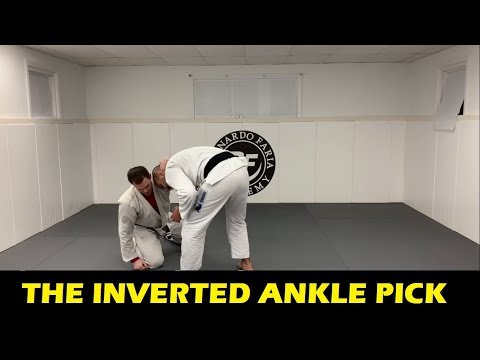
The Inverted Ankle Pick by Hudson Taylor
0
Standard Inside Ankle Pick·Bernardo Faria BJJ Fanatics·Added by Admin
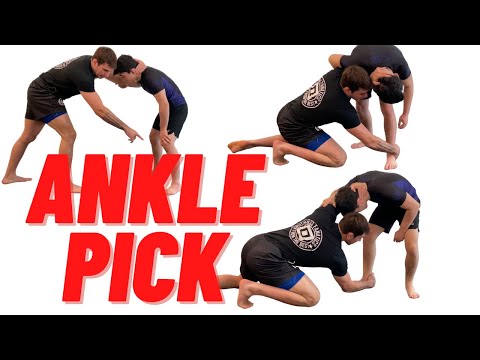
Ankle pick is one of the main techniques used by wrestlers in grappling. In this video Hudson Taylor shows a great varia…
Translation: standard inside ankle pick
The Standard Inside Ankle Pick executes the fundamental inside-angle ankle pick where the attacker uses a collar tie to snap the opponent's posture forward, loading their weight onto the near foot, then reaches down with the free hand to scoop the loaded ankle while pulling the head downward. [1] The motion creates a wheel effect: the head goes down as the ankle comes up, collapsing the opponent's base and bringing them to the mat. [1],[2] The technique requires timing the reach with the moment of maximum forward weight commitment from the opponent. [2] The attacker typically finishes in a dominant position beside the downed opponent. [2],[3]
The inside ankle pick is a high-percentage takedown in folkstyle wrestling because it requires minimal energy expenditure and can be executed from standard tie-up positions. [1] The technique exploits the opponent's forward weight commitment, using a head snap to load the target foot and a quick scoop to remove it. [1] In MMA, the ankle pick has become increasingly popular because it avoids the deep level change that exposes the attacker to knees and uppercuts. [2]
The standard inside ankle pick is the baseline version taught in wrestling programmes at all levels. [1]
Cael Sanderson used the ankle pick extensively during his undefeated 159-0 collegiate career at Iowa State University (1999-2002), making it one of the most feared techniques in NCAA wrestling during that era. [1] In MMA, Georges St-Pierre utilised ankle picks as part of his varied takedown game during his UFC welterweight title reign. [2]
No images yet for this technique.
Sign in to suggest an image.
Ankle pick is one of the main techniques used by wrestlers in grappling. In this video Hudson Taylor shows a great varia…
Ankle Pick Breakdown: EASY & LOW RISK Takedown For Grappling // The ankle pick is one of my all time favorite takedown…
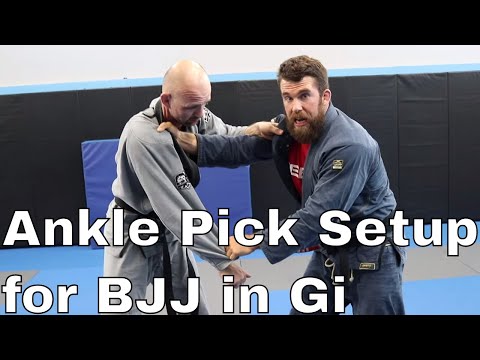
In this video I show a simple way to use the Ankle Pick in BJJ to counter stiff arm grips with the gi. If you've ever …
The standard inside ankle pick is a front-leg takedown executed by attacking the opponent's ankle from the inside angle while maintaining upper-body control. Bernardo Faria BJJ Fanatics, instructing Hudson Taylor's inverted ankle pick method, emphasizes initiating with a sleeve grip and feinting a single-leg attack to force the opponent's foot backward; once the foot steps back, the attacking hand drops to the inside of the ankle while pulling down on the sleeve and lifting the ankle upward simultaneously. The technique succeeds because the opponent loses a posting option and becomes off-balanced. Chewjitsu details the angle-pick setup using cross-collar and sleeve grips in the gi, stressing early grip dominance to prevent stiff-arming; the attacker creates an angle, drops low, and pulls the leg in. Chewjitsu notes the collar grip creates leverage that counters defensive hand placement. Giancarlo Bodoni frames the ankle pick as a low-risk alternative to double and single-leg takedowns, explaining it avoids body-weight commitment and guillotine danger. Bodoni describes the straight ankle pick from a collar tie, where the attacker posts, clubs the opponent's head, circles to square the stance, then drops the knee while bringing the opponent's head directly over the targeted foot before picking and pulling in the direction the toes point. Bodoni also presents the cross ankle pick as a secondary option when the opponent steps out of the initial pick. All three instructors agree on the importance of control and balance disruption through upper-body positioning before executing the ankle pick.
Synthesized from 3 instructors
No instructional courses yet for this technique.
Sign in to suggest a course.
Risk of injury to the person this technique is applied to
Ankle pick uses minimal force; one of the lowest-impact takedowns
Skill level needed to execute this technique reliably
Whether this technique is allowed under major competition rule sets
Japanese amateur wrestling terminology
Japanese amateur wrestling terminology
Standard katakana transliteration of Western martial arts terminology (外来語) — used in Japanese MMA, boxing, and BJJ communities
Standard katakana transliteration used in Japanese wrestling (レスリング)
hand speed, snap-down power, timing
long arms for reaching the ankle, quick reflexes
deltoids, forearm grip, core, neck (for snap-down)
Dominate grips early by swatting your opponent's hands down before they can establish control, then get your grips in place to set up the technique. Chewjitsu emphasizes being proactive with hand position rather than letting your opponent dictate the grip exchange.
Get an angle, drop down, and pull the leg in. According to Chewjitsu, you want to get your opponent to step to one side while you establish a slight angle, then drop and pull that leg to complete the takedown.
Giancarlo Bodoni advises dropping down while bringing your opponent's head down with you—don't drop with an extended arm. Keep your elbow tight and heavy, bringing their head specifically over the foot you're picking to finish the takedown.
Let go of the collar grip immediately after the takedown and pull your elbow back, as holding the collar can put you in danger of an armbar. Chewjitsu stresses this as an important detail to avoid getting caught in a submission.
The Standard Inside Ankle Pick executes the fundamental inside-angle ankle pick where the attacker uses a collar tie to snap the opponent's posture forward, loading their weight onto the near foot, then reaches down with the free hand to scoop the loaded ankle while pulling the head downward. The motion creates a wheel effect: the head goes down as the ankle comes up, collapsing the opponent's base and bringing them to the mat.
The inside ankle pick has been a staple of American folkstyle wrestling for generations, taught as a fundamental stand-up technique alongside the single and double leg. Its simplicity and effectiveness ensured its adoption into BJJ, sambo, and MMA training curricula.
IJF: banned — Banned since 2010 leg grab prohibition — direct hansoku-make for touching opp…; IBJJF: legal — Legal at all belt levels, scored as takedown (2 points); UWW: restricted — Legal in freestyle (2-4 points), banned in Greco-Roman (no attacks below waist); Unified MMA: legal — Legal takedown technique; ADCC: legal — Legal, scored 2-4 points in second half of match; FIAS Sport Sambo: legal — Legal — all takedowns permitted; FIAS Combat Sambo: legal — Legal; NCAA Folkstyle: legal — Legal, scored as takedown (2 points)
Danger rating 3/10. Moderate — ankle pick uses minimal force; one of the lowest-impact takedowns
The standard setup chain: Establish Contact → Create Off-Balance → Execute the Takedown → Follow to Ground.
Standard counters include: Sprawl — drop hips back and drive weight down to stuff the takedown attempt / Underhook — establish inside position to control distance and prevent the takedown entry / Post and Circle — post on the attacker's head and circle away to break their angle / Level Change Defence — recognize the shot early and react with appropriate hip defence.
Common variants: Inside ankle pick (reaching to the near ankle from inside tie position); Outside ankle pick (reaching to the far ankle from outside angle); Snap-down to ankle pick (using a snap-down to expose the ankle for the pick).
Cael Sanderson used the ankle pick extensively during his undefeated 159-0 collegiate career at Iowa State University (1999-2002), making it one of the most feared techniques in NCAA wrestling during that era. In MMA, Georges St-Pierre utilised ankle picks as part of his varied takedown game during his UFC welterweight title reign.
Top errors to watch for: Grabbing the ankle instead of scooping the heel — a grab is easier to shake off / Snapping and picking at the same time instead of sequencing: snap first, load the weight, then pick / Keeping your weight forward over your toes during the pick, making you vulnerable to a snap-down counter / Not stepping offline, so the opponent can simply step their picked foot backward.
The Standard Inside Ankle Pick is also known as Insaido Ankuru Pikku, Inside Ankle Grab Takedown, Near Ankle Pick TD, Standard Ashi-dori.