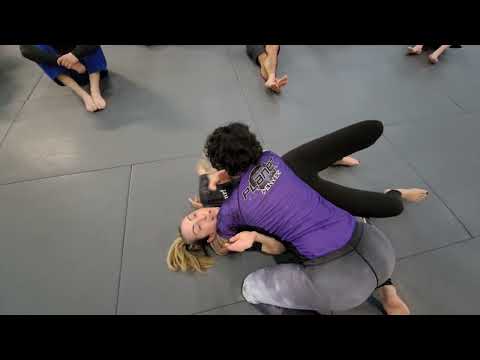
10th Planet Fundamentals Side Control Buggy Choke 3 of 3 Heather
0
10th Planet Choke·10th Planet Denver Jiu Jitsu
Translation: 10th Planet choke
The 10th Planet Choke family covers choking submissions developed within Eddie Bravo's 10th Planet Jiu-Jitsu system — specifically designed for no-gi grappling and applied from the system's proprietary guard positions (Rubber Guard, Mission Control, Truck) and unique entanglement pathways. [1] These chokes address the fundamental problem of no-gi choking: without gi collars for grip, traditional BJJ chokes are unavailable, so 10th Planet developed novel choking pathways using the legs, body positioning, and creative arm configurations. [1],[2] The most famous 10th Planet chokes include the gogoplata (shin-across-throat choke from Rubber Guard), the Twister (a spinal crank from the Truck that functions as a choke on the neck), and various guillotine-style chokes entered from the system's unique guard positions. [2],[3] While requiring flexibility and familiarity with 10th Planet nomenclature, these chokes have proven effective in EBI, ADCC, and MMA competition. [3]
10th Planet chokes were developed by Eddie Bravo as part of his 10th Planet Jiu-Jitsu system founded in 2003, specifically to address the challenge of choking opponents in no-gi grappling without access to gi collars. [1] The gogoplata gained attention when fighters used it in MMA competition and when 10th Planet practitioners demonstrated it at EBI events. [1],[2] The Twister was named by Bravo and is detailed in his book 'Twister' (2007). [2],[3] The system gained credibility when Bravo submitted Royler Gracie at ADCC 2003 and when 10th Planet practitioners began winning EBI tournaments. [3]
10th Planet chokes have proven effective in EBI, ADCC, and MMA competition, with the gogoplata and Twister producing submission victories at the highest levels. [1] Nick Diaz's gogoplata finish in the UFC and multiple EBI gogoplata submissions have validated the technique. [2] The Twister has produced numerous competition finishes in EBI and other no-gi tournaments. [3]
No images yet for this technique.
Sign in to suggest an image.
No instructional courses yet for this technique.
Sign in to suggest a course.
Risk of injury to the person this technique is applied to
The Twister is one of the most dangerous legal submissions because it attacks the cervical spine; the gogoplata applies concentrated shin pressure to the trachea; these are powerful submissions that require careful training and immediate tapping
Skill level needed to execute this technique reliably
Whether this technique is allowed under major competition rule sets
Mastering the Rubber Guard (Eddie Bravo, 2006)
Description sources — [1] Mastering the Rubber Guard (Bravo, 2006) [2] Twister (Bravo, 2007) [3] EBI and ADCC competition records
Description sources — [1] Mastering the Rubber Guard (Bravo, 2006) [2] Twister (Bravo, 2007) [3] EBI and ADCC competition records
hip flexibility (essential for Rubber Guard access), leg dexterity (shin placement for gogoplata), rotational strength (Twister application)
flexible body type, long legs, good proprioception
hip flexors/adductors (maintaining Rubber Guard), core (rotational force for Twister), hamstrings (shin placement for gogoplata)
Every move, in any martial art, shares a few universal traits. Mix and match below to pinpoint the right tool — or compare equivalents across styles.
The Crowbar is an armbar variant from rubber guard where the leg acts as a crowbar across the opponent's arm while the hips create the extension force. [1]
The Electric Chair Submission is a groin and inner-thigh hyperextension applied from the lockdown half guard position, where the attacker elevates the opponent's trapped leg upward and outward while sweeping to the top, stretching the groin muscles and adductors beyond their normal range of motion. [1] The technique begins from Eddie Bravo's lockdown — a half guard control where the attacker figure-fours their legs around the opponent's trapped leg and hooks the far ankle, creating an inescapable leg entanglement. [1] From the lockdown, the attacker underhooks the opponent's far leg (the free leg) while simultaneously whipping their hips upward, elevating the trapped leg into an extreme abduction position that forces the opponent's legs apart like a forced split. [1] The submission can finish in two ways: as a sweep (if the opponent rolls to escape the split, the attacker lands in top position), or as a tap (if the attacker maintains the elevation and continues spreading the legs, the groin muscles and hip adductors tear). [1] The name 'Electric Chair' comes from the visual appearance of the opponent suspended with legs spread in a position reminiscent of an electric chair execution. [1] Eddie Bravo developed the technique during his training at Jean Jacques Machado's academy and first demonstrated its effectiveness when he defeated Royler Gracie via triangle choke at ADCC 2003, using the Electric Chair as a key positional tool throughout the match. [2]
The Go-Go Plata (Gogoplata) is an unorthodox submission that uses the shin bone pressed across the opponent's trachea while the hands pull the head downward into the shin, creating a windpipe compression choke. [1] The attacker positions one leg across the front of the opponent's throat from a rubber guard or high guard configuration, with the shin acting as a rigid bar against the airway, while both hands grip the back of the opponent's head and pull it forward and down into the shin. [1,2] The technique exploits the anatomical vulnerability of the trachea — the shin bone (tibia) is one of the hardest surfaces on the human body, and when pressed against the relatively unprotected throat, even moderate pressure can cause choking, gagging, or tapping. [2] The Go-Go Plata gained mainstream recognition when Nick Diaz used it to submit Takanori Gomi at PRIDE 33 in February 2007, and when Shinya Aoki submitted Joachim Hansen at DREAM 3 in the same year — both high-profile finishes that demonstrated the technique's viability at the highest levels of MMA competition. [2,3] Eddie Bravo systematised the technique within his 10th Planet Jiu-Jitsu rubber guard system, documenting multiple entries and transitional pathways to the position. [1]
The Invisible Croc Submission is a choke entered from the Invisible Collar position through a crocodile-like rolling motion that tightens the collar grip. [1]
The Jiu-Claw is a 10th Planet Jiu-Jitsu submission from rubber guard where the attacker grips the opponent's face with an open-hand claw grip while the legs control posture, creating a combination face crank and neck submission that attacks the cervical spine through lateral and rotational forces applied via the jaw. [1] The technique is entered through the 'Kung Fu Move' sequence: from Mission Control (the foundational rubber guard position), the attacker threads one arm over the opponent's trapped arm and reaches for the face, gripping the chin and jaw with an open-hand claw — the fingers wrap around one side of the jaw while the thumb presses on the opposite side or above the nose. [1] Once the claw grip is established, the attacker uses the grip to rotate and laterally flex the opponent's neck by pulling the face toward the attacker's chest while the legs maintain the rubber guard posture control — the cervical spine is compressed and rotated beyond its comfortable range, creating intense pain and submission pressure. [1] The Jiu-Claw occupies an unusual position in grappling taxonomy: it is not a choke (no airway or blood vessel compression), not a standard joint lock (no single joint is isolated and hyperextended), and not a muscle compression — it is a CRANK, specifically a neck/spine crank that attacks the cervical vertebrae through the lever of the jaw. [1] Eddie Bravo included the Jiu-Claw in the Mastering the Rubber Guard system as an alternative finish when the opponent successfully defends the triangle, armbar, and Go-Go Plata from the Zombie position — the Jiu-Claw provides a fourth attack vector that requires no leg repositioning, only the hand grip on the face. [1] The technique is controversial in some grappling communities because face cranks are considered 'dirty' or unsportsmanlike — however, under most competitive rulesets (ADCC, EBI, Unified MMA), the Jiu-Claw is fully legal. [1] In IBJJF competition, face cranks without a choking component may be illegal depending on the referee's interpretation. [1]
The Loco Plata is a variant of the Go-Go Plata (Gogoplata) that attacks the opponent's throat with the shin from a modified angle, using a lateral or diagonal shin placement rather than the standard direct anterior compression of the classic Go-Go Plata. [1] While the standard Go-Go Plata places the shin directly across the front of the throat and pulls the head straight down into it, the Loco Plata positions the shin diagonally across the neck — from the opponent's clavicle on one side to the opposite jaw — creating a wedge-like compression that combines tracheal pressure with lateral carotid compression. [1] Eddie Bravo developed the Loco Plata as an alternative finish when the standard Go-Go Plata is defended: if the opponent turns their head to one side to avoid the direct anterior shin pressure, the Loco Plata follows their head angle and applies the shin from the new direction. [1] The technique is entered from the rubber guard system, typically transitioning from Mission Control or a failed standard Go-Go Plata, by adjusting the angle of the attacking leg to match the opponent's defensive head position. [1] The name 'Loco' reflects Bravo's characteristically playful naming convention — he considered the lateral angle 'crazy' because it attacks from a direction that most opponents do not anticipate after defending the standard version. [1] The Loco Plata is part of the Go-Go Plata family of attacks, which chain together to form a submission sequence where defending one variation opens another: direct Go-Go Plata → opponent turns head → Loco Plata → opponent pushes the leg → transition to omoplata or armbar. [1]
The Stoner Control Arm Triangle applies an arm triangle choke (kata gatame / head-and-arm choke) from the Stoner Control rubber guard position, using the unique leg positioning of the rubber guard to trap the opponent's arm across their own neck rather than relying on the attacker's arms to force the arm into choking position. [1] In a standard arm triangle choke from top position, the attacker must use their arms and body weight to push the opponent's arm across their neck, then wrap their own arm around the head-and-arm to create the choking mechanism — this requires significant upper body strength and positional dominance. [1] The Stoner Control Arm Triangle achieves the same arm-across-neck configuration from BOTTOM position by using the rubber guard's leg control: the high guard leg presses the opponent's trapped arm inward across their own throat, while the attacker's arms secure the head-and-arm wrap from below. [1] This bottom-position arm triangle is rare in mainstream BJJ because the standard arm triangle requires top pressure to compress the choke — the Stoner Control version compensates by using the leg's pressing force (the quadriceps is far stronger than the arms) to provide the compression that top-pressure normally supplies. [1] Eddie Bravo designed the Stoner Control Arm Triangle as part of the Stoner Control submission family — a set of attacks available from the Stoner Control position that includes this arm triangle, the Stoner Control Calf Crank, and transitions to other rubber guard positions. [1] The technique represents one of the 10th Planet system's most innovative concepts: applying traditionally top-position submissions from bottom position by substituting leg mechanics for gravity and body weight. [1]
The Carni is a shoulder lock submission from rubber guard entered through the Kung Fu Move sequence, isolating the arm and applying rotational pressure to the shoulder. [1]
The Ice Pick is a wrist lock submission from rubber guard that isolates the opponent's hand and applies leverage against the wrist joint. [1]
10th Planet chokes are the submission system from Eddie Bravo's no-gi grappling method — including the gogoplata, invisible collar choke, and various rubber guard strangles. 10th Planet appears in 33 passages across 5 books. (5 books; Bravo, Mastering the Rubber Guard; Bravo, Mastering the Twister)
According to 10th Planet Denver instructor Heather, you should sense early warning signs before the choke is fully locked in—if your opponent has long legs and you're in traditional side control for too long, they may be positioning for the buggy choke, so recognize these cues and escape before they fully secure it.
Instructor Heather emphasizes that you should get on your side first and turn into your opponent—frame on them, then rotate your body to get proper positioning before bringing your leg into the underhook.
Heather explains that getting on your side makes you more flexible and allows you to get better leverage on the opponent's neck with your lat, and it also enables you to properly position your leg (the one closest to their head) to swing up for the underhook.
The 10th Planet Choke family covers choking submissions developed within Eddie Bravo's 10th Planet Jiu-Jitsu system — specifically designed for no-gi grappling and applied from the system's proprietary guard positions (Rubber Guard, Mission Control, Truck) and unique entanglement pathways. These chokes address the fundamental problem of no-gi choking: without gi collars for grip, traditional BJJ chokes are unavailable, so 10th Planet developed novel choking pathways using the legs, body positioning, and creative arm configurations.
10th Planet chokes were developed by Eddie Bravo as part of his 10th Planet Jiu-Jitsu system founded in 2003, specifically to address the challenge of choking opponents in no-gi grappling without access to gi collars. The gogoplata gained attention when fighters used it in MMA competition and when 10th Planet practitioners demonstrated it at EBI events.
IBJJF: legal — Legal at all belt levels, gi and no-gi — chokes are the safest submission cat…; IJF: legal — Legal (shime-waza) — strangulation techniques are one of three permitted subm…; ADCC: legal — Legal; Unified MMA: legal — Legal — choke submissions are among the most common finishes in MMA; FIAS Sport Sambo: banned — All chokes prohibited in Sport Sambo; FIAS Combat Sambo: legal — Legal
Danger rating 8/10. High — the Twister is one of the most dangerous legal submissions because it attacks the cervical spine; the gogoplata applies concentrated shin pressure to the trachea; these are powerful submissions that require careful training and immediate tapping
The standard setup chain: Establish Guard Position → Enter Rubber Guard / Truck → Navigate Pathway → Position for Choke → Apply Choke → Finish.
Standard counters include: Posture Up — driving upward to break Rubber Guard control (prevents gogoplata setup) / Strip the Shin — pushing the shin off the throat when gogoplata is attempted / Prevent the Truck — not allowing the opponent to establish the calf hook and seatbelt that create the Truck / Chin Tuck — tucking the chin to prevent the shin from accessing the throat.
Common variants: Gogoplata (shin-across-throat choke from Rubber Guard/Zombie positio…); Twister (spinal crank/choke from the Truck position; devastating r…); Dead Orchid triangle (triangle choke entered from Rubber Guard pathway); Carni choke (named 10th Planet choke variation); Crackhead Control choke (choke from the Crackhead Control position); Electric chair submission (though primarily a sweep tool, can function as a neck/spi…); Invisible choke variations (chokes entered through the system's guard transitional po…).
10th Planet chokes have produced submission victories at EBI, ADCC, and in MMA (UFC). The gogoplata and Twister are the system's most successful competition finishes.
Top errors to watch for: Attempting 10th Planet chokes without adequate flexibility — forcing Rubber Guard positions without hip flexibility l… / Not understanding the positional pathway — jumping to the choke without establishing the intermediate positions (Miss… / Applying the Twister too fast in training — the spinal crank can cause serious cervical injury; always apply slowly a… / Treating 10th Planet chokes as gimmicks — these are legitimate competition techniques that have produced submission v….
The 10th Planet Choke is also known as Tensu Puranetto Chōku, 10th Planet Jiu-Jitsu Choke, 10P Choke, Eddie Bravo System Choke.