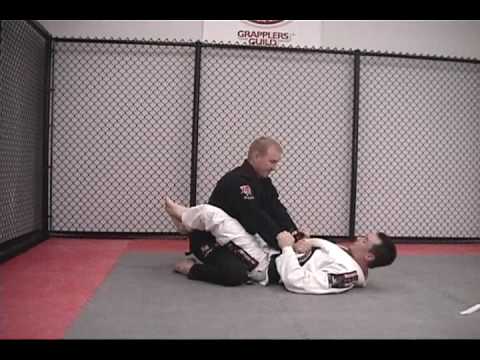
MMA Institute technique of the month: Omo plata setup and finish variation
0
Loco Plata·ziongraffix
See title
Translation: Loco Plata — 'loco' (Spanish: crazy) + 'plata' (Portuguese: plate/shin surface), meaning 'crazy shin choke' — a modified Go-Go Plata with a lateral angle that Eddie Bravo considered an insane variation
The Loco Plata is a variant of the Go-Go Plata (Gogoplata) that attacks the opponent's throat with the shin from a modified angle, using a lateral or diagonal shin placement rather than the standard direct anterior compression of the classic Go-Go Plata. [1] While the standard Go-Go Plata places the shin directly across the front of the throat and pulls the head straight down into it, the Loco Plata positions the shin diagonally across the neck — from the opponent's clavicle on one side to the opposite jaw — creating a wedge-like compression that combines tracheal pressure with lateral carotid compression. [1] Eddie Bravo developed the Loco Plata as an alternative finish when the standard Go-Go Plata is defended: if the opponent turns their head to one side to avoid the direct anterior shin pressure, the Loco Plata follows their head angle and applies the shin from the new direction. [1] The technique is entered from the rubber guard system, typically transitioning from Mission Control or a failed standard Go-Go Plata, by adjusting the angle of the attacking leg to match the opponent's defensive head position. [1] The name 'Loco' reflects Bravo's characteristically playful naming convention — he considered the lateral angle 'crazy' because it attacks from a direction that most opponents do not anticipate after defending the standard version. [1] The Loco Plata is part of the Go-Go Plata family of attacks, which chain together to form a submission sequence where defending one variation opens another: direct Go-Go Plata → opponent turns head → Loco Plata → opponent pushes the leg → transition to omoplata or armbar. [1]
The Loco Plata was developed by Eddie Bravo as an extension of his Go-Go Plata system within the 10th Planet Jiu-Jitsu curriculum. [1] Bravo, who is known for his creative and extensively named technique catalogue (with names drawn from pop culture, slang, and humour), designated the Loco Plata as the 'crazy' variant of the Go-Go Plata after discovering that a lateral shin angle allowed him to finish opponents who had learned to defend the standard version. [1] The technique appears in Mastering the Rubber Guard (2006) as part of the Go-Go Plata family of attacks, documented alongside the standard Go-Go Plata and related rubber guard submissions. [1] The Loco Plata represents the 10th Planet system's emphasis on creating chains of attacks where each technique sets up the next — a philosophy that has influenced modern no-gi grappling broadly. [1]
The Loco Plata's effectiveness is primarily as a chain submission — it catches opponents who have successfully defended the standard Go-Go Plata by turning their head, which is exactly the movement that exposes them to the lateral angle. [1] This makes the Go-Go Plata / Loco Plata combination more effective than either technique in isolation, as the opponent faces a two-sided threat. [1] The technique has been used in EBI (Eddie Bravo Invitational) competition by 10th Planet practitioners, though it is less commonly seen than the standard Go-Go Plata due to the specific defensive reaction required to create the opening. [1]
Eddie Bravo → 10th Planet Jiu-Jitsu Go-Go Plata family → documented in Mastering the Rubber Guard (2006) → part of the 10th Planet rubber guard submission chain. [1]
Used in EBI (Eddie Bravo Invitational) competition by 10th Planet practitioners as part of the Go-Go Plata chain. Less commonly seen than the standard Go-Go Plata in MMA, but effective when the opponent specifically defends the standard version by turning the head.
No images yet for this technique.
Sign in to suggest an image.
See title
Using the rubber guard to set up the gogoplata and Locoplata submission.
The Loco Plata is an advanced submission technique that emerges as a variation within the rubber guard system when the opponent defends against the Gogoplata. According to BJJ4Breakfast, the technique begins from mission control (rubber guard position achieved from closed guard), where the practitioner has one foot on the opponent's hip and the other leg hooked high across the back of the neck with a palm-facing grip. The setup follows the Gogoplata entry: the practitioner swims the arm through, clears the face, and grabs their own foot. However, when the opponent resists the Gogoplata by pushing down on the practitioner's foot to create breathing space, the practitioner peels the opponent's hand away, re-grabs their own foot, and crucially introduces the opposite leg as a base for the choke—this insertion of the second foot defines the Loco Plata. BJJ4Breakfast emphasizes that once established, the position is extremely difficult to escape and offers secondary options including sweeps and potential armbar transitions if the opponent attempts to back out or stand. The technique requires significant flexibility in the rubber guard position and is particularly effective in no-gi grappling. While ziongraffix's Omoplata variation shares foundational principles of leg positioning and wrist control, it differs fundamentally in mechanics and does not constitute the same technique as the Loco Plata.
Synthesized from 2 instructors
No instructional courses yet for this technique.
Sign in to suggest a course.
Risk of injury to the person this technique is applied to
Similar danger profile to the standard Go-Go Plata — direct tracheal and carotid compression can cause unconsciousness and airway obstruction. The lateral angle adds a neck-crank component that the standard version lacks, creating additional risk of cervical spine injury if the opponent resists aggressively instead of tapping.
Skill level needed to execute this technique reliably
Whether this technique is allowed under major competition rule sets
Mastering the Rubber Guard (Bravo, 2006)
description: [1] Bravo 2006 Go-Go Plata family
Standard katakana transliteration of Western martial arts terminology (外来語) — used in Japanese MMA, boxing, and BJJ communities
description: [1] Bravo 2006 Go-Go Plata family
Requires all the hip flexibility of the standard Go-Go Plata PLUS additional hip abduction range for the diagonal angle
Strong grip for the head pull
Core strength to maintain the rubber guard position while adjusting the shin angle
Favours practitioners with longer legs (greater shin surface for the diagonal placement)
The loco plata is a 10th Planet submission — part of Eddie Bravo's named technique system. The unconventional naming convention (loco = crazy) reflects 10th Planet's distinctive culture. (Bravo, 10th Planet system)
In Loco Plata, you use both of your feet as leverage points—you grab your own foot with your hand while using your other foot as the base—whereas Gogoplata relies on a single arm position. As BJJ4Breakfast explains, if you can't grab your foot because it's too far, you peel the opponent's hand off and bring in your other foot to create the Loco Plata position.
BJJ4Breakfast notes that if they try to back out, you can transition to an armbar by using a swimmer's motion through their arm, giving you multiple submission options even if they resist the initial tap.
Start by grabbing your own toes with your hand to create a fork grip across their chin or neck. If you can't reach your foot initially, peel their hand off first, then grab your foot while keeping one hand away so you have leverage to bring in your other foot as the base.
The Loco Plata is a variant of the Go-Go Plata (Gogoplata) that attacks the opponent's throat with the shin from a modified angle, using a lateral or diagonal shin placement rather than the standard direct anterior compression of the classic Go-Go Plata. While the standard Go-Go Plata places the shin directly across the front of the throat and pulls the head straight down into it, the Loco Plata positions the shin diagonally across the neck — from the opponent's clavicle on one side to the opposite jaw — creating a wedge-like compression that combines tracheal pressure with lateral carotid compression.
The Loco Plata was developed by Eddie Bravo as an extension of his Go-Go Plata system within the 10th Planet Jiu-Jitsu curriculum. Bravo, who is known for his creative and extensively named technique catalogue (with names drawn from pop culture, slang, and humour), designated the Loco Plata as the 'crazy' variant of the Go-Go Plata after discovering that a lateral shin angle allowed him to finish opponents who had learned to defend the standard version.
IBJJF: legal — Legal at all belt levels, gi and no-gi — chokes are the safest submission cat…; IJF: legal — Legal (shime-waza) — strangulation techniques are one of three permitted subm…; ADCC: legal — Legal; Unified MMA: legal — Legal — choke submissions are among the most common finishes in MMA; FIAS Sport Sambo: banned — All chokes prohibited in Sport Sambo; FIAS Combat Sambo: legal — Legal
Danger rating 8/10. Similar danger profile to the standard Go-Go Plata — direct tracheal and carotid compression can cause unconsciousness and airway obstruction. The lateral angle adds a neck-crank component that the standard version lacks, creating additional risk of cervical spine injury if the opponent resists aggressively instead of tapping.
The standard setup chain: Closed guard → Break posture → Establish rubber guard (Mission Control) → Threaten standard Go-Go Plata (shin across front of throat) → Opponent turns head to defend → Adjust shin angle to diagonal (Loco Plata) → Pull head into diagonal shin → Opponent taps → If opponent pushes the leg off → Transition to omoplata → If opponent postures → Return to Mission Control and reset.
Standard counters include: Posture up immediately — the Loco Plata, like all plata variants, cannot be applied if the opponent maintains upright… / Push the attacking leg off the neck — if the shin is not deeply seated, pushing it off the throat prevents the choke … / Stack — driving forward compresses the attacker and changes the angle unfavourably for the shin placement / Tuck the chin — a deeply tucked chin prevents the shin from contacting the throat.
Common variants: Standard Loco Plata (diagonal shin from left to right across the neck); Reverse Loco Plata (diagonal shin from right to left (mirrored angle)); Deep Loco Plata (the shin is threaded further across the neck for a deeper…); Loco Plata to omoplata chain (using the Loco Plata attempt as a setup for an omoplata w…).
Used in EBI (Eddie Bravo Invitational) competition by 10th Planet practitioners as part of the Go-Go Plata chain. Less commonly seen than the standard Go-Go Plata in MMA, but effective when the opponent specifically defends the standard version by turning the head.
Top errors to watch for: Attempting the Loco Plata without first threatening the standard Go-Go Plata — the Loco Plata works best as a reactio… / Incorrect shin angle — too steep an angle (closer to vertical) turns it into a neck crank rather than a choke; too sh… / Not pulling the head into the shin — as with all plata variations, the shin alone cannot finish the choke; the hands … / Losing hip position — if the attacking hip slides away from the opponent during the angle adjustment, the shin loses ….
The Loco Plata is also known as Rokopurata, Loco Plata Choke, Crazy Plata, Lateral Gogoplata, Modified Gogoplata.