Lockdown Half Guard, Part 12: Powder Keg Triangle
0
Stoner Control Arm Triangle·Cheat Code Jiu Jitsu
Follow Cheat Code Jiu Jitsu on social media: https://www.facebook.com/Cheat-Code-Jiu-Jitsu-2479604595490997 https://www.…
Translation: Stoner control arm triangle — an arm triangle choke applied from the Stoner Control rubber guard position, where the attacker's leg position traps the opponent's arm across their own neck for the choking mechanism
The Stoner Control Arm Triangle applies an arm triangle choke (kata gatame / head-and-arm choke) from the Stoner Control rubber guard position, using the unique leg positioning of the rubber guard to trap the opponent's arm across their own neck rather than relying on the attacker's arms to force the arm into choking position. [1] In a standard arm triangle choke from top position, the attacker must use their arms and body weight to push the opponent's arm across their neck, then wrap their own arm around the head-and-arm to create the choking mechanism — this requires significant upper body strength and positional dominance. [1] The Stoner Control Arm Triangle achieves the same arm-across-neck configuration from BOTTOM position by using the rubber guard's leg control: the high guard leg presses the opponent's trapped arm inward across their own throat, while the attacker's arms secure the head-and-arm wrap from below. [1] This bottom-position arm triangle is rare in mainstream BJJ because the standard arm triangle requires top pressure to compress the choke — the Stoner Control version compensates by using the leg's pressing force (the quadriceps is far stronger than the arms) to provide the compression that top-pressure normally supplies. [1] Eddie Bravo designed the Stoner Control Arm Triangle as part of the Stoner Control submission family — a set of attacks available from the Stoner Control position that includes this arm triangle, the Stoner Control Calf Crank, and transitions to other rubber guard positions. [1] The technique represents one of the 10th Planet system's most innovative concepts: applying traditionally top-position submissions from bottom position by substituting leg mechanics for gravity and body weight. [1]
The Stoner Control Arm Triangle was developed by Eddie Bravo as part of the Stoner Control submission family within the 10th Planet Jiu-Jitsu system, documented in Mastering the Rubber Guard (2006). [1] The technique represents one of the 10th Planet system's most innovative concepts: applying submissions that are traditionally associated with top position (the arm triangle is overwhelmingly used from mount or side control) from the bottom guard position by substituting the rubber guard's leg mechanics for gravity and body weight. [1] This 'bottom-position finishing' philosophy — that the guard player can finish submissions that are usually considered top-position weapons — is a signature theme of the 10th Planet system and one of its most controversial contributions to grappling theory. [1]
The Stoner Control Arm Triangle is effective because it catches opponents who are unfamiliar with bottom-position arm triangles: most grapplers learn to defend the arm triangle from bottom (when the opponent is on top) but have little experience defending it from top (when the opponent is on bottom applying it with the rubber guard). [1] The leg-compression mechanism actually provides MORE force than the top-position body-weight compression, because the quadriceps can generate forces exceeding 500 pounds while body weight is limited to the attacker's mass. [1] The technique is most effective as part of the Stoner Control submission chain, where the arm triangle is one of several threats the opponent must defend simultaneously. [1]
Traditional arm triangle (kata gatame, used from top position) → Eddie Bravo's adaptation for bottom position using rubber guard leg mechanics → documented in Mastering the Rubber Guard (2006) → part of the Stoner Control submission family. [1]
Used in EBI (Eddie Bravo Invitational) competition by 10th Planet practitioners. Bottom-position arm triangle finishes are rare in professional grappling but have been demonstrated at the EBI level. The concept of finishing traditionally top-position submissions from bottom guard has influenced modern no-gi grappling innovation.
No images yet for this technique.
Sign in to suggest an image.
Follow Cheat Code Jiu Jitsu on social media: https://www.facebook.com/Cheat-Code-Jiu-Jitsu-2479604595490997 https://www.…
Technique from Jiu-Jitsu Magazine Issue 34 July 2015 http://www.jiujitsumag.com
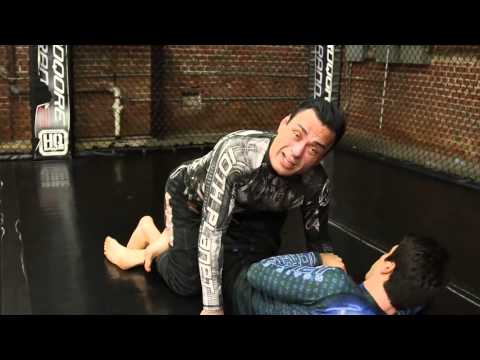
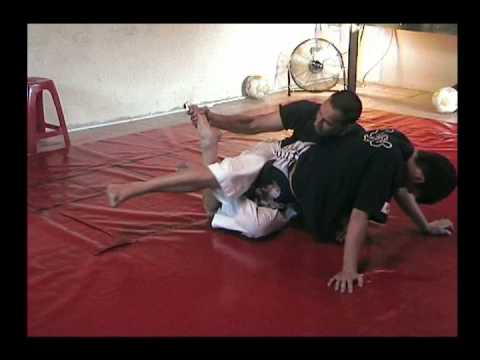
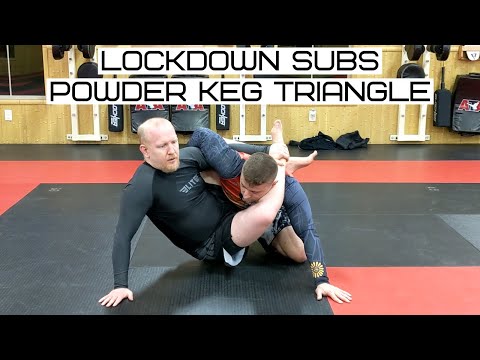
The Stoner Control Arm Triangle is a submission technique executed from stoner control (also called stowdown control), a dominant side control position common in 10th Planet Jiu-Jitsu. According to Groundworx Freestyle Jiu-Jitsu, the technique begins after establishing stoner control by securing the opponent's hips tightly while preventing them from escaping or reaching back. The submission is triggered when the opponent attempts to bridge or reach back with their far-side arm; the top player shoots their bottom arm around the opponent's neck while keeping their opposite arm pinned against the opponent's torso, creating an arm triangle configuration. The instructor emphasizes maintaining tightness throughout and straightening the opponent to apply pressure. Cheat Code Jiu-Jitsu contributes complementary material through their Powder Keg Triangle, which transitions from dogfight position into a triangle using a high underhook on the trap, posting with the free hand, and bringing the leg up the opponent's back before sliding through to lock the triangle choke. While Groundworx focuses on the reactive arm triangle from stoner control when the opponent reaches back, Cheat Code demonstrates the proactive leg-driven transition to triangle from similar ground positions. Both emphasize the importance of leg placement height and body positioning to prevent escape. JiuJitsuMag's Eddie Bravo footage discusses leg lock alternatives (vaporizer/toe-hold compression) from stoner control rather than the arm triangle specifically.
Synthesized from 3 instructors
No instructional courses yet for this technique.
Sign in to suggest a course.
Risk of injury to the person this technique is applied to
The arm triangle is a blood choke that compresses both carotid arteries simultaneously (one compressed by the opponent's own arm, the other by the attacker's wrapping arm). Unconsciousness occurs in 5-10 seconds once fully locked. The Stoner Control version's use of leg compression (stronger than arm compression) can produce even faster onset than the standard version. [1]
Skill level needed to execute this technique reliably
Whether this technique is allowed under major competition rule sets
Mastering the Rubber Guard (Bravo, 2006)
description: [1] Bravo 2006 Stoner Control section
Standard katakana transliteration of Western martial arts terminology (外来語) — used in Japanese MMA, boxing, and BJJ communities
description: [1] Bravo 2006 Stoner Control section
Requires all the hip flexibility needed for rubber guard / Stoner Control
Strong quadriceps and hip adductors for the arm-pressing mechanism
Arm strength for the head-and-arm wrap from an unfamiliar bottom-position angle
Core strength for maintaining the rubber guard structure while executing the submission
Coordination to manage leg pressing and arm squeezing simultaneously
The stoner control arm triangle applies an arm triangle choke from the stoner control half guard position — combining Eddie Bravo's half guard control with the head-and-arm choke. (Bravo, Mastering the Rubber Guard, 2006)
If you can't complete the electric chase sweep, transition directly into side control stoner control to maintain your dominant position.
Keep your body tight and close to your opponent, grabbing around their hips to maintain control. Staying close prevents them from creating space to grab your head, which you need to avoid to deploy the submission.
You need to have the proper angle and control of your opponent's head before you can apply the submission. As soon as they reach back, you can reach over on the neck, lock it up, and apply the triangle while maintaining your lockdown.
The entire stoner control arm triangle system relies on tightness. Staying loose compromises your control and prevents you from effectively setting up and finishing the submission.
The Stoner Control Arm Triangle applies an arm triangle choke (kata gatame / head-and-arm choke) from the Stoner Control rubber guard position, using the unique leg positioning of the rubber guard to trap the opponent's arm across their own neck rather than relying on the attacker's arms to force the arm into choking position. In a standard arm triangle choke from top position, the attacker must use their arms and body weight to push the opponent's arm across their neck, then wrap their own arm around the head-and-arm to create the choking mechanism — this requires significant upper body strength and positional dominance.
The Stoner Control Arm Triangle was developed by Eddie Bravo as part of the Stoner Control submission family within the 10th Planet Jiu-Jitsu system, documented in Mastering the Rubber Guard (2006). The technique represents one of the 10th Planet system's most innovative concepts: applying submissions that are traditionally associated with top position (the arm triangle is overwhelmingly used from mount or side control) from the bottom guard position by substituting the rubber guard's leg mechanics for gravity and body weight.
IBJJF: legal — Legal at all belt levels, gi and no-gi — chokes are the safest submission cat…; IJF: legal — Legal (shime-waza) — strangulation techniques are one of three permitted subm…; ADCC: legal — Legal; Unified MMA: legal — Legal — choke submissions are among the most common finishes in MMA; FIAS Sport Sambo: banned — All chokes prohibited in Sport Sambo; FIAS Combat Sambo: legal — Legal
Danger rating 8/10. The arm triangle is a blood choke that compresses both carotid arteries simultaneously (one compressed by the opponent's own arm, the other by the attacker's wrapping arm). Unconsciousness occurs in 5-10 seconds once fully locked. The Stoner Control version's use of leg compression (stronger than arm compression) can produce even faster onset than the standard version.
The standard setup chain: Closed guard → Break posture → Establish rubber guard (Mission Control) → Transition to Stoner Control → Controlling leg presses the opponent's arm across their own neck → Thread arms around the head-and-arm to complete the triangular wrap → Squeeze arms while maintaining leg press → Bilateral carotid compression → Opponent taps → If defended → transition to Stoner Control Calf Crank or back to Zombie submission chain.
Standard counters include: Prevent the arm from crossing the neck — fighting to keep the arm on the outside of the neck prevents the choking mec… / Posture up — breaking the rubber guard's posture control removes the leg that presses the arm into position / Extract the arm — pulling the trapped arm free from the leg's pressing force collapses the choke / Turn away — turning the body away from the attacking side reduces the choking angle.
Common variants: Standard Stoner Control Arm Triangle (leg pushes the arm across while arms complete the wrap fr…); Deep Stoner Arm Triangle (the leg threads further across the opponent's body for a …); Stoner to mounted arm triangle (if the Stoner Arm Triangle is partially defended, sweep t…); One-arm Stoner Arm Triangle (using only one arm for the wrap while the other hand assi…).
Used in EBI (Eddie Bravo Invitational) competition by 10th Planet practitioners. Bottom-position arm triangle finishes are rare in professional grappling but have been demonstrated at the EBI level.
Top errors to watch for: Not using the leg to press the arm — attempting to push the opponent's arm across their neck with the hands alone (as… / Incomplete arm wrap — if the arms do not fully encircle the head-and-arm, the choke cannot compress both carotids and… / Losing the Stoner Control position — if the rubber guard leg slips or the position degrades, the arm-pressing force d… / Squeezing before the arm is across — attempting to compress the choke before the opponent's arm is fully across their….
The Stoner Control Arm Triangle is also known as Sutonā Kontorōru Āmu Toraianguru, SC Arm Triangle, Stoner Triangle, Rubber Guard Arm Triangle, Head and Arm from Stoner.