HOW TO use the Electric Chair PROPERLY (10th Planet Jiu Jitsu)
0
Electric Chair Submission·Brandon Mccaghren
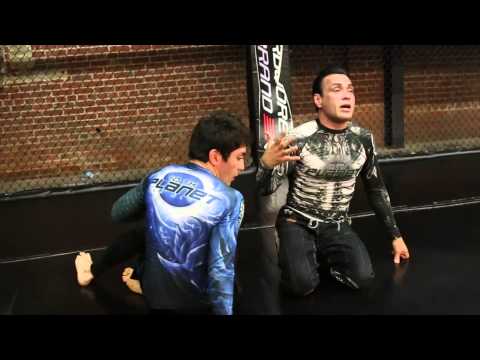
BMAC discusses how to get TO the electric chair & the options we have once we get the sweep. Check out the full Lockdow…
Translation: Electric chair — named for the extreme spreading position of the opponent's legs resembling an execution chair
The Electric Chair Submission is a groin and inner-thigh hyperextension applied from the lockdown half guard position, where the attacker elevates the opponent's trapped leg upward and outward while sweeping to the top, stretching the groin muscles and adductors beyond their normal range of motion. [1] The technique begins from Eddie Bravo's lockdown — a half guard control where the attacker figure-fours their legs around the opponent's trapped leg and hooks the far ankle, creating an inescapable leg entanglement. [1] From the lockdown, the attacker underhooks the opponent's far leg (the free leg) while simultaneously whipping their hips upward, elevating the trapped leg into an extreme abduction position that forces the opponent's legs apart like a forced split. [1] The submission can finish in two ways: as a sweep (if the opponent rolls to escape the split, the attacker lands in top position), or as a tap (if the attacker maintains the elevation and continues spreading the legs, the groin muscles and hip adductors tear). [1] The name 'Electric Chair' comes from the visual appearance of the opponent suspended with legs spread in a position reminiscent of an electric chair execution. [1] Eddie Bravo developed the technique during his training at Jean Jacques Machado's academy and first demonstrated its effectiveness when he defeated Royler Gracie via triangle choke at ADCC 2003, using the Electric Chair as a key positional tool throughout the match. [2]
The Electric Chair was developed by Eddie Bravo during his training at Jean Jacques Machado's academy in the early 2000s, as part of his larger project of creating a comprehensive no-gi grappling system. [1] Bravo drew inspiration from professional wrestling's 'Electric Chair' position (where a wrestler lifts an opponent onto their shoulders), adapting it into a legitimate submission by adding the lockdown leg entanglement. [1] The technique gained credibility when Bravo used it as a key positional tool in his upset victory over Royler Gracie at ADCC 2003 in Abu Dhabi — one of the most significant upsets in grappling history. [2] Bravo subsequently refined and documented the technique in his books Jiu-Jitsu Unleashed (2005) and Mastering the Rubber Guard (2006), and it has become one of the signature techniques of the 10th Planet Jiu-Jitsu system. [1]
The Electric Chair is a high-percentage technique from half guard bottom — a position where most grapplers are primarily defensive. [1] Its dual-threat nature (submission OR sweep) makes it particularly effective because the opponent must defend both simultaneously: defending the groin stretch often means conceding the sweep, and resisting the sweep exposes the groin to further stretching. [1] In EBI (Eddie Bravo Invitational) competition, the Electric Chair and its sweep variant have produced numerous finishes and positional advances at the professional level. [1] The technique is especially effective against wrestlers and pressure passers who commit their weight into the half guard, as their forward pressure actually assists the attacker's elevation. [1]
Eddie Bravo vs Royler Gracie, ADCC 2003 (Electric Chair used as positional tool leading to triangle choke finish) || Multiple EBI (Eddie Bravo Invitational) finishes via Electric Chair || Ben Saunders used the Electric Chair sweep in UFC competition || The lockdown-to-Electric Chair sequence is one of the most commonly seen 10th Planet techniques in professional MMA.
No images yet for this technique.
Sign in to suggest an image.
BMAC discusses how to get TO the electric chair & the options we have once we get the sweep. Check out the full Lockdow…
Technique from Jiu-Jitsu Magazine Issue 34 July 2015 http://www.jiujitsumag.com
Technique from Jiu-Jitsu Magazine Issue 34 July 2015 http://www.jiujitsumag.com
The Electric Chair submission is a leg-lock-based choke attack employed from bottom position against an opponent in base, commonly used in 10th Planet Jiu-Jitsu. According to JiuJitsuMag's Eddie Bravo, the technique begins from electric underhooks—a position that creates ambiguity between committing to a dogfight or the electric chair itself, preventing the top player from overcommitting defensively. Entry involves pushing the opponent's chest to induce a reflexive counter-push, then transitioning to secure the target leg on the shoulder while maintaining a lockdown. Brandon Maccaghren emphasizes the transition mechanics: as the guard breaks down, the bottom player drags the outside foot over the opponent's ankle to create space, then executes a 'dip set'—rhythmic bumping and stretching motions using the knees and spine to progressively improve position and set the opponent's hamstring on the shoulder. Both instructors stress that leg placement on the shoulder is critical; losing this costs the submission. From this position, Bravo describes the finish: collapsing forward with a gable grip and chest pressure to stretch the lockdown against the opponent's groin. Maccaghren notes the submission carries significant injury risk and advocates prioritizing the sweep over the submission itself. The sweep occurs when the bottom player, maintaining the leg lock, gets to their elbow, builds base, and uses spinal pressure to flip the opponent, transitioning to top control with passing options including leg-drag and toe-hold entries.
Synthesized from 3 instructors
No instructional courses yet for this technique.
Sign in to suggest a course.
Risk of injury to the person this technique is applied to
Targets the groin muscles and hip adductors — forced abduction beyond normal range can cause adductor muscle tears, groin strains, and hip joint damage. The submission has a relatively slow onset compared to chokes (the opponent feels the stretch building), but once fully applied, the pain is excruciating and the damage risk is high. Practitioners must tap early because the stretch can cause injury before the pain becomes unbearable.
Skill level needed to execute this technique reliably
Whether this technique is allowed under major competition rule sets
Mastering the Rubber Guard (Bravo, 2006)
description: [1] Bravo 2006 pp.54-65
[1] Bravo, E. with Krauss, E. and Cordoza, G. (2006). Mastering the Rubber Guard: Jiu-Jitsu for Mixed Martial Arts Competition. Victory Belt Publishing. pp. 54-65. [2] ADCC 2003 Abu Dhabi Competition results — Eddie Bravo vs. Royler Gracie, 66kg division.
Standard katakana transliteration of Western martial arts terminology (外来語) — used in Japanese MMA, boxing, and BJJ communities
description: [1] Bravo 2006 pp.54-65
Requires strong hip extension (glutes and hamstrings) for the elevation phase
Good leg dexterity for maintaining the lockdown while transitioning
Core strength for the bridging motion
Does NOT require exceptional flexibility on the attacker's part (the opponent is the one being stretched)
Favours practitioners with strong hips and legs
The electric chair submission is the submission finish from the electric chair sweep position — the attacker stretches the opponent's leg while they are elevated on the shoulder, creating a groin/hip stretch submission. Part of Eddie Bravo's 10th Planet system. (Bravo, Mastering the Rubber Guard, 2006)
According to Brandon McCaghren, frame with your humerus (upper arm) instead of just your hand—use your whole arm to block rather than trying to catch with just your hand. This gives you more surface area to work with, makes it easier, and is much harder to make an error with while keeping your elbow tight to the body.
Brandon McCaghren emphasizes using your knees to generate the movement, not just muscling with your legs. He recommends practicing a 'dip set'—bumping with your knees, stretching, bumping back until your hips come off the ground, then stretching all the way over to your shoulder and back. Once you master the motion without hands, adding hand power becomes extremely effective.
Brandon McCaghren explains that he generally prioritizes the sweep over the submission and rarely goes for the full submission with training partners, as pulling too hard can pop someone's knee. The sweep is usually the main objective, though sometimes the submission opportunity will present itself.
Brandon McCaghren advises that if you're not in trouble, continue with the technique, but if you start feeling unstable, you should concede the sweep and reset rather than risk getting passed.
The Electric Chair Submission is a groin and inner-thigh hyperextension applied from the lockdown half guard position, where the attacker elevates the opponent's trapped leg upward and outward while sweeping to the top, stretching the groin muscles and adductors beyond their normal range of motion. The technique begins from Eddie Bravo's lockdown — a half guard control where the attacker figure-fours their legs around the opponent's trapped leg and hooks the far ankle, creating an inescapable leg entanglement.
The Electric Chair was developed by Eddie Bravo during his training at Jean Jacques Machado's academy in the early 2000s, as part of his larger project of creating a comprehensive no-gi grappling system. Bravo drew inspiration from professional wrestling's 'Electric Chair' position (where a wrestler lifts an opponent onto their shoulders), adapting it into a legitimate submission by adding the lockdown leg entanglement.
IBJJF: legal — Legal at all belt levels, gi and no-gi — chokes are the safest submission cat…; IJF: legal — Legal (shime-waza) — strangulation techniques are one of three permitted subm…; ADCC: legal — Legal; Unified MMA: legal — Legal — choke submissions are among the most common finishes in MMA; FIAS Sport Sambo: banned — All chokes prohibited in Sport Sambo; FIAS Combat Sambo: legal — Legal
Danger rating 8/10. Targets the groin muscles and hip adductors — forced abduction beyond normal range can cause adductor muscle tears, groin strains, and hip joint damage. The submission has a relatively slow onset compared to chokes (the opponent feels the stretch building), but once fully applied, the pain is excruciating and the damage risk is high. Practitioners must tap early because the stretch can cause injury before the pain becomes unbearable.
The standard setup chain: Bottom half guard → Establish lockdown (figure-four legs, hook far ankle) → Jaws of Life (whip hips to create space) → Thread deep underhook under opponent's far leg → Hip thrust upward to elevate opponent's leg → Opponent's legs spread into Electric Chair → Finish: submission (continue spreading) OR sweep (roll opponent to top position) → If sweep, maintain top control → If opponent defends, transition to back take or EM Ankle Lock.
Standard counters include: Prevent the lockdown — the simplest defence is to never allow the figure-four leg entanglement; keep the trapped leg'… / Strip the underhook — if the attacker achieves the underhook on the far leg, immediately fight to remove it before th… / Drive the hips forward — pushing the hips into the attacker's chest makes the elevation angle impossible / Turn away and concede the sweep — accepting the sweep (landing in guard on top) is preferable to having the groin tor….
Common variants: Electric Chair Sweep (using the EC position to sweep to top rather than finish …); Electric Chair from dogfight (entering the EC from the dogfight (knees) position rather…); Electric Chair to back take (if the opponent defends the split by turning away, follow…); EM Ankle Lock (attacking the ankle of the elevated leg if the opponent d…); Vaporizer (an advanced 10th Planet variant that combines the EC with…).
Eddie Bravo vs Royler Gracie, ADCC 2003 (Electric Chair used as positional tool leading to triangle choke finish) || Multiple EBI (Eddie Bravo Invitational) finishes via Electric Chair || Ben Saunders used the Electric Chair sweep in UFC competition || The lockdown-to-Electric Chair sequence is one of the most commonly seen 10th Planet techniques in professional MMA.
Top errors to watch for: Shallow underhook — the most common failure; if the underhook on the far leg is not deep enough (elbow must be BEHIND… / Trying to lift with the arms — the elevation must come from the hips (bridge/hip thrust), not arm strength; attemptin… / Not maintaining the lockdown — if the lockdown loosens during the elevation, the opponent can retract their trapped l… / Rushing the entry — the lockdown must be fully secured and the opponent's base must be compromised before attempting ….
The Electric Chair Submission is also known as Erekutorikku Chea, Electric Chair, EC Submission, Groin Stretch Submission, Banana Split from Half Guard.