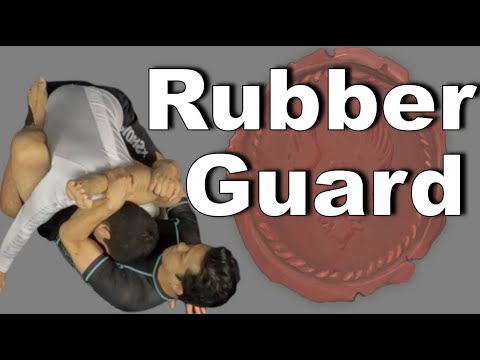
Rubber Guard | Omoplata & Gogoplata | No-Gi/Grappling
0
Go-Go Plata·玉木強 / YOSHI JIU-JITSU TECH
Give us comments if you have any question and request. And don’t forget to subscribe so you never miss one of my brand n…
Translation: Gogoplata — shin choke across the throat (plata from Portuguese for plate/flat surface, referring to the flat shin bone)
The Go-Go Plata (Gogoplata) is an unorthodox submission that uses the shin bone pressed across the opponent's trachea while the hands pull the head downward into the shin, creating a windpipe compression choke. [1] The attacker positions one leg across the front of the opponent's throat from a rubber guard or high guard configuration, with the shin acting as a rigid bar against the airway, while both hands grip the back of the opponent's head and pull it forward and down into the shin. [1],[2] The technique exploits the anatomical vulnerability of the trachea — the shin bone (tibia) is one of the hardest surfaces on the human body, and when pressed against the relatively unprotected throat, even moderate pressure can cause choking, gagging, or tapping. [2] The Go-Go Plata gained mainstream recognition when Nick Diaz used it to submit Takanori Gomi at PRIDE 33 in February 2007, and when Shinya Aoki submitted Joachim Hansen at DREAM 3 in the same year — both high-profile finishes that demonstrated the technique's viability at the highest levels of MMA competition. [2],[3] Eddie Bravo systematised the technique within his 10th Planet Jiu-Jitsu rubber guard system, documenting multiple entries and transitional pathways to the position. [1]
The Gogoplata has roots in traditional judo (where it appears as a variant of Kagato-Jime) but was virtually unknown in competition grappling until the mid-2000s. [2] Eddie Bravo incorporated and systematised the technique within his 10th Planet Jiu-Jitsu system, developing multiple entries from his rubber guard position and making it a central part of his no-gi submission arsenal. [1] The technique gained worldwide attention through two landmark MMA finishes: Nick Diaz's submission of Takanori Gomi at PRIDE 33 (February 2007) and Shinya Aoki's submission of Joachim Hansen at DREAM 3 (2007), both executed from the bottom position against elite fighters. [2],[3] Brad Imes became the first fighter to use a gogoplata in the UFC, submitting Eli Hutchinson at The Ultimate Fighter 2 Finale in November 2005. [3] The technique has since been used successfully by multiple UFC fighters including Dustin Ortiz, who submitted Willie Gates at UFC Fight Night 94. [3]
The Go-Go Plata is a low-percentage but high-impact submission — when it connects, it is extremely difficult to escape due to the direct tracheal compression. [1] Its primary value in competition is as a surprise attack from the bottom position, where most opponents do not expect a windpipe choke. [2] The technique is more effective in MMA than in pure grappling because the threat of strikes from the bottom complements the Go-Go Plata entry. [2] Statistical analysis of MMA competition shows the gogoplata as one of the rarest successful submissions, accounting for fewer than 0.5% of all submission victories, but with a near-100% finish rate once fully locked in. [3]
Brad Imes d. Eli Hutchinson via gogoplata, TUF 2 Finale (Nov 2005, first UFC gogoplata) || Nick Diaz d. Takanori Gomi via gogoplata, PRIDE 33 (Feb 2007) || Shinya Aoki d. Joachim Hansen via gogoplata, DREAM 3 (2007) || Dustin Ortiz d. Willie Gates via gogoplata, UFC Fight Night 94 (2016) || Multiple EBI (Eddie Bravo Invitational) finishes by 10th Planet practitioners
No images yet for this technique.
Sign in to suggest an image.
Give us comments if you have any question and request. And don’t forget to subscribe so you never miss one of my brand n…
No instructional courses yet for this technique.
Sign in to suggest a course.
Risk of injury to the person this technique is applied to
Extremely dangerous — compresses the trachea directly, which can cause airway obstruction, tracheal damage, and loss of consciousness from oxygen deprivation rather than blood flow restriction. Unlike most chokes which target the carotid arteries, the Go-Go Plata attacks the windpipe, making it more painful and potentially more injurious if the opponent is slow to tap.
Skill level needed to execute this technique reliably
Whether this technique is allowed under major competition rule sets
Mastering the Rubber Guard (Bravo, 2006)
[1] Bravo, E. with Krauss, E. and Cordoza, G. (2006). Mastering the Rubber Guard: Jiu-Jitsu for Mixed Martial Arts Competition. Victory Belt Publishing. [2] Aoki, S. interviewed in Grappling Magazine (2008). The Gogoplata Revolution. [3] UFC/PRIDE fight records and Sherdog.com fight database.
Standard katakana transliteration of Western martial arts terminology (外来語) — used in Japanese MMA, boxing, and BJJ communities
description: [1] Bravo 2006 pp.160-165, [2] Aoki interview 2008
Requires exceptional hip flexibility — the shin must reach the opponent's throat level from guard, demanding deep hip flexion similar to what is needed for rubber guard
Above-average hamstring flexibility for maintaining the leg position
Strong grip for the head-pull finishing mechanism
Core strength to maintain guard structure while attacking
Favours practitioners with longer legs (greater shin surface area for the choke)
The gogoplata (go-go plata) uses the shin across the opponent's throat from rubber guard or mission control — the attacker pulls the opponent's head down onto their shin. Eddie Bravo's 10th Planet system popularized this rare but spectacular submission. (Bravo, Mastering the Rubber Guard; BJJ competition records)
According to YOSHI JIU-JITSU TECH, get your legs under your opponent's armpits in a high guard position, then keep your knee close to their shoulder while grabbing your own shin. Reinforce your knee joint with your hand like a hug to create pressure, and use your knees to squeeze their armpits while creating a frame against their upper body.
YOSHI JIU-JITSU TECH emphasizes that you must continuously maintain pressure—never stop pushing your opponent's face away with your forearm and reinforcing your knee with your hand, because if you release, they will come back in front of you and escape the position.
YOSHI JIU-JITSU TECH recommends pulling your right leg out and kicking your own heel to create a stronger frame and leverage, which makes the finish much more powerful than just applying pressure alone.
YOSHI JIU-JITSU TECH stresses that you should reinforce your knee with your hand to protect it during the squeeze, rather than just squeezing with your legs alone, which can cause knee injury if your opponent reacts or tries to escape.
The Go-Go Plata (Gogoplata) is an unorthodox submission that uses the shin bone pressed across the opponent's trachea while the hands pull the head downward into the shin, creating a windpipe compression choke. The attacker positions one leg across the front of the opponent's throat from a rubber guard or high guard configuration, with the shin acting as a rigid bar against the airway, while both hands grip the back of the opponent's head and pull it forward and down into the shin.
The Gogoplata has roots in traditional judo (where it appears as a variant of Kagato-Jime) but was virtually unknown in competition grappling until the mid-2000s. Eddie Bravo incorporated and systematised the technique within his 10th Planet Jiu-Jitsu system, developing multiple entries from his rubber guard position and making it a central part of his no-gi submission arsenal.
IBJJF: legal — Legal at all belt levels, gi and no-gi — chokes are the safest submission cat…; IJF: legal — Legal (shime-waza) — strangulation techniques are one of three permitted subm…; ADCC: legal — Legal; Unified MMA: legal — Legal — choke submissions are among the most common finishes in MMA; FIAS Sport Sambo: banned — All chokes prohibited in Sport Sambo; FIAS Combat Sambo: legal — Legal
Danger rating 9/10. Extremely dangerous — compresses the trachea directly, which can cause airway obstruction, tracheal damage, and loss of consciousness from oxygen deprivation rather than blood flow restriction. Unlike most chokes which target the carotid arteries, the Go-Go Plata attacks the windpipe, making it more painful and potentially more injurious if the opponent is slow to tap.
The standard setup chain: Closed guard → Break opponent's posture → Establish rubber guard (Mission Control) → Thread shin across opponent's throat while controlling posture → Grip behind opponent's head with both hands → Pull head forward and down into the shin → Opponent taps from tracheal compression → If defended, transition to omoplata or Loco Plata.
Standard counters include: Posture up immediately — the Go-Go Plata cannot be applied if the opponent maintains upright posture and resists the … / Stack pass — driving forward and stacking the attacker negates the angle needed for the shin placement / Strip the hands from the back of the head — if the head-pull grip is broken, the shin alone cannot finish / Tuck the chin — a deeply tucked chin can prevent the shin from contacting the trachea directly.
Common variants: Standard Go-Go Plata (shin across throat from rubber guard, pulling head down w…); Reverse Go-Go Plata (applied from the back control position with the shin thre…); Go-Go Clinch (a standing variant where the attacker jumps guard and imm…); Loco Plata (Eddie Bravo's variant with a modified angle attacking fro…).
Brad Imes d. Eli Hutchinson via gogoplata, TUF 2 Finale (Nov 2005, first UFC gogoplata) || Nick Diaz d.
Top errors to watch for: Not pulling the head down — the most common error is placing the shin across the throat but relying on leg pressure a… / Shin placement too high or too low — the shin must cross the trachea directly, not the chin (too high, easily defende… / Losing hip position — if the hips slide away from the opponent, the angle becomes wrong and the shin cannot maintain … / Rushing the entry — attempting the Go-Go Plata without first establishing solid rubber guard or high guard control al….
The Go-Go Plata is also known as Gogopurata, Gogoplata, Go Go Plata, Kagato-Jime (shin strangle), Shin Choke.