Guillotine Choke
0
Guillotine Choke From Front-Headlock Sprawl·Absolute MMA St Kilda - Melbourne
The guillotine is the main option to look for when in the front headlock learn more about the front headlock position h…
Translation: Guillotine Choke (katakana loanword); also フロントチョーク (Front Choke)
The guillotine choke from front-headlock sprawl is applied after the attacker sprawls to defend a takedown attempt, catching the opponent's head in a front headlock and wrapping the arm around the neck. [1],[2] The sprawl provides hip distance and downward pressure that prevent the opponent from completing the takedown, while the wrapped arm compresses the neck. [1] The attacker may finish standing with a squeeze, pull guard to add leg control, or transition to a seated position to tighten the choke. [1],[2]
The sprawl-to-guillotine combination represents one of the fundamental counter-wrestling techniques in mixed martial arts and no-gi grappling. [1],[2] Early MMA competitors discovered that defending a takedown via sprawl created an ideal front headlock position for the guillotine. [1] This counter-wrestling application has been a primary pathway to guillotine finishes throughout UFC history and is heavily drilled in MMA training camps. [1],[2]
The guillotine from front headlock sprawl is one of the most common standing-to-ground submissions, catching opponents during failed takedown attempts. [1]
The guillotine choke was refined in BJJ and became one of the most important submissions in MMA. [1]
Guillotine chokes are among the top 5 most common submissions in UFC history, with hundreds of finishes. [1]
No images yet for this technique.
Sign in to suggest an image.
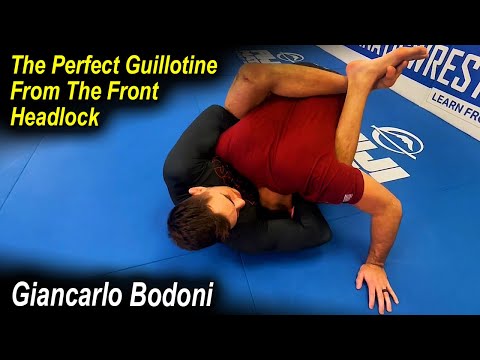
The guillotine is the main option to look for when in the front headlock learn more about the front headlock position h…
How To Do The Perfect Guillotine From The Front Headlock by Giancarlo Bodoni - Click Here To Check Out Giancarlo Bodoni'…
The guillotine choke from front headlock position is executed by establishing initial control through a chin strap and shoulder pressure on the opponent's neck, then progressing to hand connection and body positioning for the finish. Both Absolute MMA St Kilda and Bernardo Faria (featuring Giancarlo Bodoni) emphasize that proper hand placement is critical: the attacking hand wraps the neck while the second hand grasps one's own fist or the meaty part of the hand, with Bodoni highlighting a "gooseneck" wrist adjustment to ensure both carotid arteries are covered. Where Absolute MMA focuses on the mechanics of pulling the head high and positioning the ribs against the opponent's neck to enable higher hand placement on the chest, Bodoni stresses creating the threat of a go-behind to distract the opponent's hand-fighting defense. Both instructors agree that sitting to closed guard is the optimal finishing position, though they diverge on emphasis: Absolute MMA details sidestep mechanics and hip-capture control to prevent rolls, while Bodoni systematizes six finishing details—knee contraction, heel pressure, hand-to-chin proximity, chin-to-chest crunching, elbow positioning for jaw compression, and hip drive forward. Bodoni additionally recommends standing briefly to expose the opponent's waist before sitting into guard, which he argues prevents defensive rolling.
Synthesized from 2 instructors
No instructional courses yet for this technique.
Sign in to suggest a course.
Risk of injury to the person this technique is applied to
Sprawl guillotine capitalizes on failed takedown attempts; extremely common in MMA
Skill level needed to execute this technique reliably
Whether this technique is allowed under major competition rule sets
柔術B (jiujitsu-b.com); gentle-world.tech; Yahoo知恵袋 BJJ community; Wikipedia ja (フロントチョーク)
Major Japanese BJJ publication — comprehensive technique lists
Japanese BJJ submission guide
Japanese Q&A community — BJJ technique name verification
Japanese Wikipedia — martial arts technique articles
Standard katakana transliteration of Western martial arts terminology (外来語) — used in Japanese MMA, boxing, and BJJ communities
Japanese terminology sourced from 柔術B (jiujitsu-b.com); gentle-world.tech; Yahoo知恵袋 BJJ community; Wikipedia ja (フロントチョーク)
forearm and grip strength, hip flexibility for guard retention
longer arms for deeper chin-strap wrap
forearm flexors, biceps, hip flexors
Every move, in any martial art, shares a few universal traits. Mix and match below to pinpoint the right tool — or compare equivalents across styles.
The arm-in guillotine from front headlock sprawl traps the opponent's arm inside the guillotine loop while the attacker maintains a sprawl position on top. [1] After sprawling to defend a takedown, the attacker wraps the arm around the opponent's neck and one arm, locks the grip, and applies pressure by driving the hips down while pulling the neck upward. [1,2] The sprawl position provides downward weight pressure that supplements the arm squeeze, and the trapped arm fills the choking gap to increase compression efficiency. [2] This variant is common in MMA transitions where the defender sprawls a shot and immediately counters with the arm-in guillotine. [2,3]
The high-elbow guillotine from front headlock sprawl applies the elevated elbow guillotine mechanics while maintaining the dominant sprawl position. [1] After sprawling on a takedown attempt, the attacker wraps the neck and raises the choking elbow high above the opponent's back, driving the wrist deep under the chin at a steep angle. [1,2] The combination of sprawl weight pressing down and the high elbow pulling up creates a powerful vice effect on the throat. [2] This variant can be finished from the sprawl without pulling guard, making it valuable in MMA and wrestling-heavy rulesets where giving up top position is undesirable. [2,3]
Instead of attacking the neck directly, create the threat of a go-behind, which forces your opponent to worry about that escape and makes them vulnerable to the guillotine. Giancarlo Bodoni emphasizes that if you just try to attack the neck from the front headlock, it's easy for your opponent to hand-fight, so you must establish this positional threat first.
Focus on contracting rather than extending: keep your knees pulling in toward your body, heels digging into the opponent's back, bring your head forward, and angle your elbows—right elbow coming down and left elbow coming up—to crunch their chin to their chest. Giancarlo Bodoni notes that a common mistake is extending your legs and letting the head drift back, which prevents the finish.
Yes, Giancarlo Bodoni prefers to establish closed guard whenever possible before finishing, as it gives you better control and leverage for the submission. When you stand up from the front headlock, step over with one leg first (to prevent your opponent stepping across your body) and sit into closed guard.
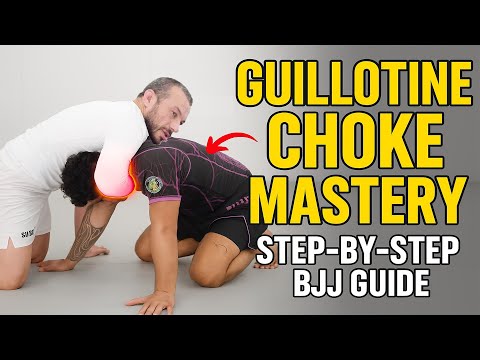
Sliding the side of your ribs to attach to your opponent's trap or neck creates a stronger choke connection than hand-fighting alone. Absolute MMA St Kilda emphasizes this body positioning as key to setting up an effective guillotine.
The guillotine choke from front-headlock sprawl is applied after the attacker sprawls to defend a takedown attempt, catching the opponent's head in a front headlock and wrapping the arm around the neck. The sprawl provides hip distance and downward pressure that prevent the opponent from completing the takedown, while the wrapped arm compresses the neck.
The sprawl-to-guillotine combination represents one of the fundamental counter-wrestling techniques in mixed martial arts and no-gi grappling. Early MMA competitors discovered that defending a takedown via sprawl created an ideal front headlock position for the guillotine.
IBJJF: legal — Legal at all belt levels, gi and no-gi — chokes are the safest submission cat…; IJF: legal — Legal (shime-waza) — strangulation techniques are one of three permitted subm…; ADCC: legal — Legal; Unified MMA: legal — Legal — choke submissions are among the most common finishes in MMA; FIAS Sport Sambo: banned — All chokes prohibited in Sport Sambo; FIAS Combat Sambo: legal — Legal
Danger rating 9/10. Sprawl guillotine capitalizes on failed takedown attempts; extremely common in MMA
The standard setup chain: Achieve Controlling Position → Isolate the Neck → Set the Grip → Apply Pressure.
Standard counters include: Tuck Chin — protect the neck by lowering the chin to prevent the choke from sinking / Two-on-One Grip Fight — use both hands to strip the choking grip before it locks / Turn Into — rotate toward the choking arm to relieve carotid pressure / Posture Up — straighten the spine and create distance to break the choking angle.
Common variants: Arm-in guillotine (traps the opponent's arm inside the choke for additional …); High-elbow guillotine (Marcelotine) (elevates the elbow above the head for stronger carotid co…); Standing guillotine (finished from the feet without pulling guard); Power guillotine (chin-strap grip with a rear-naked-choke-style finish for …).
Guillotine chokes are among the top 5 most common submissions in UFC history, with hundreds of finishes.
Top errors to watch for: Attempting to finish the guillotine while remaining in the sprawl position — without pulling guard, the opponent can … / Not sprawling deeply enough before attempting the choke — if the hips aren't low and heavy, the opponent completes th… / Wrapping the neck too loosely during the scramble — the grip must be tight immediately; a loose wrap allows the oppon… / Falling to the wrong side — when pulling guard, fall to the side of the choking arm; falling opposite opens the loop.
The Guillotine Choke From Front-Headlock Sprawl is also known as Girochin Chōku, Sprawl Guillotine, Standing Guillotine.