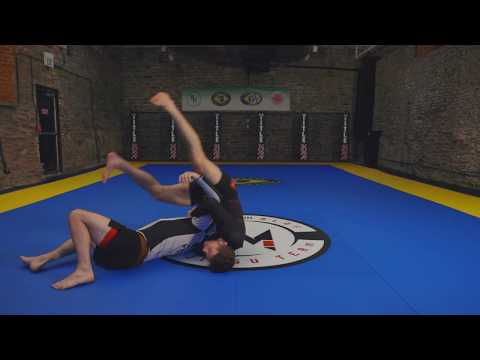
Front Headlock Choke Series: Sweep to Arm In Guillotine
0
Guillotine Choke From Front-Headlock Sprawl Arm-In·Robby Malof
https://limitlessbjj.com/ #bjj #jiujitsu #brazilianjiujitsu
Translation: Guillotine Choke (katakana loanword); also フロントチョーク
The arm-in guillotine from front headlock sprawl traps the opponent's arm inside the guillotine loop while the attacker maintains a sprawl position on top. [1] After sprawling to defend a takedown, the attacker wraps the arm around the opponent's neck and one arm, locks the grip, and applies pressure by driving the hips down while pulling the neck upward. [1],[2] The sprawl position provides downward weight pressure that supplements the arm squeeze, and the trapped arm fills the choking gap to increase compression efficiency. [2] This variant is common in MMA transitions where the defender sprawls a shot and immediately counters with the arm-in guillotine. [2],[3]
The sprawl-to-arm-in guillotine became a staple MMA counter-wrestling technique during the mid-2000s as fighters improved at punishing failed takedown attempts. [1] This transition from defensive sprawl to offensive submission exemplifies the grappling-striking integration that defines modern MMA. [2],[3]
Highly effective counter-wrestling technique — the sprawl defends the takedown while the arm-in guillotine punishes the attempt. The trapped arm's shoulder provides additional compression. [1]
Evolved from the wrestling sprawl-to-front-headlock sequence. The arm-in detail was refined by Marcelo Garcia's system. Standard MMA counter-wrestling since the early 2000s. [1]
One of the most common submission sequences in MMA — sprawl to arm-in guillotine. Appears regularly at UFC and professional MMA events as a takedown counter. [1]
No images yet for this technique.
Sign in to suggest an image.
https://limitlessbjj.com/ #bjj #jiujitsu #brazilianjiujitsu
No instructional courses yet for this technique.
Sign in to suggest a course.
Risk of injury to the person this technique is applied to
Guillotine variants compress the trachea and carotids from front headlock control
Skill level needed to execute this technique reliably
Whether this technique is allowed under major competition rule sets
柔術B (jiujitsu-b.com); gentle-world.tech; Yahoo知恵袋; Wikipedia ja (フロントチョーク)
Major Japanese BJJ publication — comprehensive technique lists
Japanese BJJ submission guide
Japanese Q&A community — BJJ technique name verification
Japanese Wikipedia — martial arts technique articles
Standard katakana transliteration of Western martial arts terminology (外来語) — used in Japanese MMA, boxing, and BJJ communities
Japanese terminology sourced from 柔術B (jiujitsu-b.com); gentle-world.tech; Yahoo知恵袋; Wikipedia ja (フロントチョーク)
forearm and grip strength, hip flexibility for guard retention
longer arms for deeper chin-strap wrap
forearm flexors, biceps, hip flexors
According to Robby Malof, it's critical to never lose your grip throughout the entire motion—keep it strong from start to finish. Post on your head, keep your hips strong, and maintain control even as you bridge and flip, ensuring you don't give up the grip at any point.
Robby Malof emphasizes positioning yourself north-south (head to head) with your opponent, then bridge your hips and flip yourself over your shoulder in one smooth motion, similar to a back roll, while keeping your posted position.
As you work the finish, drop your hips and spread your knees open wide to generate as much leverage as possible, which will help you complete the choke more effectively.
The arm-in guillotine from front headlock sprawl traps the opponent's arm inside the guillotine loop while the attacker maintains a sprawl position on top. After sprawling to defend a takedown, the attacker wraps the arm around the opponent's neck and one arm, locks the grip, and applies pressure by driving the hips down while pulling the neck upward.
The sprawl-to-arm-in guillotine became a staple MMA counter-wrestling technique during the mid-2000s as fighters improved at punishing failed takedown attempts. This transition from defensive sprawl to offensive submission exemplifies the grappling-striking integration that defines modern MMA.
IBJJF: legal — Legal at all belt levels, gi and no-gi — chokes are the safest submission cat…; IJF: legal — Legal (shime-waza) — strangulation techniques are one of three permitted subm…; ADCC: legal — Legal; Unified MMA: legal — Legal — choke submissions are among the most common finishes in MMA; FIAS Sport Sambo: banned — All chokes prohibited in Sport Sambo; FIAS Combat Sambo: legal — Legal
Danger rating 9/10. Guillotine variants compress the trachea and carotids from front headlock control
The standard setup chain: Establish Position → Create the Threat → Secure the Hold → Finish.
Standard counters include: Early Recognition — identify the submission attempt early and begin defence immediately / Posture and Base — maintain strong posture and base to prevent submission setups / Grip Fight — deny the attacker their preferred gripping configuration.
Common variants: Arm-in guillotine (traps the opponent's arm inside the choke for additional …); High-elbow guillotine (Marcelotine) (elevates the elbow above the head for stronger carotid co…); Standing guillotine (finished from the feet without pulling guard); Power guillotine (chin-strap grip with a rear-naked-choke-style finish for …).
One of the most common submission sequences in MMA — sprawl to arm-in guillotine. Appears regularly at UFC and professional MMA events as a takedown counter.
Top errors to watch for: Not including the arm fully inside the loop — the shoulder must contact the neck; a partially trapped arm creates an … / Staying in the sprawl position to finish — pull guard to create the hip extension and leg control needed for the fini… / Wrapping too loosely during the scramble — the grip must be tight immediately; the sprawl-to-guard transition is the … / Not closing the guard after pulling guard — open legs allow the opponent to pass; closed guard locks them in choking ….
The Guillotine Choke From Front-Headlock Sprawl Arm-In is also known as Girochin Chōku, Sprawl Arm-In Guillotine, Arm-In Guilhotina from Sprawl.