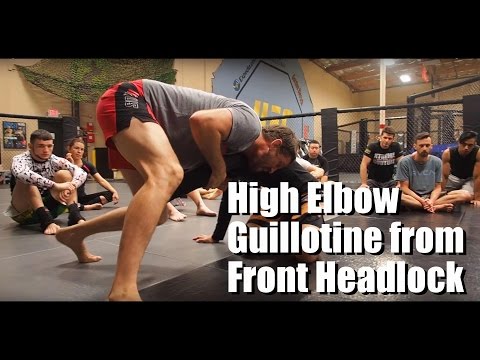
High Elbow Guillotine from the Front Headlock
0
Guillotine Choke From Front-Headlock Sprawl High-Elbow·Rich Castro
Nogi BJJ technique Xtreme Couture coach Robert Follis EM5II
Translation: Guillotine Choke (katakana loanword); also フロントチョーク
The high-elbow guillotine from front headlock sprawl applies the elevated elbow guillotine mechanics while maintaining the dominant sprawl position. [1] After sprawling on a takedown attempt, the attacker wraps the neck and raises the choking elbow high above the opponent's back, driving the wrist deep under the chin at a steep angle. [1],[2] The combination of sprawl weight pressing down and the high elbow pulling up creates a powerful vice effect on the throat. [2] This variant can be finished from the sprawl without pulling guard, making it valuable in MMA and wrestling-heavy rulesets where giving up top position is undesirable. [2],[3]
The highest-percentage sprawl-to-guillotine variation — the high-elbow angle creates a precise blood choke that produces rapid unconsciousness. The sprawl angle naturally positions the forearm for the high-elbow mechanics. [1]
Combines the wrestling sprawl defence with Marcelo Garcia's high-elbow (Marcelotine) innovation. Represents the fusion of wrestling defence and BJJ submission offence. [1]
Used at the highest levels of MMA and no-gi competition as the preferred sprawl-to-guillotine finish. The high-elbow detail increases the finishing rate compared to standard guillotine from sprawl. [1]
No images yet for this technique.
Sign in to suggest an image.
Nogi BJJ technique Xtreme Couture coach Robert Follis EM5II
No instructional courses yet for this technique.
Sign in to suggest a course.
Risk of injury to the person this technique is applied to
Guillotine variants compress the trachea and carotids from front headlock control
Skill level needed to execute this technique reliably
Whether this technique is allowed under major competition rule sets
柔術B (jiujitsu-b.com); gentle-world.tech; Yahoo知恵袋; Wikipedia ja (フロントチョーク)
Major Japanese BJJ publication — comprehensive technique lists
Japanese BJJ submission guide
Japanese Q&A community — BJJ technique name verification
Japanese Wikipedia — martial arts technique articles
Standard katakana transliteration of Western martial arts terminology (外来語) — used in Japanese MMA, boxing, and BJJ communities
Japanese terminology sourced from 柔術B (jiujitsu-b.com); gentle-world.tech; Yahoo知恵袋; Wikipedia ja (フロントチョーク)
forearm and grip strength, hip flexibility for guard retention
longer arms for deeper chin-strap wrap
forearm flexors, biceps, hip flexors
Rich Castro recommends placing one hand on the chin and the other on the back of the armpit or elbow, depending on your positioning. Avoid connecting your hands too early, as this creates excess exposure.
Your shoulder must be on the back of the neck, not the shoulder blades or further back. Placing it too far back allows your opponent to drive upward and escape; pinning the head rather than the back makes it very difficult for them to stay mobile.
Keep your arm parallel to the floor and lean your head over significantly to get your elbow over the centerline. This positioning makes the choke very difficult for your opponent to defend compared to keeping your arm higher.
The high-elbow guillotine from front headlock sprawl applies the elevated elbow guillotine mechanics while maintaining the dominant sprawl position. After sprawling on a takedown attempt, the attacker wraps the neck and raises the choking elbow high above the opponent's back, driving the wrist deep under the chin at a steep angle.
The sprawl high-elbow guillotine developed as a synthesis of Marcelo Garcia's high-elbow mechanics with the wrestling-based sprawl defence that dominates MMA grappling exchanges. Top-position guillotine finishes became increasingly common in UFC competition from the 2010s onward.
IBJJF: legal — Legal at all belt levels, gi and no-gi — chokes are the safest submission cat…; IJF: legal — Legal (shime-waza) — strangulation techniques are one of three permitted subm…; ADCC: legal — Legal; Unified MMA: legal — Legal — choke submissions are among the most common finishes in MMA; FIAS Sport Sambo: banned — All chokes prohibited in Sport Sambo; FIAS Combat Sambo: legal — Legal
Danger rating 9/10. Guillotine variants compress the trachea and carotids from front headlock control
The standard setup chain: Control the Arm → Position the Hips → Pinch Knees → Extend for the Finish.
Standard counters include: Clasp Hands — grip own wrist to prevent arm extension / Stack — drive forward to compress the attacker and relieve elbow pressure / Hitchhiker Escape — rotate the thumb toward the mat and roll to extract the arm.
Common variants: Arm-in guillotine (traps the opponent's arm inside the choke for additional …); High-elbow guillotine (Marcelotine) (elevates the elbow above the head for stronger carotid co…); Standing guillotine (finished from the feet without pulling guard); Power guillotine (chin-strap grip with a rear-naked-choke-style finish for …).
Used at the highest levels of MMA and no-gi competition as the preferred sprawl-to-guillotine finish. The high-elbow detail increases the finishing rate compared to standard guillotine from sprawl.
Top errors to watch for: Not elevating the elbow during the sprawl phase — the elbow should start rising before pulling guard; establishing th… / Pulling guard before the grip is secure — ensure the neck wrap and hand connection are solid before sitting back / Not curling the wrist after elevating the elbow — the wrist curl focuses the forearm blade into the artery; a flat wr… / Falling straight back instead of to the choking side — angle the body toward the choking arm when pulling guard.
The Guillotine Choke From Front-Headlock Sprawl High-Elbow is also known as Girochin Chōku, Sprawl High-Elbow Guillotine, Sprawl Marcelotine.