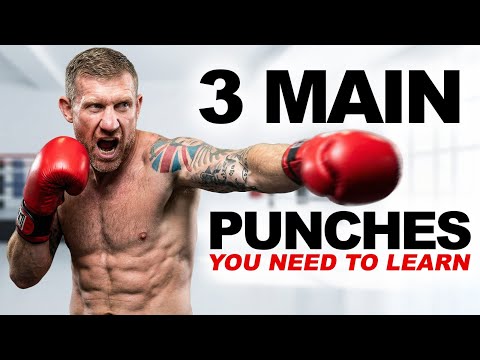
Basic Boxing Punch Numbers EXPLAINED
0
Punch·FightCamp
The SIX basic punches in boxing are the jab, cross, lead hook, rear hook, lead uppercut and rear uppercut. In this video…
突き(Tsuki)
TraditionalTranslation: punch
Punching with the closed fist is the most fundamental and universal striking technique in combat sports, with evidence of fist-fighting dating to Sumerian clay tablets from approximately 3000 BCE. [1] Ancient Greek boxing (pygmachia) was included in the Olympic Games from 688 BCE, with fighters binding their hands in leather thongs (himantes) for protection. [2] Modern Western boxing traces its lineage to 18th-century England, where Jack Broughton published the first formal boxing rules in 1743. [3] The Marquess of Queensberry Rules (1867) mandated padded gloves and three-minute rounds, fundamentally changing punching technique by allowing harder strikes to the head. [3] Parallel traditions of fist-striking developed independently in Okinawan karate (tsuki), Chinese martial arts (quan), and Thai boxing (chok). [4] Jack Dempsey's Championship Fighting (1950) provided the first comprehensive biomechanical analysis of punching technique in English. [5]
Punches account for the majority of significant strikes in MMA and are the sole offensive weapon in boxing. [1]
No images yet for this technique.
Sign in to suggest an image.
The SIX basic punches in boxing are the jab, cross, lead hook, rear hook, lead uppercut and rear uppercut. In this video…
The Heavybag Boxing Academy Program https://boxingfitness.com/heavybag?video=CPWKyPWyPr0 HAYABUSA Gloves - Use Code T…
No instructional courses yet for this technique.
Sign in to suggest a course.
Risk of injury to the person this technique is applied to
Punches to the head carry concussion and fracture risk (Walilko et al. 2005)
Skill level needed to execute this technique reliably
Whether this technique is allowed under major competition rule sets
Karate-Do Kyohan: The Master Text (Gichin Funakoshi, 1935)
Alias sources — [1] Championship Fighting (Dempsey, 1950) [2] Championship Fighting (Dempsey, 1950)
History sources — [1] Combat Sports in the Ancient World (Poliakoff, 1987) [2] The Ancient Olympics (Spivey, 2004) [3] The Art of Boxing and Manual of Training (Price, 1867) [4] Karate-Do Kyohan (Funakoshi, 1935) [5] Championship Fighting (Dempsey, 1950)
Official karate technique names (和語/漢語)
Established Japanese martial arts naming convention — native Japanese term (和語/漢語)
Alias sources — [1] Championship Fighting (Dempsey, 1950) [2] Championship Fighting (Dempsey, 1950)
History sources — [1] Combat Sports in the Ancient World (Poliakoff, 1987) [2] The Ancient Olympics (Spivey, 2004) [3] The Art of Boxing and Manual of Training (Price, 1867) [4] Karate-Do Kyohan (Funakoshi, 1935) [5] Championship Fighting (Dempsey, 1950)
hand speed, hip rotation, wrist alignment on impact
proportional reach, strong wrists, fast-twitch shoulder muscles
deltoids, pectorals, triceps, core rotators, forearms
A strike delivered with the back of the knuckles using a snapping or spinning motion, generating power through centrifugal force rather than linear extension.
The Boxing Punch family covers the punching techniques of Western boxing — the most refined and scientifically studied striking system in martial arts, developed over centuries of professional prizefighting. [1] Boxing recognises four fundamental punches — the jab (lead straight), cross (rear straight), hook (lead or rear arc punch), and uppercut (upward punch) — each with multiple variations in range, angle, and application. [1,2] Boxing punching mechanics are considered the gold standard for hand striking across all combat sports: the integration of footwork, hip rotation, shoulder torque, and weight transfer into a unified kinetic chain produces maximum force with minimum telegraph. [2,3] Every modern striking-based martial art (MMA, kickboxing, Muay Thai) has adopted boxing's punching system as its hand-striking foundation. [3]
Punches that travel along a circular or angular path to the target, bypassing the opponent's guard by attacking from the side or below.
The Fundamental Punch family covers punching techniques that span multiple martial arts traditions beyond Western boxing — including backfists, hammer fists, spinning backfists, and superman punches that appear across karate, MMA, kickboxing, and other striking systems. [1] While boxing provides the four foundational punches (jab, cross, hook, uppercut), many martial arts have developed additional fist-based striking techniques that use different striking surfaces, trajectories, and tactical applications. [1,2] The backfist (uraken) and hammer fist (tetsui) use the back of the fist and the bottom of the fist respectively, offering strikes that can be delivered from angles inaccessible to standard boxing punches. [2,3] In MMA, the spinning backfist and superman punch have become signature highlight-reel techniques that blend traditional martial arts with modern fighting. [3]
The Kung Fu Strike family within the Punch group covers fist-based striking techniques from Chinese martial arts (kung fu/wushu) systems, which have developed an extraordinarily diverse array of punching methods beyond the Western boxing framework. [1] Chinese martial arts use multiple fist formations — the standard fist (quan), phoenix-eye fist (feng yan quan, striking with the protruding second knuckle), leopard fist (bao quan, striking with the second knuckles of all four fingers), and the one-inch punch (cun jin, generating power from extremely close range). [1,2] Wing Chun's chain punches (lian huan quan) deliver rapid straight punches along the centre line, while Shaolin systems include a vast vocabulary of fist strikes targeting specific anatomical points. [2,3] These techniques emphasise different striking surfaces and force-generation principles compared to Western boxing, reflecting Chinese martial philosophy of precision targeting and energy flow (jin/qi). [3]
Punches traveling in a direct linear path from the guard position to the target, generating power through hip rotation and full extension of the arm.
An explosive lunging punch where the fighter fakes a kick to lift off the ground and throws a straight or overhand punch while airborne, using the momentum of the entire body.
The TKD Punch family encompasses the hand striking techniques (jirugi — punches, and taerigi — strikes) of Taekwondo, which are classified separately from the punching systems of boxing, karate, or Muay Thai. [1] In Taekwondo's technical taxonomy, hand techniques are divided into jirugi (thrusting/punching) and taerigi (striking/swinging), each with distinct hand formations, trajectories, and applications. [1] While Taekwondo is primarily known as a kicking art, hand techniques remain part of the ITF and WT curricula and are used in patterns (tul/poomsae), self-defense applications, and breaking demonstrations. [1,2] In WT competition, punches to the body score points but are used less frequently than kicks due to the scoring system that awards higher points for head kicks and spinning techniques. [2] In ITF competition, hand techniques play a more balanced role alongside kicks. [1,2]
Punching is the foundation of hand striking — the four basic punches (jab, cross, hook, uppercut) appear in thousands of passages. Dempsey's Championship Fighting (1950) remains the definitive text on punching mechanics. In MMA, boxing hand skills combined with wrestling form the most dominant fighting style. (200+ books; Dempsey, Championship Fighting; boxing and MMA texts)
Each number represents a different punch in boxing. FightCamp explains that 1 is the jab (lead hand), 2 is the cross (rear hand), 3 is the lead hook, 4 is the rear hook, 5 is the lead uppercut, and 6 is the rear uppercut. Learning these six basic punches lets you understand and execute any combination a coach calls out.
Tony Jeffries emphasizes that fully extending your arm makes the punch stronger and longer, whereas keeping your arm bent will reduce power. For straight punches, full extension is essential to maximize the effectiveness of the technique.
Tony Jeffries stresses that you should stay relaxed and exhale when throwing—holding your breath makes the punch tight and less smooth. Additionally, turn your fist as the punch extends to engage all the arm muscles and prevent injury to your elbow.
According to FightCamp, the more you practice the six basic punches (1-6), the better boxer you'll become. Shadow boxing while saying the numbers out loud and practicing until the punches become second nature is the recommended approach.
Strikes delivered with a closed fist, using rotational force from the hips and shoulders to generate power through the knuckles.
Punching with the closed fist is the most fundamental and universal striking technique in combat sports, with evidence of fist-fighting dating to Sumerian clay tablets from approximately 3000 BCE. Ancient Greek boxing (pygmachia) was included in the Olympic Games from 688 BCE, with fighters binding their hands in leather thongs (himantes) for protection.
Unified MMA: legal — Legal striking technique; WBC/Boxing: legal — Legal — punches are the core technique of boxing; WKF: legal — Legal, jodan/chudan punch scores 1 point (yuko) — controlled contact required; Kyokushin: restricted — Body punches legal at full power, head punches banned; WT: restricted — Punches to trunk only (1 point), punches to head banned; ITF: legal — Legal — hand techniques to head and body both permitted; WAKO: legal — Legal in Full Contact and Low Kick formats; K: legal — 1/GLORY — Legal — full power punches to head and body; IFMA: legal — Legal
Danger rating 5/10. High — punches to the head carry concussion and fracture risk (Walilko et al. 2005)
The standard setup chain: Assume Fighting Stance → Generate Power → Execute Strike → Recover to Guard.
Standard counters include: Slip — move the head off the centre line to evade the punch / Parry — deflect the incoming punch with a quick hand redirection / Counter Cross — time a straight punch over the incoming attack.
Common variants: Standard variation (primary execution of the strike from the most common stance); Power variation (modified mechanics for maximum force generation); Speed variation (minimised telegraph for a faster, harder-to-read attack); Counter variation (timed to exploit the opponent's offensive commitment).
Punches account for the majority of significant strikes in MMA and are the sole offensive weapon in boxing.
Top errors to watch for: Flaring the elbow on hooks and uppercuts — reduces power and exposes the ribs / Winding up or pulling the hand back before punching, telegraphing the shot / Pushing punches instead of snapping them — the fist should accelerate through the target and retract / Locking the elbow at full extension on straight punches, risking hyperextension.
The Punch is also known as Tsuki, Fist Strike, Closed-Fist Blow.