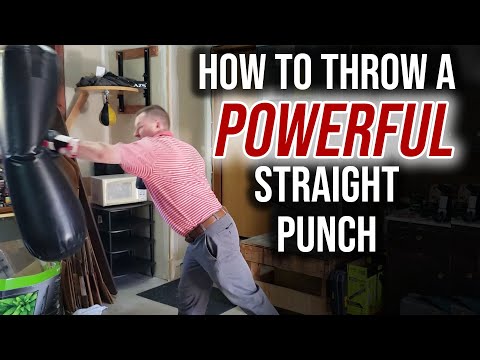
How to Throw a Powerful Straight Punch
0
Straight Punch·The Punch Doctor
https://ThePunchDoctor.com – Become more dangerous I see a lot of wrong information about straight punch mechanics on y…
Translation: straight punch
Straight punches — the jab, cross, and their variants — form the foundation of Western boxing technique and are among the most biomechanically efficient strikes in combat sports. [1] The straight punch was codified as the primary boxing technique in the 18th century, with Daniel Mendoza and 'Gentleman' John Jackson pioneering the use of the straight lead to maintain range and score. [2] Price's 1867 Art of Boxing established the straight punch as the cornerstone of scientific boxing. [3] Dempsey later provided the definitive biomechanical analysis in Championship Fighting (1950), describing the 'power line' concept where the body's kinetic chain is aligned to deliver maximum force along a straight trajectory. [1] In karate, the straight punch (choku-tsuki) was codified by Funakoshi as the fundamental hand technique. [4]
Straight punches (jab and cross) are the foundation of Western boxing. [1]
Straight punches are the most commonly thrown strikes in boxing and MMA. [1]
No images yet for this technique.
Sign in to suggest an image.
https://ThePunchDoctor.com – Become more dangerous I see a lot of wrong information about straight punch mechanics on y…
No instructional courses yet for this technique.
Sign in to suggest a course.
Risk of injury to the person this technique is applied to
Jab/cross; fundamental striking tool, cumulative brain trauma risk
Skill level needed to execute this technique reliably
Whether this technique is allowed under major competition rule sets
Karate-Do Kyohan: The Master Text (Gichin Funakoshi, 1935)
Alias sources — [1] Championship Fighting (Dempsey, 1950) [2] Championship Fighting (Dempsey, 1950)
History sources — [1] Championship Fighting (Dempsey, 1950) [2] Boxing's Greatest Fighters (Sugar, 2006) [3] The Art of Boxing and Manual of Training (Price, 1867) [4] Karate-Do Kyohan (Funakoshi, 1935)
Official karate technique names (和語/漢語)
Established Japanese martial arts naming convention — native Japanese term (和語/漢語)
Alias sources — [1] Championship Fighting (Dempsey, 1950) [2] Championship Fighting (Dempsey, 1950)
History sources — [1] Championship Fighting (Dempsey, 1950) [2] Boxing's Greatest Fighters (Sugar, 2006) [3] The Art of Boxing and Manual of Training (Price, 1867) [4] Karate-Do Kyohan (Funakoshi, 1935)
hand speed, hip rotation, wrist alignment on impact
proportional reach, strong wrists, fast-twitch shoulder muscles
deltoids, pectorals, triceps, core rotators, forearms
Every move, in any martial art, shares a few universal traits. Mix and match below to pinpoint the right tool — or compare equivalents across styles.
A powerful straight punch thrown with the rear hand, rotating the hips and shoulders fully to generate maximum force along a direct line to the target.
A quick, straight punch thrown with the lead hand from the guard position, used primarily as a range finder, setup tool, and defensive weapon.
The Lead Hand Straight (commonly called the Jab) is the most fundamental punch in boxing, delivered with the leading hand in a straight line from the guard position to the target. [1] It is the fastest punch due to the shortest distance to travel and serves as the foundation of all boxing combinations. [1] The jab controls distance, sets up power shots, and disrupts the opponent's rhythm. [1]
Oi Tsuki is the fundamental stepping punch in karate where the practitioner lunges forward with the rear foot stepping to the front while simultaneously delivering a straight punch with the arm on the same side as the stepping leg. [1] Unlike gyaku tsuki (reverse punch) where the punching arm is opposite to the lead leg, oi tsuki coordinates the punch with the forward step, using the body's forward momentum to power the strike. [1] It is typically the first punch taught in karate and appears in nearly every kata. [1]
A fundamental two-punch combination consisting of a lead-hand jab immediately followed by a rear-hand cross, the most basic and widely taught combination in striking arts.
Seiken Gedan Tsuki is a straight punch targeting the lower level (below the belt) — typically the groin, lower abdomen, or thigh — using the fore-fist (seiken). [1] The punch travels in a straight line from the hip to the lower target, with the fist rotating to palm-down at the moment of impact. [1] It is one of the three basic height levels of the karate straight punch (jodan/chudan/gedan). [1]
The straight punch (jab and cross) travels the shortest distance and is the fastest punch. The jab is the most important punch in boxing — it sets up everything else. (Dempsey, Championship Fighting; Nakayama, Dynamic Karate)
The Punch Doctor emphasizes pushing with your back foot to drive your hips forward, which gets your entire torso moving. This hip rotation is the key to transferring power through your body into the punch.
You should clench your fist as hard as you can at the moment of impact to make your fist sturdy and solid, like hitting with a two-by-four. This tight grip at impact prevents your arm from moving backward and allows you to transfer your weight through the strike.
The Punch Doctor recommends clenching your fist at the point of impact rather than aiming two inches past it, as this gives you a stable surface to land with. Aiming beyond the target causes your arm to collapse and reduces the solidity of the punch.
Punches traveling in a direct linear path from the guard position to the target, generating power through hip rotation and full extension of the arm.
Straight punches — the jab, cross, and their variants — form the foundation of Western boxing technique and are among the most biomechanically efficient strikes in combat sports. The straight punch was codified as the primary boxing technique in the 18th century, with Daniel Mendoza and 'Gentleman' John Jackson pioneering the use of the straight lead to maintain range and score.
Unified MMA: legal — Legal striking technique; WBC/Boxing: legal — Legal — punches are the core technique of boxing; WKF: legal — Legal, jodan/chudan punch scores 1 point (yuko) — controlled contact required; Kyokushin: restricted — Body punches legal at full power, head punches banned; WT: restricted — Punches to trunk only (1 point), punches to head banned; ITF: legal — Legal — hand techniques to head and body both permitted; WAKO: legal — Legal in Full Contact and Low Kick formats; K: legal — 1/GLORY — Legal — full power punches to head and body; IFMA: legal — Legal
Danger rating 5/10. High — jab/cross; fundamental striking tool, cumulative brain trauma risk
The standard setup chain: Fighting Stance → Weight Transfer → Extend → Snap Back.
Standard counters include: Slip — move the head off the centre line to evade the punch / Parry — deflect the incoming punch with a quick hand redirection / Counter Cross — time a straight punch over the incoming attack.
Common variants: Standard cross (rear-hand straight punch with full hip rotation); Counter cross (pull counter) (leaning back to avoid the jab, firing the cross as a counter); Step-in cross (stepping forward with the punch for added reach and power); Body cross (targeting the solar plexus or liver with the straight rea…).
Straight punches are the most commonly thrown strikes in boxing and MMA.
Top errors to watch for: Flaring the elbow outward on the cross, which reduces power and telegraphs the punch / Reaching forward with the head instead of stepping with the feet — puts you off-balance and chin-first / Dropping the lead hand after the jab before throwing the cross, opening a window for the counter hook / Over-rotating the torso on the cross so your shoulder passes your chin — you lose your guard and balance.
The Straight Punch is also known as Choku-tsuki, Linear Punch, Direct Punch.