Kung Fu Strike

Family

カンフーストライク(Kanfū Sutoraiku)

Translation: Kung fu strike

Overview

The Kung Fu Strike family within the Punch group covers fist-based striking techniques from Chinese martial arts (kung fu/wushu) systems, which have developed an extraordinarily diverse array of punching methods beyond the Western boxing framework. [1] Chinese martial arts use multiple fist formations — the standard fist (quan), phoenix-eye fist (feng yan quan, striking with the protruding second knuckle), leopard fist (bao quan, striking with the second knuckles of all four fingers), and the one-inch punch (cun jin, generating power from extremely close range). [1],[2] Wing Chun's chain punches (lian huan quan) deliver rapid straight punches along the centre line, while Shaolin systems include a vast vocabulary of fist strikes targeting specific anatomical points. [2],[3] These techniques emphasise different striking surfaces and force-generation principles compared to Western boxing, reflecting Chinese martial philosophy of precision targeting and energy flow (jin/qi). [3]

Also known as
Chinese Martial Arts PunchWushu Fist TechniqueCNKung Fu Fist StrikeCN

History & Origin

Chinese fist-based striking techniques have been developed over thousands of years across hundreds of kung fu styles, from Shaolin Temple boxing (dating traditionally to the 6th century CE, historically documented from the 16th century) to Wing Chun (attributed to Ng Mui and Yim Wing Chun, c. 17th–18th century). [1] Bruce Lee's one-inch punch demonstration at the 1964 Long Beach International Karate Championships brought Chinese punching concepts to worldwide attention. [1],[2] Xingyi Quan's five element fists represent one of the most systematic Chinese punching methodologies, with each fist corresponding to a different force vector and application. [2],[3]

Effectiveness

Chinese martial arts punching techniques offer alternative striking surfaces and angles that complement standard boxing. [1] Wing Chun's centreline theory and chain punching have been tested in MMA with mixed results — effective at close range but challenging to apply against orthodox boxing defence. [2] The one-inch punch demonstrates that extreme short-range power is possible through biomechanical coordination, though its practical combat application remains debated. [3]

Lineage

Chinese fist techniques trace through Shaolin (external systems), Wudang (internal systems like Xingyi and Bagua), and Wing Chun (centreline striking), with Bruce Lee synthesising elements into Jeet Kune Do. [1],[2]

Competition Record

Chinese punching techniques are used in wushu sanda competition and have been tested in MMA with varying success. Wing Chun practitioners have competed in MMA and kickboxing with mixed results. [1],[2]

Images

No images yet for this technique.

Sign in to suggest an image.

Biomechanical Mechanism

Primary ActionDelivering force through a closed fist using Chinese martial arts-specific fist formations, striking surfaces, and power generation methods
Joints InvolvedWrist (different fist formations require specific wrist alignments — vertical fist in Wing Chun vs horizontal in boxing), elbow (Wing Chun emphasises elbow-in centreline striking), shoulder (different mechanics — Wing Chun uses forward shoulder drive rather than hip rotation for some punches), hips (Shaolin punching uses deep stances and waist turning; Wing Chun uses less hip rotation)
Force VectorWing Chun chain punch: linear, straight down the centreline, Shaolin long-range punch: linear with deep stance drive, One-inch punch: explosive short-range force generation through coordinated whole-body activation
Strike MechanicChinese punching systems often use the vertical fist (thumb up) rather than the horizontal fist (palm down) of boxing; the vertical fist aligns the wrist more neutrally and enables centreline striking

Position & Entry

Wing Chun chain punch (lian huan quan)From the Wing Chun guard (wu sao/man sao), punch straight down the centreline with alternating hands in rapid succession — each punch retracts as the next extends; the punches are delivered from the centre with elbows in [1]
One-inch punch (cun jin)From very close range (hand nearly touching the target), generate explosive force through simultaneous hip snap, shoulder drive, and wrist snap — famously demonstrated by Bruce Lee
Shaolin straight punchFrom a deep horse stance or bow stance, drive the fist forward with waist rotation, fully extending the arm while pulling the opposite hand to the hip (hikite) — similar mechanics to karate punching

Videos

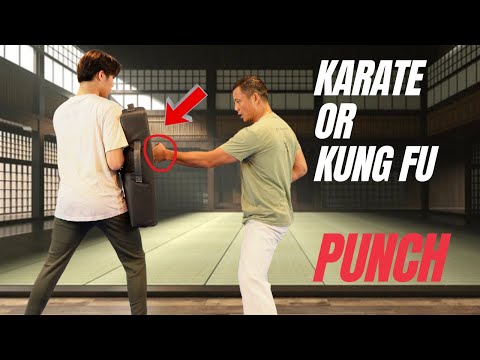
Karate Punch vs Kung Fu Punch: Martial Arts Comparison

0
Kung Fu Strike·Len Tran

Ever wondered why karate and kung fu punches feel so different? In this detailed breakdown, I reveal the hidden mechanic

1 video

Learn This Technique

No instructional courses yet for this technique.

Sign in to suggest a course.

Ratings

Danger Rating

Risk of injury to the person this technique is applied to

5
High5/10

Chinese martial arts punches carry standard hand-injury risks; phoenix-eye fist targeting pressure points can cause significant pain; many techniques have not been extensively tested under full-contact competition conditions

Difficulty

Skill level needed to execute this technique reliably

Intermediate
Competition Legality

Whether this technique is allowed under major competition rule sets

Restricted
Kyokushin — Body punches legal at full power, head punches banned {srcIKO Kyokushin Tournament Rules}
Legal
Unified MMA — Legal striking technique
Unified Rules of MMA, August 2025PDF
WBC/Boxing — Legal — punches are the core technique of boxing {srcWBC Rules of Boxing}
ITF — Legal — hand techniques to head and body both permi...
ITF Competition RulesPDF
WAKO — Legal in Full Contact and Low Kick formats
WAKO Competition RulesPDF
K-1/GLORY — Legal — full power punches to head and body {srcK-1/GLORY Kickboxing Rules}
IFMA — Legal
IFMA Muay Thai RulesPDF

Training Notes

Wing Chun chain punches are trained on the wooden dummy (muk yan jong) and through chi sao (sticky hands) drills to develop centreline awareness and sensitivity [1]
One-inch punch power comes from whole-body coordination, not arm strength — the hip snap, shoulder drive, and wrist snap must fire simultaneously; practice on a heavy bag from progressively closer distances
Iron fist conditioning (tie sha zhang) — traditional Chinese hand conditioning involves striking sand bags, then iron shot bags to harden the fists; this is a long-term process that must be done gradually to avoid injury [2]
Many Chinese fist formations target specific anatomical points — learning traditional Chinese medicine meridian points enhances targeting precision
Shaolin punching is practiced within forms (taolu) — the forms encode combinations, angles, and applications that are extracted through partner training
The vertical fist (used in Wing Chun and some Shaolin systems) should be trained alongside the horizontal fist — each has advantages at different ranges
Train Chinese punching alongside modern sparring methods to test which techniques are effective under pressure

Common Mistakes

!Using Phoenix-eye fist without conditioning — the protruding knuckle can be injured if the fist formation is incorrect or the hand is not conditioned
!Chain punching without structure — Wing Chun chain punches require proper elbow-in centreline structure; sloppy chain punches are weak and easily deflected
!Attempting one-inch punch without whole-body coordination — using only the arm produces minimal power; the technique requires synchronised activation of legs, hips, core, shoulder, and wrist
!Training only forms without partner application — forms encode techniques but partner training develops timing and applicability
!Using traditional fist formations in competition without testing them in sparring — some traditional techniques require modification for effectiveness under modern competition conditions
!Neglecting guard position — many traditional Chinese striking stances leave the head less protected than a boxing guard

Related Techniques

Counter Techniques

Setup Chain

1Establish Rangeclose to Chinese punching range (often closer than boxing range)
2Hand Fightestablish contact through trapping or grip fighting (Wing Chun chi sao concept)
3Attack Centredrive punches down the centreline or to targeted pressure points
4Chain Attacksfollow with rapid follow-up strikes (chain punching or combination)
5Controlmaintain centreline dominance through forward pressure
6Disengage or Transitionexit to safe range or transition to trapping/clinch

Sources & References

Primary Source

Tao of Jeet Kune Do (Bruce Lee, 1975)

1BookThe Tao of Wing Chun (Danny Xuan & John Little, 1998)

Description sources — [1] The Tao of Wing Chun (Xuan & Little, 1998) [2] Tao of Jeet Kune Do (Lee, 1975) on Chinese punching influences [3] Xingyi Quan classical texts

2BookDynamic Karate (Nakayama, 1966)
3BookTao of Jeet Kune Do (Lee, 1975)
4BookXingyi Quan (Sun Lutang, 1915)
5CitationThe Tao of Wing Chun (Danny Xuan & John Little, 1998)

Description sources — [1] The Tao of Wing Chun (Xuan & Little, 1998) [2] Tao of Jeet Kune Do (Lee, 1975) on Chinese punching influences [3] Xingyi Quan classical texts

6CitationDynamic Karate (Nakayama, 1966)
7CitationTao of Jeet Kune Do (Lee, 1975)
8CitationXingyi Quan (Sun Lutang, 1915)

Community

Athletics

Requires

hand conditioning (many techniques need hardened fists), centreline awareness, whole-body coordination for short-range power

Favours

quick hands, strong wrists, good proprioception

Key muscles

forearms (fist stability and grip), core (power transfer), shoulders (forward drive for Wing Chun punching), hip flexors (stance work)

Sub-techniques

Phoenix Eye Fist

SubFamily

The Phoenix Eye Fist is a Chinese martial arts striking technique where the index finger knuckle is extended beyond the other knuckles to form a single protruding point, creating a concentrated striking surface for attacking pressure points, nerve clusters, and other anatomically vulnerable targets. [1] The fist is formed by curling all fingers tightly except the index finger, which extends its proximal interphalangeal (PIP) joint slightly forward of the other knuckles while the distal phalanx curls back toward the palm — the result is a fist with a single bony point protruding approximately 1-2 centimetres beyond the standard fore-fist surface. [1,2] This single-point concentration of force dramatically increases the pressure (force per unit area) delivered to the target: a standard punch distributes impact across approximately 8-10 cm² of the front two knuckles, while the Phoenix Eye concentrates the same force onto approximately 1 cm² of a single knuckle — producing roughly 8-10x the pressure on the target tissue. [1] This extreme pressure concentration is what makes the Phoenix Eye effective against small, precise targets that a regular punch would strike too broadly to affect: the temple, the hollow behind the ear (mastoid process), the throat (specifically the carotid sinus), the sternum notch (suprasternal notch), intercostal nerve points between the ribs, and the philtrum (the groove between the nose and upper lip). [1,2] The technique appears across multiple Chinese martial arts systems, most prominently in Wing Chun, Southern Praying Mantis, Hop-Gar, and various Hakka boxing styles. [1,2] In Japanese karate, the equivalent technique is called Ippon Ken (一本拳, 'one-point fist') and appears in several traditional kata. [3] The Phoenix Eye requires significant finger conditioning to use safely — without conditioning, the protruding index knuckle can fracture, dislocate, or hyperextend on impact against hard targets like the skull. [1,2]

Explore

Notes

Kung fu strikes appear in 918+ passages under 'knife hand,' 222 under 'spear hand,' and hundreds more across Chinese martial arts texts. Chinese striking includes unique hand formations: tiger claw, crane beak, phoenix eye fist, iron palm, and dim mak (pressure point strikes). (200+ books; Chinese martial arts texts in corpus)

Frequently Asked Questions

What's the main difference between how a Kung Fu strike and a Karate punch use the body?

In Kung Fu striking, you go loose initially and your whole body moves with you as you deliver the strike. In contrast, Karate punches rely more heavily on hip rotation to drive into the target, and you must lock the wrist at impact. According to Len Tran, the Kung Fu approach sends your entire body with the strike rather than isolating power through hip and wrist mechanics.

Why is it important to tighten up during a Kung Fu strike?

Tightening up at impact is crucial because if you don't generate enough damage, your opponent will likely get angry and come after you. According to Len Tran, you start loose during the strike but must tighten your body as you make contact to maximize the force delivered.

How should I use my legs and hips when throwing a Kung Fu strike?

You want to use your legs as well as your hip and anchor your stance before delivering the strike. Len Tran emphasizes that you go loose as you begin the movement, turn your hips, and anchor your position to generate full momentum with your body moving forward toward your target.

How does the Kung Fu Strike work?

The Kung Fu Strike family within the Punch group covers fist-based striking techniques from Chinese martial arts (kung fu/wushu) systems, which have developed an extraordinarily diverse array of punching methods beyond the Western boxing framework. Chinese martial arts use multiple fist formations — the standard fist (quan), phoenix-eye fist (feng yan quan, striking with the protruding second knuckle), leopard fist (bao quan, striking with the second knuckles of all four fingers), and the one-inch punch (cun jin, generating power from extremely close range).

Where does the Kung Fu Strike come from?

Chinese fist-based striking techniques have been developed over thousands of years across hundreds of kung fu styles, from Shaolin Temple boxing (dating traditionally to the 6th century CE, historically documented from the 16th century) to Wing Chun (attributed to Ng Mui and Yim Wing Chun, c. 17th–18th century).

Is the Kung Fu Strike legal in competition?

Unified MMA: legal — Legal striking technique; WBC/Boxing: legal — Legal — punches are the core technique of boxing; WKF: legal — Legal, jodan/chudan punch scores 1 point (yuko) — controlled contact required; Kyokushin: restricted — Body punches legal at full power, head punches banned; WT: restricted — Punches to trunk only (1 point), punches to head banned; ITF: legal — Legal — hand techniques to head and body both permitted; WAKO: legal — Legal in Full Contact and Low Kick formats; K: legal — 1/GLORY — Legal — full power punches to head and body; IFMA: legal — Legal

How dangerous is the Kung Fu Strike?

Danger rating 5/10. Moderate — Chinese martial arts punches carry standard hand-injury risks; phoenix-eye fist targeting pressure points can cause significant pain; many techniques have not been extensively tested under full-contact competition conditions

How do I set up the Kung Fu Strike?

The standard setup chain: Establish Range → Hand Fight → Attack Centre → Chain Attacks → Control → Disengage or Transition.

How do I defend against the Kung Fu Strike?

Standard counters include: Boxing Guard — a tight boxing guard effectively blocks chain punches / Footwork — stepping offline defeats centreline theory / Clinch — entering the clinch neutralises close-range Chinese striking / Takedown — shooting for a takedown bypasses the striking exchange.

What are the variants of the Kung Fu Strike?

Common variants: Chain punch (lian huan quan) (rapid alternating straight punches down the centreline; W…); One-inch punch (cun jin) (explosive short-range power generation; Bruce Lee's famou…); Phoenix-eye fist (feng yan quan) (protruding second knuckle targets nerve points and soft t…); Leopard fist (bao quan) (flat fist striking with the second knuckles; targets sola…); Back fist (pi quan) (chopping downward fist; found in many Shaolin forms); Drilling fist (zuan quan) (upward spiralling punch in Xingyi Quan); Crushing fist (beng quan) (straight forward punch in Xingyi Quan; one of the five el…).

How effective is the Kung Fu Strike in competition?

Chinese punching techniques are used in wushu sanda competition and have been tested in MMA with varying success. Wing Chun practitioners have competed in MMA and kickboxing with mixed results.

What are common mistakes when doing the Kung Fu Strike?

Top errors to watch for: Using Phoenix-eye fist without conditioning — the protruding knuckle can be injured if the fist formation is incorrec… / Chain punching without structure — Wing Chun chain punches require proper elbow-in centreline structure; sloppy chain… / Attempting one-inch punch without whole-body coordination — using only the arm produces minimal power; the technique … / Training only forms without partner application — forms encode techniques but partner training develops timing and ap….

What are other names for the Kung Fu Strike?

The Kung Fu Strike is also known as Kanfū Sutoraiku, Chinese Martial Arts Punch, Wushu Fist Technique, Kung Fu Fist Strike.