Four Direction Punch - Taekwon-Do Lesson #15
0
TKD Punch·Donato Nardizzi
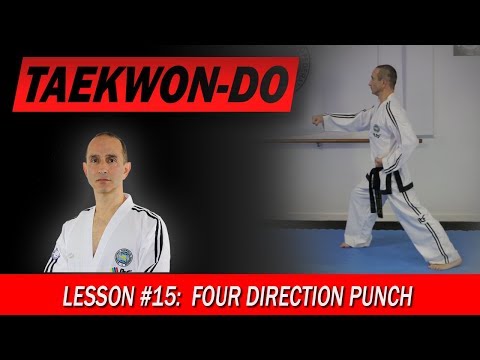
This video shows you how to practice Four Direction Punch which is a fundamental exercise taught to beginners to prepare…
Translation: Taekwondo punching and striking techniques
The TKD Punch family encompasses the hand striking techniques (jirugi — punches, and taerigi — strikes) of Taekwondo, which are classified separately from the punching systems of boxing, karate, or Muay Thai. [1] In Taekwondo's technical taxonomy, hand techniques are divided into jirugi (thrusting/punching) and taerigi (striking/swinging), each with distinct hand formations, trajectories, and applications. [1] While Taekwondo is primarily known as a kicking art, hand techniques remain part of the ITF and WT curricula and are used in patterns (tul/poomsae), self-defense applications, and breaking demonstrations. [1],[2] In WT competition, punches to the body score points but are used less frequently than kicks due to the scoring system that awards higher points for head kicks and spinning techniques. [2] In ITF competition, hand techniques play a more balanced role alongside kicks. [1],[2]
Taekwondo's hand techniques derive primarily from the karate systems that Korean martial artists studied during the Japanese occupation of Korea (1910–1945). [1] When General Choi Hong Hi and other founders systematized Taekwondo in the 1950s–60s, they retained and modified the hand techniques from Shotokan karate, adding the sine wave motion and distinctive Korean nomenclature. [1],[2] The ITF system under General Choi maintained a balanced curriculum of hand and foot techniques, while the WT (Olympic) system gradually de-emphasized hand techniques in favor of spectacular kicking techniques that scored higher under the electronic scoring system introduced in 2009. [2]
TKD punches are effective when delivered with proper body mechanics but are generally underdeveloped compared to boxing or Muay Thai hand techniques due to training emphasis on kicking. [1] In MMA, Taekwondo fighters typically supplement their hand techniques with boxing training. In self-defense, the TKD reverse punch (bandae jirugi) delivers solid power through hip rotation. [1],[2]
Taekwondo lineage: Japanese Shotokan karate (via Korean students during Japanese occupation 1910–1945) → Korean kwans (Chung Do Kwan, Moo Duk Kwan, Song Muk Kwan, etc.) → unified under General Choi Hong Hi as Taekwon-Do (ITF, 1966) and separately as World Taekwondo (WT/Kukkiwon, 1973). [1]
TKD hand techniques score in both WT and ITF competition, though kicks receive higher point values in WT. In ITF semi-contact, punches are scored equally with kicks to the same target. [1]
No images yet for this technique.
Sign in to suggest an image.
This video shows you how to practice Four Direction Punch which is a fundamental exercise taught to beginners to prepare…
1 on 1 Lessons - http://www.AlexWongTKD.com Follow me on Social Media! TRAIN WITH ME ONLINE - http://www.AlexWongTKD.c…
No instructional courses yet for this technique.
Sign in to suggest a course.
Risk of injury to the person this technique is applied to
Standard hand striking force. TKD punches are generally less powerful than boxing punches due to different training emphasis.
Skill level needed to execute this technique reliably
Whether this technique is allowed under major competition rule sets
Choi, H.H. (1985). Encyclopedia of Taekwon-Do (15 vols). International Taekwon-Do Federation.
[1] Choi, Encyclopedia of Taekwon-Do, Vol. 3–4, Hand Techniques chapters
[2] Park & Gerrard, Tae Kwon Do: The Ultimate Reference Guide, punching and striking sections
[1] Choi, Encyclopedia of Taekwon-Do, Vol. 3–4, Hand Techniques chapters
[2] Park & Gerrard, Tae Kwon Do: The Ultimate Reference Guide, punching and striking sections
hip rotation, wrist alignment, sine wave body mechanics
coordinated athletes who can integrate body drop with arm extension
hip rotators, core, triceps, forearm extensors (wrist lock), deltoids
Every move, in any martial art, shares a few universal traits. Mix and match below to pinpoint the right tool — or compare equivalents across styles.
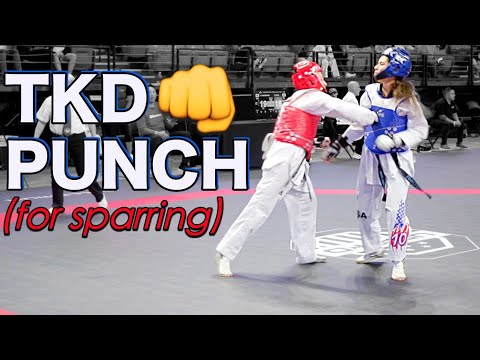
Make sure to use a bigger motion rather than keeping it too tight and in close, as judges are more likely to miss and not score a very small punch. Alex Wong also recommends bringing your elbow up and trying to get a pop on the hogu so the judges can hear the strike as well.
Use it as a counter to your opponent's front leg kick, or to close distance by swinging in and over their leg. You can also throw it from the clinch after switching your stance for a straighter punch.
Move your foot in an arc whether going forward or backwards, moving it in and out repeatedly to stay balanced throughout the technique.
The TKD Punch family encompasses the hand striking techniques (jirugi — punches, and taerigi — strikes) of Taekwondo, which are classified separately from the punching systems of boxing, karate, or Muay Thai. In Taekwondo's technical taxonomy, hand techniques are divided into jirugi (thrusting/punching) and taerigi (striking/swinging), each with distinct hand formations, trajectories, and applications.
Taekwondo's hand techniques derive primarily from the karate systems that Korean martial artists studied during the Japanese occupation of Korea (1910–1945). When General Choi Hong Hi and other founders systematized Taekwondo in the 1950s–60s, they retained and modified the hand techniques from Shotokan karate, adding the sine wave motion and distinctive Korean nomenclature.
WT Taekwondo: Legal: legal — punches to the trunk protector score 1 point; punches to the head are not per…; ITF Taekwondo: Legal: legal — hand techniques score equally with kicks to the same target; Unified MMA: Legal: legal — standard striking technique
Danger rating 4/10. Moderate — standard hand striking force. TKD punches are generally less powerful than boxing punches due to different training emphasis.
The standard setup chain: Ap chagi (front kick) feint → close distance → bandae jirugi to body → Step and jab (baro jirugi) → opponent covers → reverse punch (bandae jirugi) to midsection → Catch opponent's kick → step in → reverse front strike to the face.
Standard counters include: Lean back — pull head out of punching range / Side step — move laterally to avoid the linear trajectory / Front kick (ap chagi) — intercept the puncher with a longer-range technique.
Common variants: Baro jirugi (obverse punch (same side hand and foot forward)); Bandae jirugi (reverse punch (opposite hand to lead foot)); Dollyo jirugi (circular punch (hook equivalent)); Bandae ap taerigi (reverse front strike (see child entry)); Dung joomuk taerigi (back fist strike); Sonkal taerigi (knife hand strike).
TKD hand techniques score in both WT and ITF competition, though kicks receive higher point values in WT. In ITF semi-contact, punches are scored equally with kicks to the same target.
Top errors to watch for: Over-relying on arm power — TKD punches require whole-body mechanics / Not retracting the reaction hand — wastes potential power / Poor fist formation — loose wrist leads to sprained wrist on impact / Punching from too far — TKD fighters often misjudge punching range due to kick-heavy training.
The TKD Punch is also known as Tekondō Panchi, Jirugi, Taerigi, TKD Striking, Taekwondo Hand Techniques.